

First Nations superhero ‘Condoman’ was a world leader in HIV prevention. Aunty Gracelyn Smallwood made it happen
- Written by Geraldine Fela, Post-Doctoral Research Fellow in the Department of History and Archaeology , Macquarie University
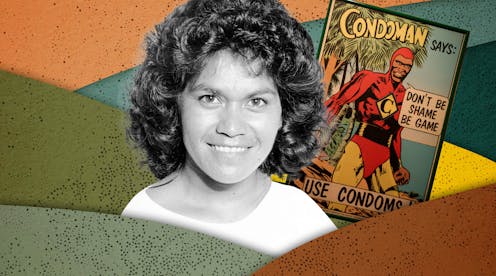
When HIV arrived on Australian shores in the early 1980s, politicians and healthcare workers worried the virus would run rampant in remote Aboriginal and Torres Strait Islander communities. This didn’t happen – thanks to highly successful health promotion campaigns and public health programs rolled out around the country by Aboriginal-controlled medical services, from 1987.

The most famous of these was “Condoman”, the First Nations superhero whose safe-sex directive “Don’t be shame, be game: Use condoms!” captured hearts and minds across the continent.
Aunty Gracelyn Smallwood, a proud Birrigubba, Kalkadoon and South-Sea Islander woman and registered nurse/midwife, was central to this public health response, working alongside her colleague and friend Phillip Mills and other health workers throughout the state.
Her advocacy took her from her hometown of Townsville all the way to the highest offices of Australia’s HIV and AIDS response, where she played a part in shaping a world-leading approach to the virus.
Don’t be shame, be game!
In 1987, Aunty Gracelyn joined the the National Advisory Commission on AIDS (NACAIDS) as the new Aboriginal and Torres Strait Islander representative. Chaired by media personality Ita Buttrose, the committee was, in Aunty Gracelyn’s words, made up of “middle-class white folks” who “really didn’t know our world”.
The infamous Grim Reaper campaign featured a black-cloaked wraith in a bowling alley “striking down” so-called everyday Australians. Aunty Gracelyn explained to her colleagues that while it might connect with non-Indigenous Australians, for the communities she represented, it was simply a frightening and off-putting “skeleton walking around with a big cane knife”. Moreover, there were no bowling alleys in the remote communities and missions where many members of Aunty Gracelyn’s community lived or came from.
As a result, Aunty Gracelyn got some modest federal government funding, just A$5,000, to put together a team of health workers and social workers from community-controlled health organisations across Queensland.
 Aunty Gracelyn Smallwood (with Aboriginal and Torres Strait Islander Social Justice Commissioner June Oscar) in 2017.
Human Rights/Wikimedia Commons, CC BY
Aunty Gracelyn Smallwood (with Aboriginal and Torres Strait Islander Social Justice Commissioner June Oscar) in 2017.
Human Rights/Wikimedia Commons, CC BY
Together, they visited Aboriginal and Islander communities all over the state and then returned to Townsville. There, she and her team walked up and down the streets gathering community leaders. They knew they needed to talk to the Elders first about whatever health program they were going to run.
Over several days, they held workshops and discussions. From these first workshops, Condoman was born, when one of the Elders said “we can have our own Black hero and call him condom man”. The idea was sketched by a graphic artist and modelled on popular comic-book character The Phantom.
The Condoman campaign was originally designed for Northern Queensland, but after its initial launch in 1987, it was quickly taken up by Aboriginal communities across the continent. The campaign was so successful, in 1988 Aunty Gracelyn was asked to be a keynote speaker for a World Health Organization conference in London.
Here, she spent time with her family friend Burnam Burnam, the Aboriginal activist who that year planted an Aboriginal flag at the Cliffs of Dover, claiming England in the name of Aboriginal people. She even managed to sneak a copy of Burnam Burnam’s writings into a Buckingham Palace function, leaving a copy under a tablecloth.
After the conference, she took Condoman around the world, visiting Black and Native American communities in the United States.
Black land, Black health, Black power
Aunty Gracelyn was born in Townsville in 1951. When 90% of Australia voted yes in the 1967 referendum, the Townsville population had voted 90% no. She grew up determined to fight against racism.
 Dr Gracelyn Smallwood.
CityLibraries Townsville/Wikipedia, CC BY-SA
Dr Gracelyn Smallwood.
CityLibraries Townsville/Wikipedia, CC BY-SA
From a young age, she was immersed in stories of her family’s experiences of racism and resistance. Her father and his siblings were removed from their family and homeland at young ages and sent to Palm Island, a notoriously cruel mission. Decades before, in 1957, her father’s uncle had staged a hunger strike on Palm Island, with six other freedom fighters.
Aunty Gracelyn spent most of her childhood in Garbutt, Aitkenvale and West End, on the outskirts of Townsville, in northern Queensland. The family lived in a series of condemned homes. One was a tin shack, with no electricity and a dirt floor. Every day in the Queensland heat, the children of the family walked to gather copper wires and bottles to supplement their parents’ meagre earnings.
As Aunty Gracelyn was coming into adulthood, a militant Indigenous rights movement was taking the political stage. In 1966, Gurindji stockmen and domestic servants walked off Wave Hill station in the Northern Territory, refusing to continue working for rations, and animating the struggle for Land Rights. They embarked on a seven-year struggle, ultimately winning back their land. The struggle for land and justice spread across the continent.
 A 2022 eenactment of the Wave Hill Walkout during Gurindji or Freedom Day Festival.
Glenn Campbell/AAP
A 2022 eenactment of the Wave Hill Walkout during Gurindji or Freedom Day Festival.
Glenn Campbell/AAP
In the late 1960s and early 1970s, Redfern in Sydney and Fitzroy in Melbourne became the centres of this powerful Indigenous political movement. Aboriginal-controlled medical services were established by activists and community leaders, introducing the politics of self-determination and community control into the field of Aboriginal health.
After the 1967 referendum, Aunty Gracelyn began her nursing and midwifery training. She completed it in 1973, becoming one of a small number of Aboriginal and Islander women who, despite institutional and interpersonal racism, had made their way into the nursing profession.
She worked as a remote nurse, specialising in sexual infections, from 1973 to 1975. Then she returned to Townsville, where her political and professional worlds collided.
Highly politicised by her experiences of poverty and racism, and influenced by her family’s long legacy of resistance, she was drawn to the emerging politics of Aboriginal control and self-determination.
In 1974, she helped found the Townsville Aboriginal and Islanders Health Service, the first Aboriginal and Torres Strait Islander controlled health service in the area. She became the first registered nurse and midwife to work there, and did so voluntarily.
Responding to HIV
By the early 1980s, Aunty Gracelyn was a key figure in the emerging Aboriginal health sector and a regular speaker at conferences, both nationally and internationally.
During a 1985 visit to the US, she saw how sick an HIV-positive friend was, and realised the significance of HIV. Case numbers were still low in Australia, but Aunty Gracelyn worried about where things could be heading. She returned home and immediately started a public health campaign.
In July 1987, a Daily Telegraph article reported on the AIDS education campaign Aunty Gracelyn had been running for the previous 12 months in Townsville. It noted that “Aboriginal nurse Ms Smallwood” had spoken to close to 10,000 people in her “face-to-face AIDS Campaign”.
The campaign included pre-match pep talks to “shocked footballers, cricketers and basketball players”. Aunty Gracelyn told the reporter that, while the “heterosexual males in the football teams […] constantly say you should be talking to the poofters”, once she asked them if they had had more than one partner, “you can almost hear a pin drop”.
Her education work drew the attention of the National Advisory Commission on AIDS and led to her joining it.
Indigenous health in Indigenous hands
In 1997, ten years after the launch of Condoman, Aunty Gracelyn’s contribution to public health was acknowledged by Nelson Mandela.
She was invited to attend the 20th-anniversary memorial service for Steve Biko, a leader in South Africa’s anti-apartheid struggle, who was murdered in police custody. Here, she encountered civil rights activist and Black Panther Kwame Ture (formerly Stokely Carmichael). She used the time to meet with activists and lectured in the townships on HIV and AIDS.
Her visit to South Africa, the site of a struggle against racism that had reverberated around the world, was a coming together of the many threads of her life and politics.
 In 1997, Nelson Mandela acknowledged Aunty Gracelyn’s contribution to public health.
Kim Ludbrook/AAP
In 1997, Nelson Mandela acknowledged Aunty Gracelyn’s contribution to public health.
Kim Ludbrook/AAP
The Condoman campaign was the result of an approach to public health and health promotion that was interwoven with Aunty Gracelyn’s fierce anti-racism and commitment to the politics of self-determination. It is an important example of the highly successful, community-led responses to HIV that were implemented by Aboriginal and Torres Strait Islander communities across the continent in the 1980s and ‘90s.
With some fluctuations, rates of HIV diagnosis among Aboriginal and Torres Islander people have remained at approximate parity with the non-Indigenous population.
In 2018, the Medical Journal of Australia published an article warning new surveillance data showed the potential for a “concentrated epidemic” of HIV among Aboriginal and Torres Strait Islander people. The authors argued low uptake of new biomedical interventions (such as PrEP) among Indigenous people threatened to undermine Australia’s 2020 HIV elimination targets.
In 2022, data from the Kirby Institute showed that after a spike in 2015–16, the HIV notification rate among Aboriginal and Torres Strait Islander people declined steadily between 2016 and 2021. This brought it back to approximate parity with non-Indigenous people.
Though some of this data was collected during the COVID-19 pandemic and is based on small numbers, so should be treated with caution, the overall trajectory of declining numbers tells a story of hope. Indigenous communities are continuing to defy expectations.
This is a testament to the success of the community-led public health response to the virus. It’s an important reminder that when Indigenous health is in Indigenous hands, the results can be extraordinary.
This article is based on a section of Geraldine Fela’s book, Critical Care: Nurses on the Frontline of Australia’s AIDS Crisis (NewSouth), published this month.
Authors: Geraldine Fela, Post-Doctoral Research Fellow in the Department of History and Archaeology , Macquarie University

















