

Look up! A once-in-a-lifetime explosion is about to create a ‘new’ star in the sky
- Written by Tanya Hill, Senior Curator (Astronomy), Museums Victoria and Honorary Fellow at University of Melbourne, Museums Victoria Research Institute

Any night now, a “new star” or nova will appear in the night sky. While it won’t set the sky ablaze, it’s a special opportunity to see a rare event that’s usually difficult to predict in advance.
The star in question is T Coronae Borealis (T CrB, pronounced “T Cor Bor”). It lies in the constellation of the northern crown, prominent in the Northern Hemisphere but also visible in the northern sky from Australia and Aotearoa New Zealand over the next few months.
Most of the time T CrB, which is 3,000 light years away, is much too faint to be seen. But once every 80 years or so, it brightly erupts.
A brand new star suddenly seems to appear, although not for long. Just a few nights later it will have rapidly faded, disappearing back into the darkness.
A burst of life
During the prime of their lives, stars are powered by nuclear fusion reactions deep inside their cores. Most commonly, hydrogen is turned into helium creating enough energy to keep the star stable and shining for billions of years.
But T CrB is well past its prime and is now a stellar remnant known as a white dwarf. Its internal nuclear fire has been quenched, allowing gravity to dramatically compress the dead star.

T CrB also has a stellar companion – a red giant that has puffed up as it enters old age. The white dwarf mops up the swollen red giant’s gas, and this forms what’s known as an accretion disc around the dead star.
The matter keeps piling up on a star that’s already compressed to its limit, forcing a continual rise in pressure and temperature. Conditions become so extreme, they mimic what once would’ve been found inside the star’s core. Its surface ignites in a runaway thermonuclear reaction.
When this happens, the energy released makes T CrB shine 1,500 times brighter than usual. Here on Earth, it briefly appears in the night sky. With this dramatic reset, the star has then expelled the gas and the cycle can begin all over again.
Animation of a nova erupting as thermonuclear reactions ignite on the smaller white dwarf star. Credit: NASA/Conceptual Image Lab/Goddard Space Flight Center.How do we know it’s due?
T CrB is the brightest of a rare class of recurrent novae that repeat within a hundred years – a time scale that allows astronomers to detect their recurrent nature.
Only ten recurrent novae are currently known, although more novae may be recurrent – just on much greater timescales that aren’t as easily tracked.
The earliest known date of T CrB erupting is from the year 1217, based on observations recorded in a medieval monastic chronicle. It’s remarkable that astronomers can now predict its eruptions so precisely as long as the nova follows its usual pattern.
The star’s two most recent eruptions – in 1866 and 1946 – showed the exact same features. About ten years prior to the eruption, T CrB’s brightness increased a little (known as a high state) followed by a short fading or dip about a year out from the explosion.
 The light curve of T CrB during the nova event of 1946, compiled from 6,597 observations logged with the American Association of Variable Star Observers (AAVSO).
Museums Victoria/AAVSO
The light curve of T CrB during the nova event of 1946, compiled from 6,597 observations logged with the American Association of Variable Star Observers (AAVSO).
Museums Victoria/AAVSO
T CrB entered its high state in 2015 and the pre-eruption dip was spotted in March 2023, setting astronomers on alert. What causes these phenomena are just some of the current mysteries surrounding T CrB.
 The recent light curve of T CrB shown in two filters or bands – V (green) and B (blue) – and compiled using 95,901 observations from the AAVSO. It’s possible, especially in the B band, to see T CrB enter the high state in 2015 and currently experiencing the pre-eruption dip.
Museums Victoria/AAVSO
The recent light curve of T CrB shown in two filters or bands – V (green) and B (blue) – and compiled using 95,901 observations from the AAVSO. It’s possible, especially in the B band, to see T CrB enter the high state in 2015 and currently experiencing the pre-eruption dip.
Museums Victoria/AAVSO
How can I see it?
Start stargazing now! It’s a good idea to get used to seeing Corona Borealis as it is now, so that you get the full impact of the “new” star.
Corona Borealis currently reaches its best observing position (known as a meridian transit) around 8:30pm to 9pm local time across Australia and Aotearoa. The farther north you are located, the higher the constellation will be in the sky.
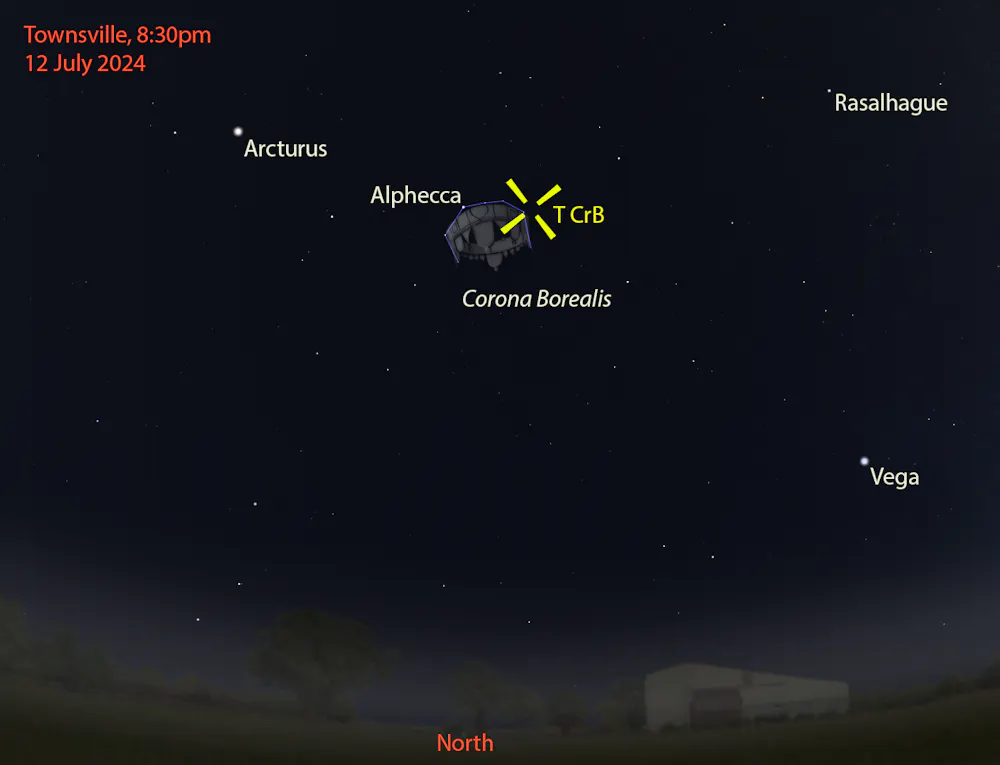 The farther north you are located, the higher Corona Borealis will appear in the northern sky. The new star will be about as bright as Alphecca in Corona Borealis or the nearby Rasalhague in Ophiuchus.
Museums Victoria/Stellarium
The farther north you are located, the higher Corona Borealis will appear in the northern sky. The new star will be about as bright as Alphecca in Corona Borealis or the nearby Rasalhague in Ophiuchus.
Museums Victoria/Stellarium
 Whereas down south in Hobart, Corona Borealis stays low in the north. The bright star Arcturus acts as a good guide.
Museums Victoria/Stellarium
Whereas down south in Hobart, Corona Borealis stays low in the north. The bright star Arcturus acts as a good guide.
Museums Victoria/Stellarium
 Across Aotearoa, T CrB is best seen around 9pm throughout July. Additional constellations are shown for reference.
Museums Victoria/Stellarium
Across Aotearoa, T CrB is best seen around 9pm throughout July. Additional constellations are shown for reference.
Museums Victoria/Stellarium
The nova is expected to be a reasonable brightness (magnitude 2.5): about as bright as Imai (Delta Crucis), the fourth brightest star in the Southern Cross. So it will be easy to see even from a city location, if you know where to look.
 During July evenings, the Southern Crux can be found on its side, high in the southwest from Australia and Aotearoa.
Museums Victoria/Stellarium
During July evenings, the Southern Crux can be found on its side, high in the southwest from Australia and Aotearoa.
Museums Victoria/Stellarium
We won’t have much time
We won’t have long once it goes off. The maximum brightness will only last a few hours; within a week T CrB will have faded and you’ll need binoculars to see it.
It almost certainly will be an amateur astronomer that alerts the professional community to the moment when T CrB outbursts.
These dedicated and knowledgeable people routinely monitor stars from their backyards on the chance of “what if” and therefore fill an important gap in night sky observations.
The American Association of Variable Star Observing (AAVSO) has a log of over 270,000 submitted observations on T CrB alone. Amateur astronomers are collaborating here and around the world to continually monitor T CrB for the first signs of eruption.
 By September, Corona Borealis will be moving lower into the northwest sky and best seen between 7:30pm to 8pm local time.
Museums Victoria/Stellarium
By September, Corona Borealis will be moving lower into the northwest sky and best seen between 7:30pm to 8pm local time.
Museums Victoria/Stellarium
Hopefully the nova will erupt as expected sometime before October, because after that Corona Borealis leaves our evening sky in the Southern Hemisphere.
Authors: Tanya Hill, Senior Curator (Astronomy), Museums Victoria and Honorary Fellow at University of Melbourne, Museums Victoria Research Institute

















