

First Nations women are at greater risk of stillbirth. Here’s why – and what we can do about it
- Written by Deanna Stuart-Butler, Indigenous Research Officer, The University of Queensland
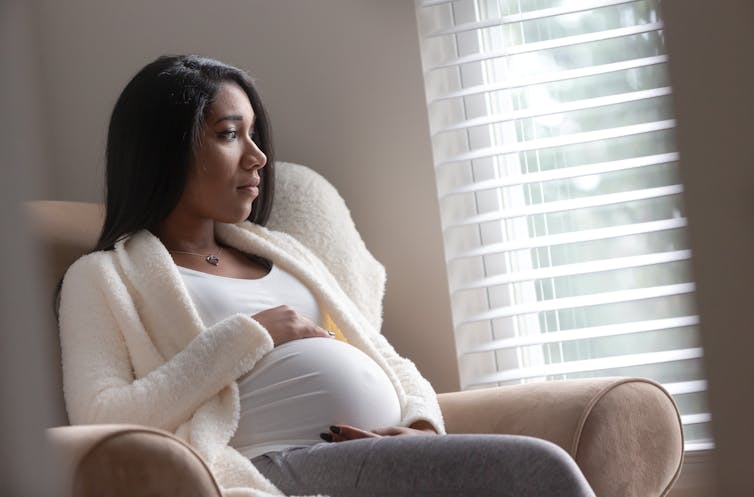
Australian national data show First Nations women face almost twice the risk of stillbirth or “sorry business babies” compared to non-First Nations women.
To address this inequity, Australia’s national stillbirth action plan focuses on ensuring culturally safe stillbirth prevention and care for First Nations women.
But first, we must understand the underlying reasons for the ongoing disparities in stillbirth rates and other pregnancy-related outcomes.
We argue much of the inequity can be linked to the ongoing impact of colonisation on First Nations women and birthing. Here’s why.
Ongoing intergenerational trauma
First Nations people have lived in Australia for at least 65,000 years. Prior to European invasion and settlement in 1788, more than 2,000 generations of First Nations people lived in connection to family, community, Country and their ancestors.
Colonisation saw First Nations women stripped of their traditional pregnancy and birthing practices, including use of medicinal plants, techniques for active labour and pain control, and songs for labour.
From the mid-1800s to the 1970s, First Nations babies and children were forcibly removed from their communities and placed with non-First Nations families.
Loss of land, violence and abuse, medical experimentation, cultural suppression and other systemic injustices have led to widespread intergenerational trauma that contributes to poorer health outcomes today.
Intergenerational trauma described in four minutes (The Healing Foundation)Maternity services aren’t designed for First Nations women
Historical violence and exclusion have led to an intergenerational distrust of colonial systems, services and spaces among First Nations people. First Nations people have been expected to adapt to a Western health service, rather than these services adapting to First Nations people’s ways of knowing, being and doing.
There is also a shortage of First Nations health-care workers. This further limits First Nations people’s access to culturally responsive care.
Recognition of the importance of Birthing on Country has led to services like Waminda and Birthing In Our Community.
But there aren’t enough of these services for all First Nations women. And barriers to setting up the services persist.
Resources aren’t designed for First Nations women
Pregnancy information resources have historically been designed for a colonial audience. These resources do not speak to First Nations women and have rarely been developed by and with First Nations people.
More contemporary initiatives have better engaged First Nations people in, or have them lead, resource development.
The Centre of Research Excellence in Stillbirth’s Indigenous Advisory Group recently led the development of the Stronger Bubba Born pregnancy information website and resources for First Nations women. The information is the same as that given to non-First Nations women, as part of the Safer Baby Bundle, but it has been culturally adapted for its target audience.
Stronger Bubba Born introductory video (The Stillbirth Centre of Research Excellence)Racism and discrimination in maternity services
While some First Nations women face overt racism in maternity services, many more are discriminated against through implicit biases. This is where care providers’ unconsciously held beliefs about First Nations people influence their judgements of and interactions with pregnant First Nations women.
Active stereotypes that are commonly applied to pregnant First Nations women include assuming drug and alcohol use and a perceived unsuitability for motherhood. This stems from the historical marginalisation of First Nations people.
But implicit bias isn’t the only source. Institutional racism also contributes to worse health outcomes among First Nations women. It occurs because of embedded structures or policies that perpetuate racial disparities, and it often goes unnoticed by non-First Nations midwives. Institutional racism plays out in various ways, including restrictions on the numbers of family/support people able to visit.
All of this leads to power imbalances and First Nations women being less likely to attend antenatal appointments.
Providers don’t understand First Nations health
The Australian First Nations view of health differs from the Western view. Connection to family, Country and community defines First Nations people’s health, rather than illness, disease, and notions of “risk”.
Physical, spiritual, cultural, social, emotional and mental health are interconnected, and land is a source of strength, identity and healing.
These concepts form the foundation of Birthing on Country and underscore the importance of self-determination in providing culturally responsive maternity care.
Yet maternity care providers have limited knowledge of First Nations women’s cultural needs and little education and training on this.
Where to from here?
To eliminate racial disparities in stillbirth rates in Australia, our health system and broader society needs to recognise the effects of colonisation and the structural forces that continue to influence First Nations people’s health.
This requires acknowledging and sitting in discomfort with Australia’s history.
The Healthy Yarning Guide is a workshop based on two-way learning and yarning for non-First Nations maternity care providers and maternity service administrations.
The workshop aims to empower people to sensitively discuss stillbirth prevention with First Nations women. Participants learn about Australia’s history and the effects of colonisation in First Nations women and birthing, as well as what culturally responsive care looks like for First Nations families.
We have a long way to go in ensuring First Nations women and families receive high-quality, culturally responsive maternity care. But formal education within maternity services is a crucial place to start.
In this article, we use the term “First Nations” to refer Aboriginal and Torres Strait Islander people in Australia. We acknowledge there is variation in preferences for the terms “First Nations”, “Indigenous” and “Aboriginal and Torres Strait Islander”.
Authors: Deanna Stuart-Butler, Indigenous Research Officer, The University of Queensland

















