Restoring logged forests doesn’t mean locking them up as ‘wilderness’ – it means actively managing them
- Written by Jack Pascoe, Research fellow in ecology and land management, The University of Melbourne
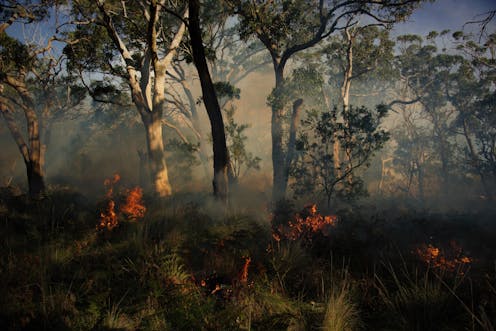
On January 1 this year, the commercial logging of native forests ended in Victoria and Western Australia. It was one of the most significant changes in the history of forest management in Australia.
After the chainsaws fell silent, the debate began over how to best care for our forests in future. There has been a stream of articles about the threats of thinning forests, the damage from fire management, and confusion over Indigenous-led forest management.
These practices are worth discussing. But conflating them with the destructive commercial logging practices of the past is unwarranted.
We have a rare opportunity to consider a fundamental question – how much should we intervene and manage our forests? With commercial logging gone, should we aim to create “wilderness” – nature without people – or should we manage Country, as Australia’s Traditional Custodians have done for millennia?
Forest Country has changed profoundly
Before European colonisation, Traditional Custodians managed Country through the careful application or exclusion of fire and watched which plants grew and which animals thrived. Over tens of thousands of years, this experience accumulated.
Unfortunately, in the past 250 years of colonisation, Australia’s forested landscapes, once tended for thousands of generations, have changed profoundly.
These changes began with the displacement of Traditional Custodians and the sudden change to cultural fire regimes. In Tasmania, for instance, Palawa people used fire to create open woodlands. After colonisation, their fire regime was abandoned and the woodlands reverted to rainforest.
More recently, large areas of Australia’s forests have been damaged by a century or more of logging, land clearance, bushfires and flooding. As a result, today’s forests would be unrecognisable to earlier generations of Traditional Custodians.
In response, some Traditional Custodian groups in Victoria have restarted cultural management, partnering with Western scientists to begin to heal Country.
Their efforts cover everything from reintroducing cultural fire to thinning out dense regrowth in post-logging forests to produce ecological and cultural benefits, such as accelerating the return of large, old trees vital to many other species.
If these efforts are successful, we expect to see more biodiversity, healthier, more resilient forests, as well as new support for Traditional Custodians’ management of cultural landscapes.
What does it mean to care for a forest?
To be clear, no two forests are alike. There’s no blueprint to manage all forests.
Some forests are fire-tolerant, while others are fire-sensitive. Each forest has its own history of disturbances and its own ability to respond to future disturbances.
In the lowland mixed-species forests of Victoria and coastal New South Wales, for instance, trees can recover quickly after a fire. But in the tall, wet mountain ash forests of Victoria and Tasmania, recovery may take decades or longer.
Forest structure matters too. Forests comprised of large trees are more likely to stay healthy and recover quicker from bushfires than forests of densely packed small trees.
Caring for Forest Country means reading the needs of each forest to ensure it can endure whatever the future holds.

Removing trees to save the forest?
You might look at a forest with lots of small trees and think it’s a good thing – the forest is growing back.
But you can have too much of a good thing. Very dense forests typically emerge in response to an intense disturbance, whether logging, floods, or fire. Tens of thousands of seedlings can regenerate per hectare. As they grow, the seedlings compete intensely for water, light and soil nutrients.
At such high densities, growth quickly slows and the overall health of the forest declines. This delays the development of large trees, which are disproportionately important to bird, mammal and insect species.
Worse, because these young trees are growing slowly, they are vulnerable to bushfire for decades longer. This is crucially important, as climate change is triggering more frequent landscape-scale bushfires.
Thinning forests is done by removing some trees so those remaining can grow larger, faster. It’s similar to how gardeners thin out a vegetable patch, removing weaker seedlings so others can thrive.
Around the world, thinning has been done by foresters for centuries to speed up production of larger, more valuable logs. But thinning can benefit forests in other ways.
Research in North America and Europe has shown thinned forests are often more resilient to warmer, drier climate conditions and had ecological benefits. In Australia, studies have shown thinning can increase water availability in drought-impacted forests, accelerate carbon sequestration, and improve habitat outcomes. In other Victorian forests, thinning increased tree growth and led to a more varied set of species in the forest understorey.
Thinning is not a silver bullet – it may produce ecological benefits in some forests, but not in others.
For instance, researchers explored whether past commercial thinning operations affected the amount of a tree’s crown consumed by subsequent bushfire. In mountain ash forest, thinning didn’t change the rate of crown consumption in either young or old forests. In drier forests, thinning reduced fire severity in young forests – but not in old forests.
This raises important questions: If the thinning had been done for ecological, not commercial, reasons, would the results have been different? If they had been done in other forest types, would the results have been different?
We don’t have good answers to these questions because so little research on ecological thinning has been done in Australia’s forests. But we do know that it has had positive results in many other forests around the world.
A way forward
Australia’s Traditional Custodians are rightly acknowledged as the continent’s first scientists. By living on and working with Country, they learned how it responded.
As we turn an historic page in forest management in parts of Australia, Western scientists could do well to learn from and partner with Traditional Owners to explore new ways to manage Country. Try new approaches. Learn from practice. And work together to figure out how best to heal Forest Country.
Read more: Indigenous knowledge and the persistence of the 'wilderness' myth
Authors: Jack Pascoe, Research fellow in ecology and land management, The University of Melbourne