

Play-based learning can set your child up for success at school and beyond
- Written by: Natalie Robertson, Lecturer in Early Childhood Education, Deakin University
As the new school year begins, many families are deciding where to enrol their child in preschool or school. Preschools and schools offer various approaches to early education, all promoting the benefits of their particular programs.
One approach gaining momentum in the early years of primary school curriculum is play-based learning. Research shows play-based learning enhances children’s academic and developmental learning outcomes. It can also set your child up for success in the 21st century by teaching them relevant skills.
What is play-based learning?
Children are naturally motivated to play. A play-based program builds on this motivation, using play as a context for learning. In this context, children can explore, experiment, discover and solve problems in imaginative and playful ways.
A play-based approach involves both child-initiated and teacher-supported learning. The teacher encourages children’s learning and inquiry through interactions that aim to stretch their thinking to higher levels.
For example, while children are playing with blocks, a teacher can pose questions that encourage problem solving, prediction and hypothesising. The teacher can also bring the child’s awareness towards mathematics, science and literacy concepts, allowing them to engage with such concepts through hands-on learning.
While further evidence is needed on cause and effect relationships between play and learning, research findings generally support the value of good quality play-based early years programs.
Read more: Should we just let them play?
How does it compare to direct instruction?
Play-based learning has traditionally been the educational approach implemented by teachers in Australian preschool programs. It underpins state and national government early learning frameworks.
Research has shown the long-term benefits of high-quality play-based kindergarten programs, where children are exposed to learning and problem solving through self-initiated activities and teacher guidance.
In contrast to play-based learning are teacher-centred approaches focused on instructing young children in basic academic skills. Although this more structured teaching and learning style is the traditional approach to primary school programs, research is emerging that play-based learning is more effective in primary school programs. In these recent studies, children’s learning outcomes are shown to be higher in a play-based program compared to children’s learning outcomes in direct-instruction approaches.
Research has also identified young children in direct-instruction programs can experience negative effects. These include stress, decreased motivation for learning, and behaviour problems. This is particularly so for children who are not yet ready for more formal academic instruction.
What can be gained through play-based programs?
As with traditional approaches, play-based early years programs are focused on teaching and learning. In such programs, play can be in the form of free play (activity that is spontaneous and directed by the child), and guided play (also child-directed, but the teacher is involved in the activity as a co-player) with intentional teaching. Both have benefits for children’s learning. To capitalise on these benefits, an optimum play-based program will provide opportunities for both free play and guided play.
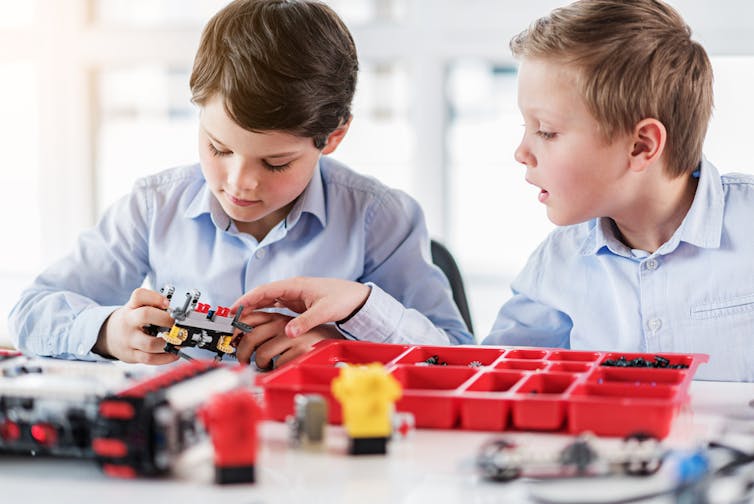 In constructive play, children cooperate and problem-solve, engaging with mathematical and spatial concepts to design and create three-dimensional constructions from their imagination.
Shutterstock
In constructive play, children cooperate and problem-solve, engaging with mathematical and spatial concepts to design and create three-dimensional constructions from their imagination.
Shutterstock
Involvement in play stimulates a child’s drive for exploration and discovery. This motivates the child to gain mastery over their environment, promoting focus and concentration. It also enables the child to engage in the flexible and higher-level thinking processes deemed essential for the 21st century learner. These include inquiry processes of problem solving, analysing, evaluating, applying knowledge and creativity.
Read more: Demand for people skills is growing faster than demand for STEM skills
Play also supports positive attitudes to learning. These include imagination, curiosity, enthusiasm, and persistence. The type of learning processes and skills fostered in play cannot be replicated through rote learning, where there is an emphasis on remembering facts.
The inquiry-based nature of play is supported through the social interactions of teachers and children. Teachers take an active role in guiding children’s interactions in the play. Children are supported in developing social skills such as cooperation, sharing and responding to ideas, negotiating, and resolving conflicts.
Teachers can also use children’s motivation and interest to explore concepts and ideas. In this way, children acquire and practice important academic skills and learning in a playful context.
For example, research indicates the increased complexity of language and learning processes used by children in play-based programs is linked to important literacy skills. These include understanding the structure of words and the meanings of words.
Another study found children’s vocabulary and ability to tell a story was higher in a play-based classroom than a traditional classroom.
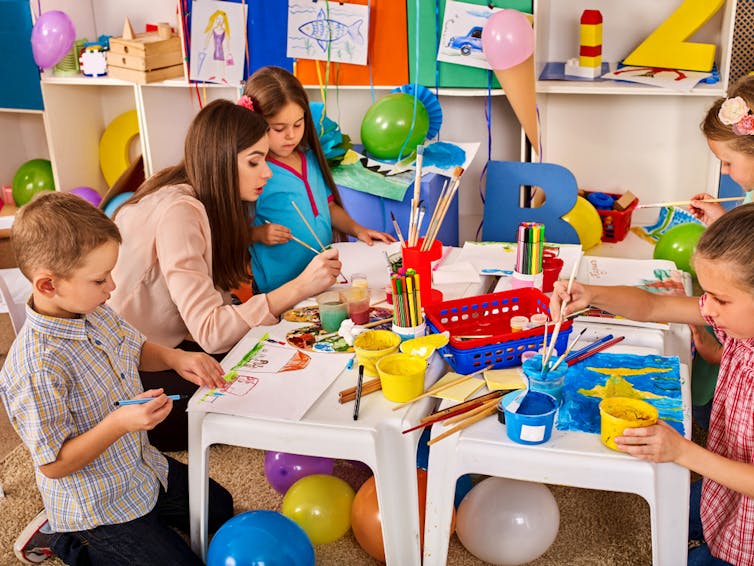 Learning in guided play: teachers help children with educational tasks during play.
Shutterstock
Learning in guided play: teachers help children with educational tasks during play.
Shutterstock
Teacher-led learning and direct instruction methods have their place in educational contexts. But the evidence also points to the benefits of quality play-based programs for our youngest learners. In play-based programs, time spent in play is seen as important for learning, not as a reward for good behaviour. In such classrooms, children have greater, more active input into what and how they learn.
Research shows play-based programs for young children can provide a strong basis for later success at school. They support the development of socially competent learners, able to face challenges and create solutions.
Authors: Natalie Robertson, Lecturer in Early Childhood Education, Deakin University


















