With a million home batteries, we could build far fewer power lines. We just need the right incentives
- Written by Scott Hamilton, Adjunct associate professor, Department of Chemical and Biological Engineering, Monash University
It’s no secret Australia has abundant and cheap renewable energy, especially wind and solar power. But yes, there are times when the sun doesn’t shine and the wind doesn’t blow. We need energy storage to get us through those still nights and dreary days.
The Australian Energy Market Operator (AEMO) reports investment in storage capacity continues to increase, filling gaps left by retiring coal-fired power stations. But it warns sufficient storage is needed to ensure electricity supply is reliable throughout the transition.
Energy storage is the special sauce that makes renewables work anytime, anywhere and everywhere. Being able to send this stored renewable energy back to the grid on demand makes the most of the existing electricity network, including transmission lines.
We need both short- and long-duration storage to maintain energy security. This will enable renewable energy to be collected, stored and dispatched when needed. AEMO forecasts reliability levels can be maintained over most of the next ten years if programs and initiatives already established are delivered on time and in full. But we can’t afford any delays.
Storage on the grid
Old-fashioned power stations burning coal tend to run continuously, which helps make the electricity grid stable and reliable. In contrast, renewables need to be backed with storage such as batteries to provide a continuous supply of electricity.
The modern electricity network is being designed to handle the power produced when the sun is shining brightly and the wind is blowing hard, at the same time. But this only happens about 25% of the time.
Similarly, transmission lines are being built to a maximum capacity. But we could get by with fewer transmission lines if we store more solar and wind power for later. That’s why many renewable generation projects include storage on site or nearby, and why it also makes sense to have batteries in our homes or communities.

Australia has some of the world’s biggest batteries
The 300 megawatt Victorian Big Battery, near Geelong, is the biggest in Australia and one of the biggest in the world. It can store enough energy to power more than a million homes for 30 minutes.
The federal government is also funding six large-scale batteries through the Capacity Investment Scheme. This includes a 350MW energy storage system on the site of the Jeeralang Power Station, near Morwell in the Latrobe Valley. But the title of the nation’s biggest battery will soon be handed to the 850MW Waratah Super Battery in New South Wales.
What’s next?
Other emerging battery systems could power the future. For example, new lithium-sulphur batteries deliver more energy per gram and last longer than existing lithium-ion batteries. This has been achieved simply by adding sugar.
Australia has all the critical minerals needed to make batteries (lithium, nickel, copper, cobalt). But about 90% of the batteries we currently use come from China.
The 2024 National Battery Strategy vision is for Australia is a globally competitive producer of batteries and battery materials by 2035.
Battery booster scheme needed
Australia has the policy settings and incentives about right for building grid-scale storage systems. But almost half the effort in getting to 82% renewables by 2030 will come from consumers – mainly rooftop solar systems, backed by home and business battery storage.
We have just passed the point at which the payback period for small-scale batteries falls within the product’s lifetime, making the upfront cost worthwhile.
But government incentives are still needed to make it more affordable to install small-scale solar batteries. This would help families and businesses reduce their power bills, gain better control of when and how they produce energy, and build a more resilient energy system.
More than 300,000 solar power systems are installed on Australian homes and businesses each year. The total reached more than 3.7 million systems at the start of this year. With the right ambition and policy settings, we could have similar rates of uptake in home batteries – going from about 250,000 at the moment to more than one million by 2030.
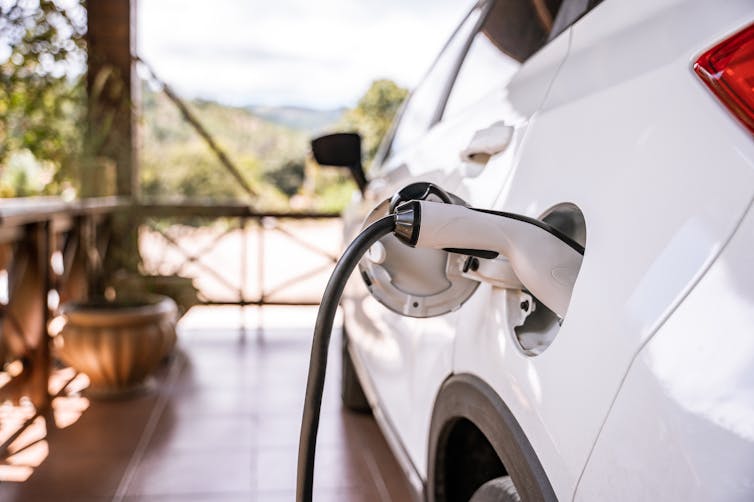
What’s more, electric vehicles are essentially large “batteries on wheels”. They can be plugged in at home to provide backup power in blackouts, or at times of peak demand.
Government incentives are also needed here to drive the further uptake of electric vehicles in the domestic, commercial and industry sector. The upfront price of an EV is too high for many Australians. Perverse incentives such as the diesel rebate are also slowing the switch in some sectors such as mining.
Australia is already a world leader in rooftop solar. With the right policy levers, we can also lead the world in home energy storage.
The energy storage toolkit
Batteries alone aren’t enough. As the penetration of renewables increases, the importance of long duration energy storage technologies will increase. In general, these technologies provide more than eight hours of energy storage using various electrochemical, mechanical, thermal and mechanical means.
Beyond batteries, other energy storage solutions include pumped hydro such as Snowy 2.0, “green gravity” using mine shafts, green hydrogen and concentrated solar thermal power plants.
Get smart about storage
Many energy storage options are readily available now and could be manufactured in Australia. We have the technology to empower communities, create thousands of new jobs and help save the planet.
If we’re smart about it, we can even get by with fewer transmission lines and less bulky electricity infrastructure.
Authors: Scott Hamilton, Adjunct associate professor, Department of Chemical and Biological Engineering, Monash University