No, you're probably not 'addicted' to your smartphone – but you might use it too much
- Written by Andrew Campbell, Senior Lecturer in Psychology, University of Sydney
The term “addiction” is often bandied about when we think someone spends too much time on something we deem detrimental to their health and well-being. From checking our phones repetitively, to playing with specific apps and texting, the modern culprit is excessive smartphone use.
Worldwide, more than two billion people own smartphones and the average user checks their phone 85 times a day.
Obsessively checking our smartphone apps may look like addiction but, for most people, it is reinforced behaviour that could be broken without severe or long-lasting withdrawal effects.
Read more: Constantly texting your friends about problems may be increasing your anxiety
Having said this, a small proportion of people may be more prone to behavioural addictions to smartphone functions such as online gambling, pornography, games and social media. Clinically speaking, you can’t become addicted to a device, but you can develop behavioural addictions to smartphone functions.
What is addiction?
The World Health Organisation (WHO) classifies addiction as a dependence on a substance, such as illicit or prescription drugs, tobacco or alcohol. A person is addicted when they have a physical and behavioural dependence on the substance.
In 2013, the fifth edition of the Diagnostic and Statistical Manual of Mental Disorders (known as the “clinician’s bible”) introduced wider criteria for “behavioural addictions”, which doesn’t include the physical dependence element. These are compulsions to engage in a task or act that leads to psychological pleasure.
Behavioural addictions, such as gambling or sex addiction, can cause psychological harm, as well as wider relationship problems with friends, family and colleagues.
 Smartphone obsessions don’t usually involve severe mental dysfunction and therefore aren’t addictions.
Tony Lam Hoang
Smartphone obsessions don’t usually involve severe mental dysfunction and therefore aren’t addictions.
Tony Lam Hoang
Both “substance” and “behavioural” addictions impact the way we process information. Over time, the brain rewires itself to seek out the reward it needs to gain pleasure or relief from stress. The more an addict seeks a specific reward that triggers both dopamine and other physiological effects (such as stress and pain relief), the more the brain decreases sensitivity to the reward circuits.
To date, smartphone use has not led to mass accounts of severe mental dysfunction. So we’re unlikely to all be “addicted” to our smartphones, as we often tell each other.
Read more: Can people really be addicted to sex?
Rather than addiction, smartphone users more commonly report obsessive behaviour. Users constantly check their phone, seeking opportunities for a short dopamine reward, or a distraction from boredom or mundane tasks such as travelling on public transport.
Nonetheless, some researchers have yet to rule out the potential for smartphone addiction in people who are at high risk of behaviour addiction. These people may experience several negative behavioural changes over time, such as anxiety and irritability, as well as extreme distress when they’re unable to access their smartphone.
Recent studies in Switzerland have confirmed that people under the age of 18 are at risk of obsessive or addictive-like behaviours around their smartphone use, most likely due to poor impulse control related to their developing frontal lobe. This suggests that adults with poor impulse control and/or personality disorders may be more at risk for smartphone addiction.
The problem with social media
The behavioural impact of smartphone social media use spans from obsessive behaviour (engaging in and checking smartphone apps until they no longer provide a rewarding dopamine hit) to behavioural addiction (compulsively seeking a dopamine hit via a reward provided by our phone).
Read more: How parents and teens can reduce the impact of social media on youth well-being
The average user in the US spends around five hours a day on functional smartphone activities such as texting, social media use, internet searchers, phone calls; half that time is spent on social media (including texting).
The specific functional use of our smartphone is what we need to look more closely at. Social media rewards users via “likes”, emoji use and social engagement with a large audience. The more people respond to a post, the more we gain a sense of enjoyment that people are validating our thoughts or interests.
Social media engagement, and constantly texting friends and family, may be more of a concern than the device on which it is used, because it does lead to dopamine increases, and thus, pleasure or stress relief.
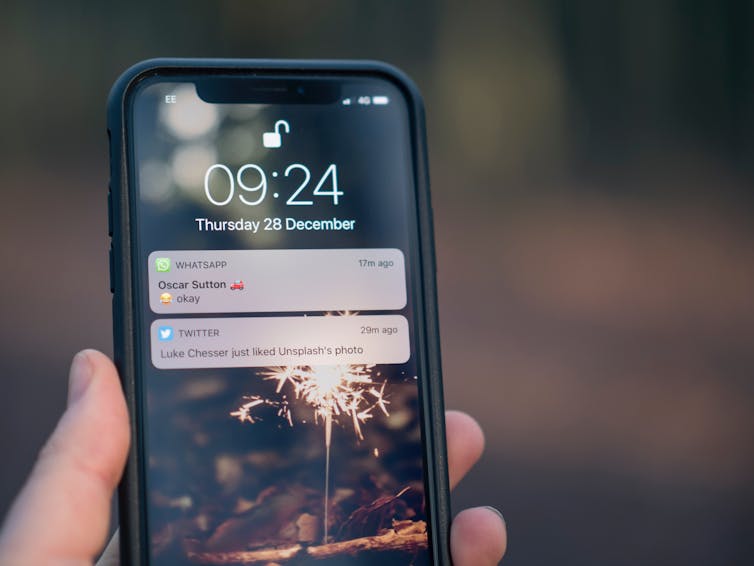 Turn off your notifications if you want to cut down on your smartphone use.
Jamie Street
Turn off your notifications if you want to cut down on your smartphone use.
Jamie Street
People are hard-wired to seek affirmation and acceptance in social settings. Before the rise of Facebook and Instagram, humans sought out one another via many settings for social engagement and social validation. So it’s no surprise that when we have the technology to extend our social connections into wider communities – we do so without question.
As adults, we know we can’t socialise all the time because of other demands on our time. Yet, as young people, the social world is our priority, as it influences our identity development and need to feel validated outside our tried-and-true friends and family.
Those who have problems with prolonged use of smartphone functions such as social media, media streaming services, games and frequent texting, may fit the criteria of “problematic internet use”.
In these cases, it’s important to unpack the specific reward you get from the function you engage in the most on your smartphone, to see if you can obtain the same reward through more productive and healthy activities.
Read more: There's a new addiction on campus: Problematic Internet Use (PIU)
If you are always on social media, for instance, ask yourself: what do I gain from posting and replying online? Can I gain the same rewarding benefits from face-to-face social engagements?
For some, online engagement diversifies their offline social engagement, while others are unaware that most of their life is now lived online.
Time to put the smartphone down?
Many smartphone users are obsessed or infatuated with their smartphone functions. But over time, they will become less interesting and far more a tool we engage with when we need to, just as society has adjusted to computer use.
In the meantime, we need to educate young people about problematic internet use and help them understand why using functions on their smartphone can be potentially time-wasting and, at worst, negatively impact their mental wellness. This can be communicated in early childhood and reinforced throughout the developmental stages.
 Yes, it’s time for a smartphone detox.
Jacob Ufkes
Yes, it’s time for a smartphone detox.
Jacob Ufkes
As for adult smartphone users, here are some evidence-based tips for reducing your smartphone use:
Reduce the number of apps on your phone – assess what you actually need and use most often, not just for distraction purposes. The fewer icons on your home screen the better.
Turn off notifications through your settings button. Your phone should only notify you for meaningful events to aid in your health and productivity during work hours.
When charging your phone at night, don’t do it next to your bed. It’s tempting to reach for your smartphone first thing upon waking. Instead, try and wake up thinking about the day ahead rather than “what did I miss on social or news media while I was asleep?”
Be aware when reaching for your phone during the day, especially when bored – try a mindfulness breathing exercise instead to relax and clear your mind. There are many techniques that are evidence based, but here is one example that takes just three minutes.
If you truly want to reduce time checking your smartphone, look more closely at your social media use and, if necessary, remove your social media apps.
Authors: Andrew Campbell, Senior Lecturer in Psychology, University of Sydney