

Black balls on Sydney beaches are likely ‘fatbergs’ showing traces of human faeces, methamphetamine and PFAS: new analysis
- Written by: Jon Beves, Associate Professor of Chemistry, UNSW Sydney
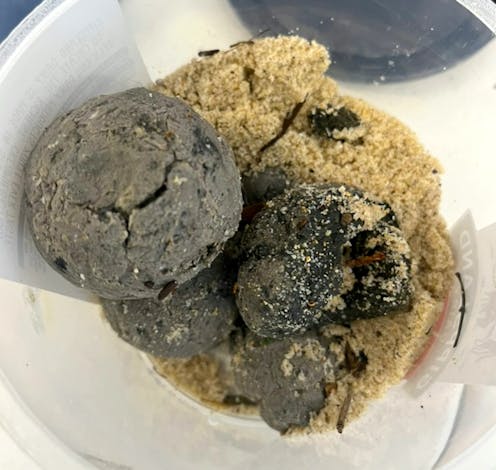
The mysterious black balls that washed up on Sydney’s beaches in mid-October were likely lumps of “fatberg” containing traces of human faeces, methamphetamine and PFAS, according to a new detailed analysis of their composition.
Initial reports suggested the ominous lumps were probably tar balls from an oil spill. However, analysis with a barrage of scientific tests has revealed a more complicated picture.
The mysterious black balls
On October 16, the first reports emerged from Coogee Beach in Sydney’s east. Lifeguards reported numerous black spheres on the sand that appeared at first glance to be tar-like.
Similar sightings were soon reported at nearby Bondi, Bronte, Tamarama and Maroubra beaches, prompting immediate closures and cleanup efforts. Authorities initially feared these could be toxic “tar balls”, leading to health advisories and public warnings.
Preliminary testing by Randwick Council was consistent with tar balls made up of oil and debris.

Oil – or something more disgusting?
We set out to find out exactly what the black balls were made of and where they came from. We ran a wide range of tests and analyses with colleagues from UNSW in collaboration with the Mark Wainwright Analytical Centre and the the environmental forensics arm of the federal Department of Climate Change, Environment, Energy and Water (DCCEEW). We also collaborated with the NSW Environment Protection Authority (EPA), and Randwick Council.
Initial testing, based primarily on results from a technique called solid-state nuclear magnetic resonance spectroscopy, suggested the material resembled unrefined oil. However, further testing indicated a different, more disgusting, composition.
 A cross section of one of the balls, showing its sandy coating and surface, some fibres, and the core.
Jake Ireland, CC BY
A cross section of one of the balls, showing its sandy coating and surface, some fibres, and the core.
Jake Ireland, CC BY
Analysing the elements involved revealed the black goop was mostly carbon. Radiocarbon dating then showed only about 30% of the carbon had a fossil origin, suggesting fossil fuels were not the major component of the balls.
We also identified significant levels of calcium, and much smaller amounts of various metals. Spectroscopic tests showed signatures in the black balls matching fats, oils and greasy molecules often found in soap scum, cooking oil and food sources. This pointed to human waste.
PFAS, drugs and signs of faeces
The next step was to see if we could dissolve the substance in organic solvents. Only about one-third to one-half of the mass dissolved this way.
We were able to take a closer look at the dissolved part using a technique called mass spectrometry, which identifies molecules by their weight and electric charge. This revealed molecules found in vehicle-grade fuels as well as organic molecules such as fatty acids and glycerides.
We also identified industrial perfluoroalkyl substances (PFAS or “forever chemicals”), steroidal compounds such as norgestrel, antihypertensive medications such as losartan, pesticides, and veterinary drugs. This is consistent with contamination from sewage and industrial runoff.
 The crushed up interior of one ball, ready for testing.
Jon Beves, CC BY
The crushed up interior of one ball, ready for testing.
Jon Beves, CC BY
There were also signs of human faecal waste, including a cholesterol byproduct called epicoprostanol and residues of recreational drugs including tetrahydrocannabinol (also known as THC, a compound found in the cannabis plant) and methamphetamine. This is consistent with contributions from domestic waste.
Analysing the part of the mass that we couldn’t dissolve proved more challenging. Here we tried solid-state nuclear magnetic resonance and a method called Fourier transform infrared spectroscopy, which uses infrared light to detect chemicals. The results suggested the presence of fats, but they were not definitive.
Were the blobs lumps of fatberg?
So what does all this mean? The high levels of fats, oils, greasy molecules and calcium, along with the low solubility, are consistent with a “fatberg”: a congealed mass of fats, oils and greasy molecules that can accumulate in sewage.
The detection of markers of human fecal matter, medication and recreational drugs suggest the origin may be sewage or other urban effluent. However, while the composition of these black balls suggests they may be similar to fatbergs, we cannot definitively confirm their exact origin.
The black ball incident does highlight the broader issue of pollution along Sydney’s coastline.
Recent reports indicate about 28% of monitored swimming sites in New South Wales are prone to pollution. Many receive poor water quality ratings, especially after rain. Beaches such as Gymea Bay, Coogee Beach, Malabar Beach, and Frenchmans Bay have been identified as areas of concern, with advisories against swimming due to contamination from human faecal matter.
Urban waste pollution
Analysing and understanding urban waste pollution is not an easy task. It requires a multi-disciplinary approach.
To unravel the complex composition of the blobs, we used carbon-14 dating, mass spectrometry, elemental analysis and microscopy techniques.
Even after all we did, we cannot yet draw definitive conclusions regarding the primary source of the blobs. This uncertainty reflects the broader challenges faced by scientists and environmental agencies in tracking and addressing pollution in coastal areas.
This incident underscores the importance of thorough scientific analysis in understanding environmental issues. By continuing to investigate the sources and composition of such pollutants, we can learn more about how urban waste management affects the health of our coasts.
This research was led by UNSW researchers, including Associate Professor Jon Beves, Dr Tim Barrows, Dr Martin Bucknall, Professor William Alexander Donald, Dr Albert Fahrenbach, Dr Sarah Hancock, Dr Christopher Hansen, Ms Lisa Hua, Dr Martina Lessio, Dr Chris Marjo, Associate Professor Vinh Nguyen, Dr Martin Peeks, Dr Aditya Rawal, Dr Chowdhury Sarowar, Professor Timothy Schmidt, Dr Jake Violi and Dr Helen Wang.
Authors: Jon Beves, Associate Professor of Chemistry, UNSW Sydney


















