

How do brains coordinate activity? From fruit flies to monkeys, we discovered this universal principle
- Written by: Brandon Robert Munn, Postdoctoral research fellow, University of Sydney
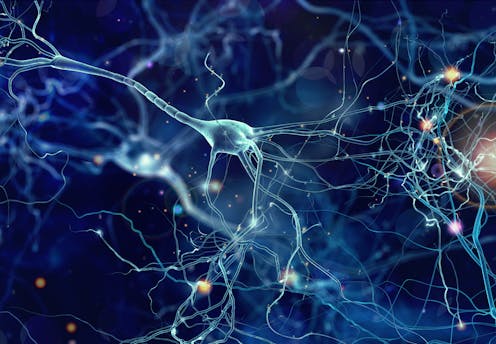
The brain is a marvel of efficiency, honed by thousands of years of evolution so it can adapt and thrive in a rapidly changing world. Yet, despite decades of research, the mystery of how the brain achieves this has remained elusive.
Our new research, published in the journal Cell, reveals how neurons – the cells responsible for your childhood memories, thoughts and emotions – coordinate their activity.
It’s a bit like being a worker in a high-performing business. Balancing individual skills with teamwork is key to success, but how do you achieve the balance?
As it turns out, the brain’s secret is surprisingly simple: devote no more than half (and no less than 40%) of each cell’s effort to individual tasks. Where does the rest of the effort go? Towards scalable teamwork.
And here’s the kicker: we found the exact same organisational structure across the brains of five species – from fruit flies and nematodes to zebrafish, mice and monkeys.
These species come from different branches of the tree of life that are separated by more than a billion years of evolution, suggesting we may have uncovered a fundamental principle for optimised information processing. It also offers powerful lessons for any complex system today.
The critical middle ground
Our discovery addresses a long-standing debate about the brain: do neurons act like star players (each highly specialised and efficient) or do they prioritise teamwork (ensuring the whole system works even when some elements falter)?
Answering this question has been challenging. Until recently, neuroscience tools were limited to either recording the activity of a few cells, or of several million.
It would be like trying to understand a massive company by either interviewing a handful of employees or by only receiving high-level department summaries. The critical middle ground was missing.
However, with advances in calcium imaging, we can now record signals from tens of thousands of cells simultaneously. Calcium imaging is a method that lets us watch neural activity in real time by using fluorescent sensors that light up according to calcium levels in the cell.
An example of calcium imaging shows neuron activity in a zebrafish brain.Applying insights from my physics training to analyse large-scale datasets, we found that brain activity unfolds according to a fractal hierarchy. Cells work together to build larger, coordinated networks, creating an organisation with each scale mirroring those above and below.
This structure answered the debate: the brain actually does both. It balances individuality and teamwork, and does so in a clever way. Roughly half of the effort goes to “personal” performance as neurons collaborate within increasingly larger networks.

The brain can rapidly adapt to change
To test whether the brain’s structure had unique advantages, we ran computational simulations, revealing that this fractal hierarchy optimises information flow across the brain.
It allows the brain to do something crucial: adapt to change. It ensures the brain operates efficiently, accomplishing tasks with minimal resources while staying resilient by maintaining function even when neurons misfire.
Whether you are navigating unfamiliar terrain or reacting to a sudden threat, your brain processes and acts on new information rapidly. Neurons continuously adjust their coordination, keeping the brain stable enough for deep thought, yet agile enough to respond to new challenges.
The multiscale organisation we found allows different strategies – or “neural codes” – to function at different scales. For instance, we found that zebrafish movement relies on many neurons working in unison. This resilient design ensures swimming continues smoothly, even in fast-changing environments.
By contrast, mouse vision adapts at the cellular scale, permitting the precision required to extract fine details from a scene. Here, if a few neurons miss key pieces of information, the entire perception can shift – like when an optical illusion tricks your brain.
 Evolutionary tree of species analysed in our study, each displaying a fractal neural organisation that balances efficiency and resilience. (MYA: million years ago; BYA: billion years ago)
Brandon Munn
Evolutionary tree of species analysed in our study, each displaying a fractal neural organisation that balances efficiency and resilience. (MYA: million years ago; BYA: billion years ago)
Brandon Munn
Our findings reveal that this fractal coordination of neuron activity occurs across a vast evolutionary span: from vertebrates, whose last common ancestor lived 450 million years ago, to invertebrates, dating back a billion years.
This suggests brains have evolved to balance efficiency with resilience, allowing for optimised information processing and adaptability to new behavioural demands. The evolutionary persistence hints that we’ve uncovered a fundamental design principle.
A fundamental principle?
These are exciting times, as physics and neuroscience continue interacting to uncover the universal laws of the brain, crafted over aeons of natural selection. Future work will be needed to see how these principles might play out in the human brain.
Our findings also hint at something bigger: this simple rule of individual focus and scalable teamwork might not just be a solution for the brain.
When elements are organised into tiered networks, resources can be shared efficiently, and the system becomes robust against disruptions.
The best businesses operate in the same way — when a new challenge arises, individuals can react without waiting for instructions from their manager, allowing them to solve the problem while remaining supported by the organisation rapidly.
It may be a universal principle to achieve resilience and efficiency in complex systems. It appears basketball legend Michael Jordan was right when he said: “talent wins games, but teamwork and intelligence win championships”.
Authors: Brandon Robert Munn, Postdoctoral research fellow, University of Sydney


















