

massive data haul reveals why so many plants and animals suffer after fire
- Written by: Don Driscoll, Professor in Terrestrial Ecology, Deakin University
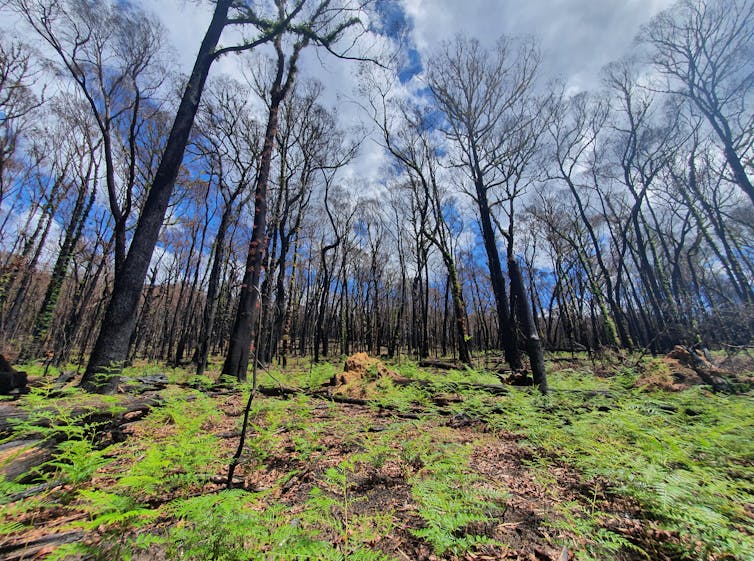
The megafires that tore through Australia’s forests in 2019–20 burnt more than ten million hectares. The tragedy prompted a massive research effort to understand how plants and animals were affected.
So what did it uncover? Research published today in the journal Nature set out to answer that question. In a collaboration involving more than 100 scientists, we brought together data for more than 1,300 animal and plant species. As far as we know, it’s the world’s largest dataset of biodiversity responses after a single fire season.
We found populations of some species declined, while other species became more common after the fires. Importantly, the results depended strongly on the condition of the land before the fire – especially how frequently it had been burned before the megafires.
The findings have profound implications for how Australia manages its natural environments. Authorities often use frequent fuel-reduction burning to prepare for bushfires – however our findings suggest this primes ecosystems for major disruption when the next wildfire hits.

An unparallelled opportunity
Global warming and other human-caused changes are driving more frequent and severe bushfires around the world. In the past 20 years, extreme fires have doubled globally. This in turn is helping fuel Earth’s species extinction crisis.
After Australia’s 2019-20 fires, rapid assessments estimated almost 900 plant and animal species were severely impacted, or put at heightened extinction risk from future fires. In response, government and non-government organisations allocated hundreds of millions of dollars for field-based monitoring and recovery.
This extraordinary monitoring effort provided an unparalleled opportunity to measure how extreme fires affect biodiversity.
We collated 62 sets of data involving 810,000 records of the presence, absence or abundance of species in burnt and unburnt sites.
It covered 1,380 species including plants, birds, frogs, mammals, reptiles, insects and land snails. The records were collected along more than 1,000 kilometres of Australia’s east coast, plus sites in South Australia and Western Australia.
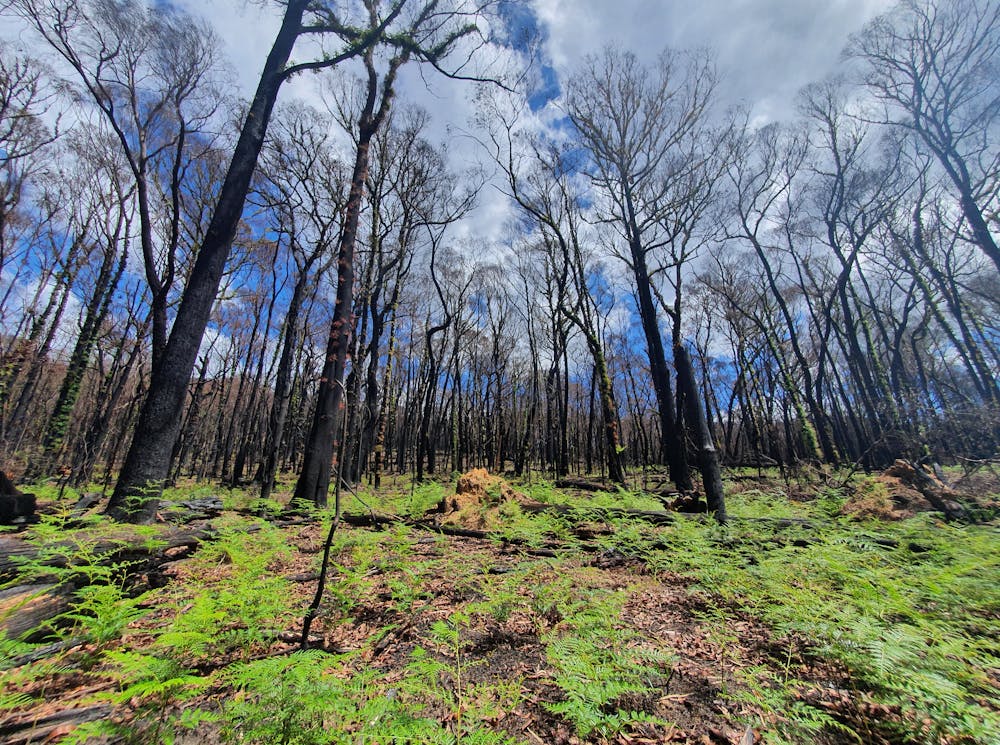 Global warming and other human-caused changes are driving more frequent and severe bushfires.
Tim Doherty
Global warming and other human-caused changes are driving more frequent and severe bushfires.
Tim Doherty
The losers
We found 55% of species declined after the 2019-20 megafires – either because they were less abundant overall or occupied fewer sites.
Species in areas exposed to frequent or recent past fires struggled the most. Sites that experienced three or more fires in the 40 preceding years had declines up to 93% larger than with sites not burnt, or burnt once over the same period.
Too-frequent bushfires can mean plants don’t have enough time between fires to set seeds. It can also wipe out valuable animal habitats such as logs, dead trees and tree hollows.
Among all the animal and plant groups that we examined, mammals were the most sensitive, showing average declines twice as large as other groups.
Mammals may be too large to shelter in the small burrows and crevices that smaller animals can squeeze into, they cannot fly to escape the flames, and naturally require more food because they are warm-blooded.
The winners
Some 45% of species were more commonly found in burnt sites after the megafires. The size of increases generally mirrored the size of declines in other species under the same conditions.
The most important example relates to fire frequency. Sites burnt frequently experienced both the largest declines and largest increases after the 2019-20 fires.
There are several ways frequent fire before the megafires could allow species to increase.
Species that re-establish quickly after a fire could have large populations before the next fire. This means more individuals could survive the fire, leading to successively larger populations.
And if individuals do survive a fire, their living conditions may become easier if, say, their predators did not survive, or there is less competition from other animals for resources.
Some plants may become increasingly abundant after each successive fire, such as grasses, benefiting animal species that eat or shelter in them.
This is not to say that megafires are good for biodiversity overall, or that more abundant species balance out the losses.
The species that do well after fire will continue to thrive as recently burnt areas become more common. That’s great, but the declining species will become an increasingly severe problem for conservation.
The decline is also a big problem for humans, who depend on biodiversity for a range of services.
A rethink is needed
Bushfire management agencies aim to reduce fire risks through frequent fuel-reduction burning. This involves a program of deliberately burning blocks of native vegetation at relatively short intervals, to reduce flammable materials such as plants, fallen branches, logs, twigs, leaves and bark.
But our research suggests this practice, which increases fire frequency, may create larger disruptions to ecosystems when big bushfires occur.
Past research has found that bushfires can be less severe when fuel-reduction burning has been undertaken in the three to five years prior.
And in some cases, when fuel-reduction burning was recent and nearby, it can help protect infrastructure from fire.
But our findings indicate even if a bushfire is not particularly severe, the harm to plants and animals can be extreme when sites have been burnt three or more times over 40 years, or within the ten preceding years.
So, frequent fuel-reduction burning, combined with any other preceding bushfires, condemns many plants and animals to large, potentially catastrophic declines in the next bushfire.
 WSpecies in areas that had experienced frequent or recent past fires struggled most after the 2019-20 megafires.
AP Photo/Rick Rycroft
WSpecies in areas that had experienced frequent or recent past fires struggled most after the 2019-20 megafires.
AP Photo/Rick Rycroft
Clearly, fire management and policy needs a big rethink. Alternative approaches to large-scale prescribed burning are required.
This could include developing the skills and technologies to rapidly detect and suppress bushfires. It may also involve supporting Indigenous “right-way fire”, a culturally informed method of fire management.
Encouragingly, we found severe bushfire impacts could be moderated if a lot of unburnt habitat exists within 2.5 kilometres. This allows plant seeds and animals to move from unburnt to recently burnt habitats, helping the damaged area to recover.
So, fire managers should protect remaining unburnt patches after fire, rather than burning them to prevent later flare-ups. If unburnt patches can be retained while fires are being fought, native communities will be able to recover more rapidly.
However, we should not forget that Australia’s 2019-20 megafires were the predictable consequence of climate change.
The alternative fire management approaches we suggest will likely fail if climate change continues unabated.
Authors: Don Driscoll, Professor in Terrestrial Ecology, Deakin University


















