

Knowing superstitions aren’t real doesn’t stop us behaving superstitiously – why?
- Written by: Stephanie Gomes-Ng, Senior Lecturer of Psychology, Auckland University of Technology
Former New Zealand prime minister John Key has three white rabbits painted on his helicopter, a nod to his “massively superstitious” habit of repeating “white rabbits” three times at the start of every month.
Tennis champion Rafael Nadal performs the same sequence of actions (shirt-tug, hair-tuck, face-wipe) before every serve. Taylor Swift paints “13” on her hand for good luck before a show, while Rihanna won’t allow anything yellow in her dressing room.
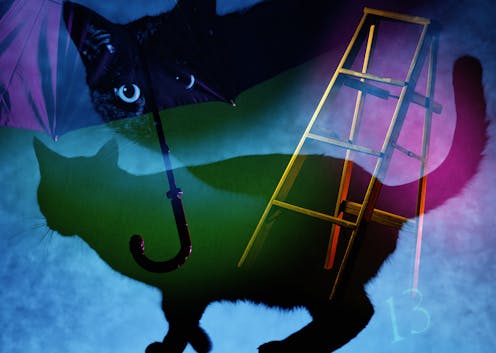
Perhaps you, too, are superstitious. Maybe you have a lucky number, avoid black cats, or shudder at the thought of opening an umbrella indoors.
Even if you don’t consider yourself superstitious, little things like saying “bless you” after a sneeze, knocking on wood or crossing your fingers are all examples of behaviours with superstitious origins.
We humans are particularly susceptible to superstitions. But why are we so quick to develop superstitious behaviours, and do we really believe they can bring good or bad luck?
In our new research, we set out to answer this question. We tested whether people could tell the difference between outcomes they caused and outcomes they didn’t cause, and this told us something about the cognitive roots of human superstition.
Learning about cause and effect
From as early as four months, infants learn their actions produce outcomes – kicking their legs shakes the crib, shaking a rattle makes an interesting noise, dropping a toy on the floor means mum or dad picks it up.
As we grow older, we develop a more sophisticated understanding of cause-and-effect relationships, asking “why?” questions about the world around us.
This sensitivity to causes and effects sets the stage for important developmental milestones, like imaginative play, planning actions to achieve a goal, predicting others’ intentions, anticipating and regulating emotions, and cooperating with others.
The ability to learn about relationships between causes and effects is a defining feature of human cognition. But how does this square with our superstitious tendencies?
When cause and effect is an illusion
We learn about causes and effects from experience. When our behaviour is followed by an outcome, we learn about the relationship between our action and that outcome. The more often this action-outcome pairing occurs, the stronger the perceived link between them.
This is why we repeat behaviours that produce rewarding outcomes, and avoid repeating behaviours that produce punishing ones.
But what happens if an outcome follows our actions by coincidence? If I wear my lucky socks and my favourite sports team wins, this is probably just a coincidence (it’s unlikely my sock-wearing actually caused the win). But if this happens a few times, I may develop a superstition about my lucky socks.
This suggests superstitious behaviour arises because we aren’t particularly good at discerning when our actions cause an outcome, versus when our actions just coincide with (but do not cause) an outcome. This is a common explanation for superstition – but does it have any weight?
Testing our ability to detect causality
We can test what underpins superstitious behaviour by simply asking people “who caused that outcome?”. Getting it right would suggest we can discern action-outcome relationships (and therefore that there must be some other explanation for superstitious behaviour).
Our research did exactly that. We asked whether people could tell when their actions did or didn’t cause an outcome.
We recruited 371 undergraduate students from a large New Zealand university, who participated in one experimental session for a course credit. Participants played a game where a positive outcome (winning) or a negative outcome (losing) occurred either after their own action (clicking a button), or independently of their action.
Importantly, participants weren’t given any information beforehand about the type of outcome or whether it would depend on their behaviour. This meant they had to rely on what they actually experienced during the game, and we could test their ability to judge whether they had caused the outcome.
This also meant participants’ preexisting superstitions and other characteristics (such as age) didn’t affect our results. Their behaviour during the task was representative of human behaviour more generally.
Participants’ scores indicated they often got it right: in about 80% of trials, they knew when they’d caused the outcome, and when they hadn’t.
A built-in bias
The distinction between causing and not causing the outcomes was sometimes very subtle. This made it more difficult for participants to tell what had occurred.
When they weren’t sure, participants defaulted to saying “I caused it”, even if they actually hadn’t. They were biased to attribute outcomes to their own actions, particularly after winning outcomes.
This bias may be the key to explaining why we’re superstitious: something I did caused something to happen, even if I can’t be sure what it was. And it suggests knowing superstitions aren’t real may not actually stop us from behaving superstitiously.
On the surface, this may not make sense – why expend energy doing things we know don’t affect outcomes? But if we look deeper, this bias serves an important purpose, because it helps ensure we don’t miss any potential connections between our actions and their outcomes. In other words, it’s better to be safe than sorry.
Research shows that engaging in superstitious behaviour can also increase confidence in our abilities to achieve a goal, improve performance in different tasks, and alleviate anxiety by giving us a sense of control.
The tendency to attribute positive outcomes to our actions (as we found) can boost self-esteem and psychological wellbeing. So, perhaps we’d all benefit by indulging in a little superstitious behaviour. Touch wood.
Authors: Stephanie Gomes-Ng, Senior Lecturer of Psychology, Auckland University of Technology


















