

how queen bees and wasps set our backyards abuzz in readiness for summer
- Written by: Jennifer Jandt, Senior Lecturer in Ecology, University of Otago
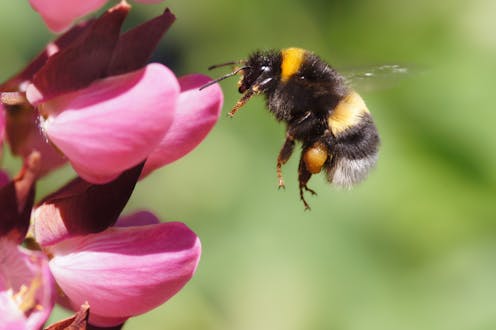
As we transition to warmer weather in the austral summer, many changes take place. Domestic dogs and cats may shed winter coats. Fish such as bass and trout prepare fat reserves for migrations to deeper waters. And social insect queens emerge from hibernation in search of a place to start their nests.
Most people won’t be surprised that bumble bees and ground-nesting wasp colonies have queens. What is surprising, though, is that those big bees and wasps we see in the spring are the queens – not the workers – building their nests all on their own.

Bumble bees and yellowjacket wasps typically nest in the ground (though you might see some nesting in trees or buildings). To locate the perfect nest site, both species search for abandoned rodent holes (the perfect cosy size to insulate a big queen and a small nest).
After they find their spot, the queens forage and defend their young from the perils of life as an insect – predators, pesticides and pathogens. If the queen can’t find a nest site and gather enough resources, or perishes before workers emerge, the colony will fail before it even gets started.
Life of the larvae
Like butterflies, wasps and bees start life as helpless larvae. Wasp and bee larvae are essentially big stomachs with a mouth. They have no legs, and are stuck in place until they’re grown. Larvae rely entirely on older generations to survive.
Wasps collect pulp to smooth into hexagonal paper cells (similar to the inside of a honey bee nest) where the defenceless larvae will grow. They usually collect this pulp from untreated wood – the wasp that landed next to you on the park bench is just gathering building materials. She won’t take much, and she won’t stay long.
Bumble bees produce wax that they mould into honey pots (to store food) and balls (where they nestle their eggs). The bees need enough nutrition to produce this wax, which they’ll get from the flowers in your garden.
Wasp larvae are primarily carnivorous, getting protein from live prey or carrion. Bees get protein from floral resources like pollen, although adults of both species feed on nectar.
 Wasp queen licking honey dew from aphids on rose leaves.
Jennifer Jandt, CC BY-NC-SA
Wasp queen licking honey dew from aphids on rose leaves.
Jennifer Jandt, CC BY-NC-SA
After a few weeks, larvae will spin silken cocoons and pupate (just like butterflies). This is a chance for the queens to take a break from feeding those hungry larvae (which are insatiable before they pupate), and focus on raising more young.
The queens still continue foraging, though – no one is coming to feed them until their daughters are adults.
Once the offspring emerge from their pupae as adults, they won’t leave the nest just yet. They will need a day (at least) just for their exoskeleton (their body and wings) to harden. Until the exoskeleton is set, bees and wasps can’t fly to forage, or sting to defend.
They also need time to develop a circadian rhythm. This ensures when they emerge from the underground nest, they do so when it’s light outside (wasps and bees don’t forage too well in the dark).
Division of labour
We are now nearing the end of spring in Aotearoa. There are still a few queen wasps and bumble bees flying around, but we are also starting to see small foragers. These are the “first cohort” of workers. The queen – who did all the chores on her own – was limited in terms of what she could feed her young.
In early spring, food might be scarce. Once the first cohort of workers emerge, things outside and inside the nest begin to shift. Floral resources and insect prey numbers increase – meaning foragers have an easier time finding food.
Because workers are foraging, the queen can remain in the nest where she primarily lays eggs and incubates her developing brood.
Workers also subdivide the chores in the nest. Some will forage for protein, some for sugar, and others (like wasps) will forage for nest material or water. Some workers might remain in the nest to keep the temperature and humidity constant, others might remain in the nest to watch for invaders or predators.
 Bumble bee queens are much larger than the workers (number tags help identify individuals from the nest and don’t affect their behaviour).
Jennifer Jandt, CC BY-NC-SA
Bumble bee queens are much larger than the workers (number tags help identify individuals from the nest and don’t affect their behaviour).
Jennifer Jandt, CC BY-NC-SA
Queen bumble bees and yellowjackets only live for about one year. They emerge as adults in autumn, mate, then hibernate over the winter months. After emerging from hibernation in spring, they start a new colony on their own and watch as it grows to hundreds (bumble bees) or thousands (yellowjackets) of workers.
At some point, the queen will stop laying eggs. She’ll often leave the nest on her own when she knows her time is up. The workers will make sure the larvae in the nest are raised as new queens, and the cycle starts anew.
Among royalty
In the North Island, there have been a number of “frighteningly large” perennial yellowjacket nests reported.
 Wasps (like this yellowjacket queen) can be as effective as bees at transferring pollen between flowers.
Jennifer Jandt, CC BY-NC-SA
Wasps (like this yellowjacket queen) can be as effective as bees at transferring pollen between flowers.
Jennifer Jandt, CC BY-NC-SA
As our climate changes, warming temperatures may extend the season of social wasp nests, leading to more of these large nests. Although the original queen dies, the new queens may choose to join an established nest of workers and take over as the new queen (skipping that period of hibernation).
Yellowjacket wasps sometimes receive a bad rap, particularly due to their very effective nest defence strategies, with the potential to butt heads with gardeners.
But wasps – just like bees and butterflies – are important pollinators in our floral ecosystems, and also help keep annoying pest bug populations down. So, if you’ve noticed the huge wasps and bumble bees flying around this spring, just remember – you’re among royalty.
Authors: Jennifer Jandt, Senior Lecturer in Ecology, University of Otago


















