Trusted partner to the Pacific, or giant fossil fuel exporter? This week, Australia chose the latter
- Written by: Wesley Morgan, Research Associate, Institute for Climate Risk and Response, UNSW Sydney
Australia has long tried to be two things at once – a trusted friend to Pacific nations in a bid to reduce China’s influence, and a giant exporter of fossil fuels. This diplomatic tightrope has become increasingly hard to walk, as Pacific nations see climate change as an existential threat.
This week, Australia’s government was forced to make a choice in a very public forum. It chose fossil fuels.
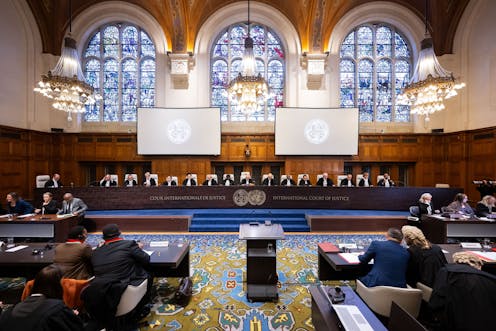
Disappointed by the slow pace of United Nations climate talks, Vanuatu and other Pacific nations launched a case at the International Court of Justice in the Netherlands to clarify the obligations countries have to prevent harm to the Earth’s climate system for current and future generations.
While international climate negotiations are often conducted behind closed doors, this case is being broadcast in public. We can clearly see the arguments Australia has laid out and the countries it has aligned itself with.
In the courtroom on Monday, Australia sided with major emitters and fossil fuel exporters such as Saudi Arabia, the United States and China to try and minimise their legal liability in contributing to climate change.

What’s at stake in this case?
This week marks a milestone in a five-year legal campaign, travelling from a university tutorial in Vanuatu’s capital, Port Vila, through the halls of the United Nations in New York and now to the world’s court in the Hague. The International Court of Justice is the only international court able to settle disputes between United Nations member states.
In 2019, 27 law students at the University of the South Pacific were given a challenge: find the most ambitious legal pathways towards climate justice. They decided filing a case with the world court fitted the bill.
In 2023, Vanuatu and other nations succeeded in passing a resolution at the UN General Assembly requiring the world court to give an advisory opinion on two questions – what obligations do states have under international law to protect the climate from greenhouse gas emissions, and what are the legal consequences for states causing “significant harm” to the earth’s climate?
Ahead of the hearing, the world court has received a record number of written submissions. Justices will hear two weeks of oral submissions. They will then produce an advisory opinion, expected to set a new benchmark in international law, by clarifying the legal obligations countries have to tackle emissions.
While an advisory opinion is not binding, the court’s findings will feed into national court cases and UN climate talks.
For Australia, this case presents a direct challenge. It has no plans to phase down fossil fuel exports. In fact, it plans to expand them.
If the court’s opinion draws clear lines between fossil fuel exporters and climate damage, it could have severe implications for Australia. It could, for instance, pave the way to compensation lawsuits for climate damage.
Since 2000, Australia has approved more than 700 oil, gas and coal projects. Dozens more are in the approvals pipeline. Just this week the federal government cleared the way for three new coal mines.
Australia is now one of the world’s largest exporters of coal and gas. This is relatively new. While coal has been exported since 1801, large-scale exports of liquefied natural gas only began a decade ago.
When burned overseas, emissions from Australia’s fossil fuel exports are now more than double those of its entire domestic economy. These emissions damage our global climate, increasing risk of harm to people in Australia and worldwide.
What did Australia argue at the Hague?
In bringing the case, Vanuatu has argued actions causing climate change are unlawful under a range of international obligations including the law of the sea, human rights law and environmental law.
Australian delegates commended Vanuatu’s leadership in bringing this case and reiterated Australia’s commitment to working with the Pacific on climate.
But after the diplomatic niceties, Australian Solicitor-General Stephen Donaghue got down to business. He told the court only the Paris Agreement – which requires countries to set targets to cut domestic emissions – should apply when it comes to mitigating climate change.
Donaghue also argued greenhouse gas emissions are different to, say, one country’s toxic waste damaging the environment of another. This, he argued, was because emissions have many sources.
Donaghue and the Australian delegation argued the court should take a narrow view of obligations to cut emissions and suggested responsibility for harms caused by climate change could not be pinned on individual states.
Australia has also argued protecting human rights does not extend to obligations to tackle climate change.
In 2022, Torres Strait islanders told a UN Human Rights Committee that a failure to address climate change violated their human rights. In response, the Australian government used very similar arguments, claiming climate change was best addressed through UN climate negotiations.
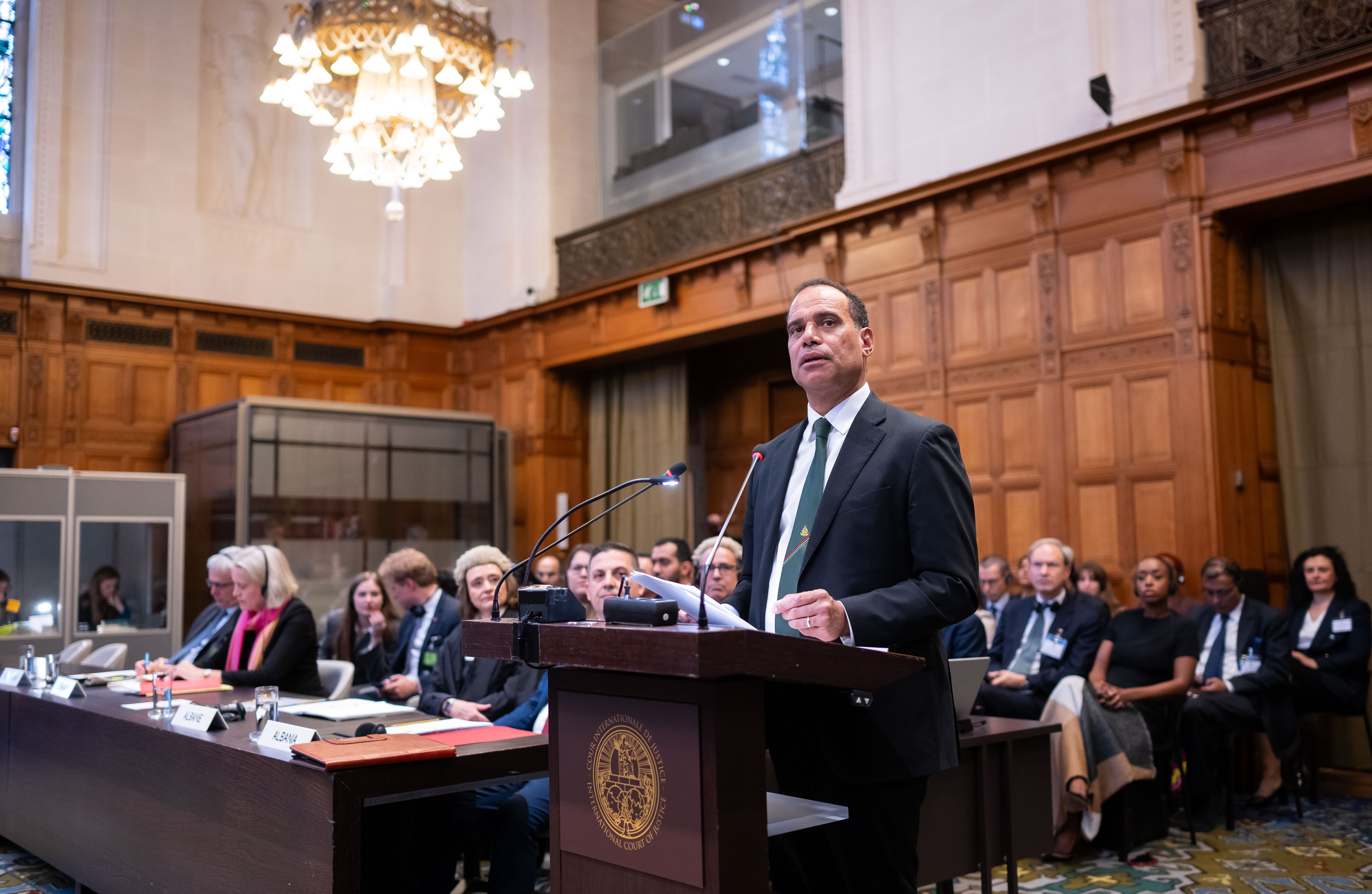
 On Monday, special climate envoy Ralph Regenvanu began testifying for Vanuatu.
International Court of Justice, CC BY-NC-ND
On Monday, special climate envoy Ralph Regenvanu began testifying for Vanuatu.
International Court of Justice, CC BY-NC-ND
What does this mean?
The court’s opinion will be handed down next year.
Despite Australia’s arguments, recent rulings by other courts and tribunals suggest the court may not decide in our favour.
For example in May, the International Tribunal on the Law of the Sea found greenhouse gas emissions were a form of marine pollution (because they acidify and heat the ocean), which countries have obligations to prevent. The tribunal rejected arguments that state obligations were limited to implementing the Paris Agreement.
A ruling on a similar case from the Inter-American Court of Human Rights is expected before the end of the year.
Relationships with Pacific states are likely to come under strain as the proceedings in the Hague roll on.
Matters could come to a head next year, when the court will release its advisory opinion.
A decision is still pending on whether Australia will host COP31, the 2026 UN climate talks, alongside Pacific island countries.
If our COP bid succeeds, it could give Canberra a chance to signal a shift away from fossil fuel exports in favour of green exports such as critical minerals and green iron. Doing so would align Australia’s interests with the Pacific – and present it much more clearly as a partner of choice.
Authors: Wesley Morgan, Research Associate, Institute for Climate Risk and Response, UNSW Sydney