

Bovaer is added to cow feed to reduce methane emissions. Does it get into milk and meat? And is it harmful for humans?
- Written by: Ian Musgrave, Senior lecturer in Pharmacology, University of Adelaide
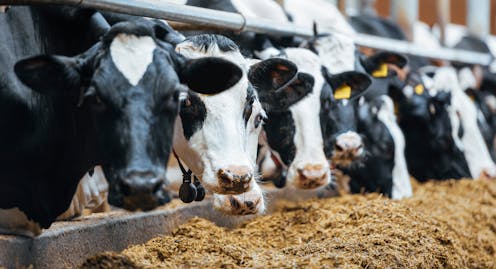
Concern has been rising over the use of a feed supplement, Bovaer 10, to reduce methane production in cows.
Bovaer 10 consists of silicon dioxide (basically sand), propylene glycol (a food stabiliser approved by Food Safety Australia New Zealand) and the active compound 3-nitrooxypropanol (3-NOP).
There has been an enormous amount of misinformation about the safety of 3-NOP, with some labelling milk from herds fed the additive as “Frankenmilk”. Others have been concerned it could make its way to humans via beef.
The bottom line is that 3-NOP is safe. Let’s unpack some of the major misunderstandings.
Why do we need to reduce methane production?
In our attempts to reduce global warming, most of the focus has been on CO₂ as a a major human-produced greenhouse gas. But methane is also a greenhouse gas, and although we produce less of it, it is a far more potent greenhouse gas than CO₂.
Agriculture is the largest human-produced source of methane. As cattle herds expand to fuel our increasing desire for meat and milk, reducing methane production by cows is an important way to reduce greenhouse emissions.
There are several ways to do this. Stopping the bacteria in cows’ stomachs that generate methane from making methane is one approach.
The methane cows and sheep produce is not from the animals themselves, but from microbes that live in their digestive systems. 3-NOP stop the enzymes that do the final step of methane synthesis in these microbes.
3-NOP is not the only compound trialled as a feed additive. A seaweed-based Australian product, Rumin8, for example, is also under development. Saponins, soap-like chemical compounds found in plants, and essential oils have also been investigated.
However, 3-NOP is currently one of the most effective treatments.

But isn’t it a poison?
There is concern on social media about Bovaer “poisoning our food”.
But, as we say in toxicology, it’s the dose that makes the poison. Arsenic, for example, is lethal at 2–20 milligram per kilogram of body weight.
In contrast, 3-NOP was not lethal at the doses used in safety studies, up to 600 mg 3-NOP per kg of body weight. At 100 mg per kg of body weight in rats, it had no adverse effects.
What about reproductive issues?
The effect of 3-NOP on reproductive organs has caused a lot of comment.
Research in rats and cows found that doses of 300–500 mg per kg of body weight resulted in ovarian and testicular shrinkage.
To put that in perspective, to achieve the same exposure in humans, a 70 kg human would need to consume 21–35 grams (around 2 tablespoons) of pure 3-NOP a day every day for weeks on end to see this effect.
No human will be exposed to this amount as 3-NOP does not enter milk – it’s fully metabolised in the cow’s gut.
No cow will be exposed to these levels either.
What about cancer?
3-NOP is not genotoxic or mutagenic, meaning it can’t damage DNA. So 3-NOP’s effects are dose-limited, meaning small doses aren’t harmful while very high doses are (unlike radiation, where there is no safe dose).
At a dose of 300 mg per kg of body weight, researchers found benign tumours in the small intestines of female rats, but not male rats, after 2 years of daily consumption. At a 100 mg of 3-NOP per kg of body weight, no tumours were seen.
Cows are consuming less than 2 grams Bovaer 10 a day (of which only 10% or 0.2 grams, is 3-NOP). This is around 1,000 times less than the acceptable daily intake of 1 mg 3-NOP per kg of body weight a day for a 450 kg cow.
This level of intake will not result in tumours, or any of the other adverse effects.
So how much will humans be exposed to?
Consumers of milk and meat will be exposed to zero 3-NOP. 3-NOP does not get into milk or meat: it is completely metabolised in the cow’s gut.
Farmers might be exposed to a small amount handling the feed additive and industrial workers producing 3-NOP will be potentially exposed to more. Farmers and industrial workers already wear personal protective equipment to reduce exposure to other agricultural chemicals – and are recommended to do so with Bovear 10 as well.
How extensively has it been tested?
3-NOP has been developed over 15 years, subject to multiple reviews by the European Food Safety Authority, the United Kingdom’s Food Safety Authority and others.
It has been extensively tested over months of exposure to cattle with no adverse effects. Some studies actually say it improves milk and meat quality.
Bovaer has been approved for use in dairy cattle by the European Union since 2022 and in Japan in 2024. It is also used in many other countries, including in beef products in Australia.
Very little 3-NOP enters the environment (less than 0.2% of the ingested dose), it does not accumulate and is readily broken down so is not an environmental risk.
Since humans are not exposed to 3-NOP though milk and meat, long-term human exposure is not an issue.
What does Bill Gates have to do with it?
Bill Gates has invested in a different feed treatment for methane, the Australian seaweed based Rumin8. But he has nothing to do with Bovaer 10.
The Bill and Melinda Gates Foundation has given research grants to the company that makes 3-NOP for malaria control research, not for 3-NOP.
The bottom line is that adding 3-NOP to animal feed poses no risk to consumers, animals or the environment.
Authors: Ian Musgrave, Senior lecturer in Pharmacology, University of Adelaide


















