

birds are reshaping themselves in a warming world
- Written by: Sara Ryding, Postdoctoral research fellow, Deakin University
For wildlife, climate change is a bit like the “final boss” the protagonist faces in a video game: big, hulking and inescapable.
This formidable enemy has forced wildlife to alter where and how they live. Higher temperatures exert so much stress on wildlife that over generations, they are forced to change and adapt.
We wanted to better understand how this pattern of change was playing out in Australian birds.
Our two pieces of recent research identified that, in response to warming, more than 100 species of Australian birds have developed smaller bodies and bigger beaks over time.
Shape-shifting wildlife
When we talk about shape-shifting, we’re not talking about werewolves or Ant-Man. Rather, we are referring to body size getting smaller and appendages such as beaks, tails and limbs getting bigger.
This enables animals to shed excess heat more efficiently by providing more surface area to do so – something engineers know when designing radiators, for instance.
Just as the hot water pipes in radiators help dissipate internal heat through the periphery, bird beaks are perforated with blood vessels that transfer heat from the body’s core to the beak surface, where it is then lost to the environment.
This way, for both a radiator and a beak, increasing the surface area of the structure (while minimising the distance the heat has to travel from the core) maximises the heat loss.
The link between body shape and heat loss has led to the prediction that animals will change body shape over time, in response to climatic warming.
Three years ago, Deakin University researchers published a paper showing examples of such changes occurring in a handful of diverse species all across the world.
Now, we significantly expand on this with two recently published studies focusing on Australian birds. We identified decreasing body sizes and increasing beak sizes over time, in response to climatic warming. Combined, the studies include over 100 species of birds from across Australia.
What we did and what we found
Our studies used two different data sets and methods to detect shrinking and shape-shifting.
The first used an extraordinary dataset collected by community scientists of the Victorian Wader Study Group and the Australasian Wader Studies Group, who have been monitoring Australian shorebirds for nearly 50 years.
Their monitoring includes measurements such as bill length, wing length and body mass in more than 100,000 individual birds. The data allowed us to identify increasing beak sizes and decreasing body sizes in both resident and migratory species of shorebirds in northern and southern Australia.
For example, iconic migrants like red knots and sharp-tailed sandpipers have both increased beak size over the last 50 years.
The second dataset, collected by Deakin researchers, used 3D scans of museum specimens to measure the beak surface area of specimens from the past century.
Through this approach, more than 5,000 specimens were measured for beak surface area, which was supplemented by measurements of wing length.
The results showed the same pattern of bigger beaks and smaller body sizes were identified across a vast range of birds, all the way from ducks to songbirds.
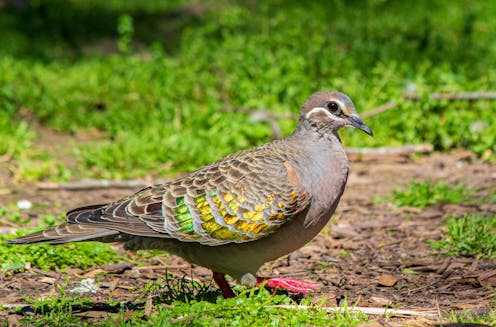
For example, the chip-stealing silver gull and dazzling common bronzewing have both increased beak size over the past century.
Australia is heating up. The shape-shifting and shrinking that we see in birds indicate ways in which they may be adapting to cope with these higher temperatures.
Short-term weather versus long-term trends
One surprising aspect, reflected in both studies, is that short-term spells of excessive heat can cause responses in bird shape that contradict the long-term trends.
While body size decreases in response to shorter-term periods of higher temperature, bill size also shrank.
Since beak sizes increase over the long-term because of climatic warming, why would they decrease in response to short-term bursts of higher temperature?
Climatic warming does not only affect the temperature birds experience, but also their environment.
In an environment with high baseline temperatures, such as Australia, periods of high temperature may mean less food. This can hamper the growth of young birds.
In this way, both body and beak size would decrease after hot temperatures due to stunted growth as food gets more scarce.
And in short-term periods of extreme temperatures, having a big beak can be a liability. Hot air from the environment will actually move into the beak, causing the bird to heat up too much, with potentially fatal consequences.
Whatever their cause, the contrasting trends between short and long-term responses to hot environments show things are complex in a changing climate.
A question of survival
It might be tempting to view shrinking and shape-shifting as proof animals are successfully adapting to climate change.
However, that would be a premature conclusion: it shows us that some species are responding, but we don’t know how these changes impact their survival prospects.
Such questions are difficult to answer but form the focus of our current research.
Importantly, while both studies show bigger beaks and smaller bodies across species overall, both also show certain species are adapting more than others.
And many are not shrinking or shape-shifting at all in response to climate change.
Is that because these species don’t need to adapt, or because they can’t?
If the former, we can breathe a small sigh of relief. If the latter, we should be very concerned.
In the aftermath of COP29, the UN Climate Change Conference in November in Azerbaijan, discussion of how climate change impacts fauna should be high on everyone’s agenda.
Authors: Sara Ryding, Postdoctoral research fellow, Deakin University


















