

What is a dark comet? A quick guide to the ‘new’ kids in the Solar System
- Written by: Rebecca Allen, Co-Director Space Technology and Industry Institute, Swinburne University of Technology
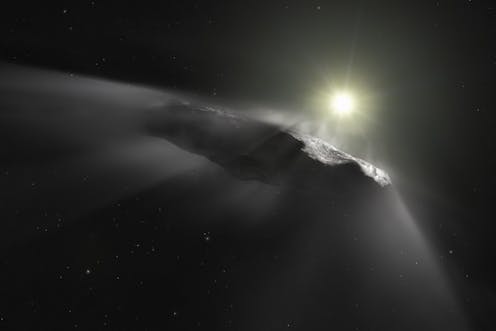
In 2017, NASA discovered and later confirmed the first interstellar object to enter our Solar System.
It wasn’t aliens. But artist impressions of the object (called ‘Oumuamua, the Hawaiian word for “scout”) do resemble an alien spaceship out of a sci-fi novel. This strange depiction is because astronomers don’t quite know how to classify the interstellar visitor.
Its speed and path around the Sun don’t match a typical asteroid, but it also has no bright tail or nucleus (icy core) we normally associate with comets. However, 'Oumuamua has erratic motions that are consistent with gas escaping from its surface. This “dark comet” has had astronomers scratching their heads ever since.

Flash forward to today, and more of these mysterious objects have been discovered, with another ten announced just last week. While their nature and origins remain elusive, astronomers recently confirmed dark comets fall into two main categories: smaller objects that reside in our inner Solar System, and larger objects (100 metres or more) that remain beyond the orbit of Jupiter.
In fact, 3200 Phaethon – the parent body of the famous Geminid meteor shower – may be one of these objects.
How do dark comets differ from normal comets?
Comets, often described as the Solar System’s “dirty snowballs”, are icy bodies made of rock, dust and ices. These relics of the early Solar System are critical to unlocking key mysteries around our planet’s formation, the origins of Earth’s water, and even the ingredients for life.
Astronomers are able to study comets as they make their close approach to our Sun. Their brilliant tails form as sunlight vaporises their icy surfaces. But not all comets put on such a dazzling display.
The newly discovered dark comets challenge our typical understanding of these celestial wanderers.
 Image of comet C/2023 A3 Tsuchinshan-ATLAS taken by astronauts aboard the International Space Station.
NASA
Image of comet C/2023 A3 Tsuchinshan-ATLAS taken by astronauts aboard the International Space Station.
NASA
Dark comets are more elusive than their bright siblings. They lack the glowing tails and instead resemble asteroids, appearing as a faint point of light against the vast darkness of space.
However, their orbits set them apart. Like bright comets, dark comets follow elongated, elliptical paths that bring them close to the Sun before sweeping back out to the farthest reaches of the Solar System.
They go beyond Pluto, some even making it out to the Oort Cloud, a vast bubble of tiny objects at the fringe of our Solar System. Their speed and paths are what allow astronomers to determine their origins.
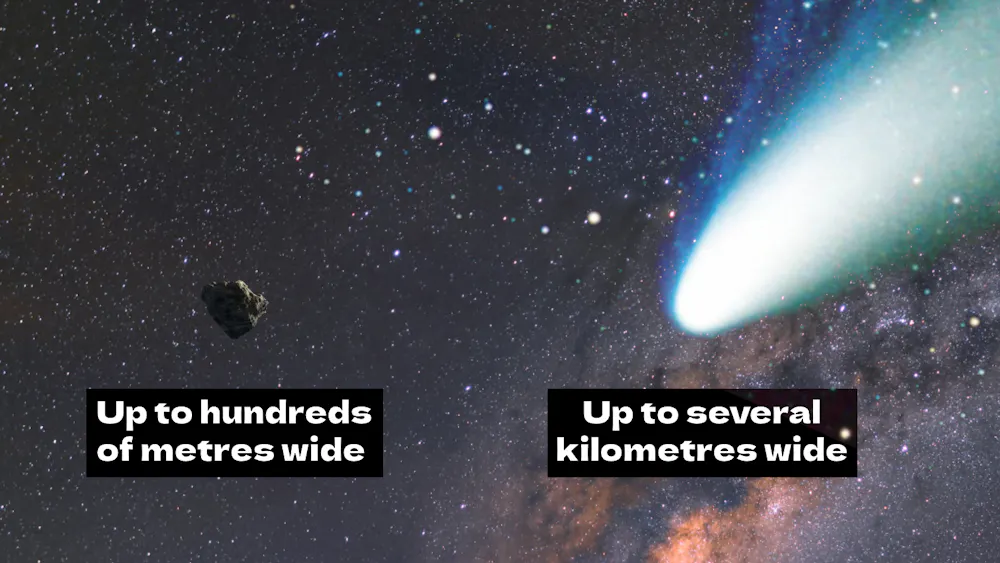 A comparison of dark comets and bright comets set against the Milky Way. On the left, a small, rocky, dark comet represents their typical size of one metre to a few hundred metres wide. On the right is a larger, icy, bright comet with a glowing tail, whose size ranges from 750 metres to 20 kilometres wide. The stark difference in size explains why dark comets lack the bright, visible tails of their larger, more iconic counterparts.
Composition: Dr Kirsten Banks; Background image: R. Wesson/ESO; Dark comet: Nicole Smith/University of Michigan, made with Midjourney; Bright comet: Linda Davison
A comparison of dark comets and bright comets set against the Milky Way. On the left, a small, rocky, dark comet represents their typical size of one metre to a few hundred metres wide. On the right is a larger, icy, bright comet with a glowing tail, whose size ranges from 750 metres to 20 kilometres wide. The stark difference in size explains why dark comets lack the bright, visible tails of their larger, more iconic counterparts.
Composition: Dr Kirsten Banks; Background image: R. Wesson/ESO; Dark comet: Nicole Smith/University of Michigan, made with Midjourney; Bright comet: Linda Davison
But what makes these comets so dark? There are three main reasons: size, spin and composition or age.
Dark comets are often small, just a few metres to a few hundred metres wide. This leaves less surface area for material to escape and form into the beautiful tails we see on typical comets. They often spin quite rapidly and disperse escaping gas and dust in all directions, making them less visible.
Lastly, their composition and age may result in weaker or no gas loss, as the materials that go into the tails of bright comets are depleted over time.
These hidden travellers may be just as important for astronomical studies, and they may even be related to their bright counterparts. Now, the challenge is to find more dark comets.
How can we find dark comets?
How do we even find these mysterious dark comets in the first place? As they get closer to the Sun, we don’t see spectacular tails of debris.
Instead, we rely on the light they reflect from our Sun.
 Several astronomical images are combined to capture the faint, fast moving object ‘Oumuamua in the centre. The white streaks are stars.
ESO/K. Meech et al.
Several astronomical images are combined to capture the faint, fast moving object ‘Oumuamua in the centre. The white streaks are stars.
ESO/K. Meech et al.
These little guys might be stealthy for our eyes, but they are often no match for our large telescopes around the world. The discovery of ten new dark comets revealed last week was all thanks to one amazing instrument, the Dark Energy Camera (DECam) on a large telescope in Chile.
This camera can’t “see” dark energy directly, but it was designed to take massive photos of our universe – for us to see distant stars, galaxies and even hidden Solar System objects.
In their recent study, astronomers pieced together that some of these nightly images contained likely dark comets.
 A) The Dark Energy Camera (DECam), mounted on the Victor M. Blanco four-metre telescope at the Cerro Tololo Inter-American Observatory in the Chilean Andes (Credit: Dark Energy Survey). B) Two examples of newly discovered dark comets within the DECam data, from Seligman et al. (2024).
The good news is, we are starting to focus more attention on these objects and on how to find them.
In even better news, in 2025, we’ll have a brand new mega camera in Chile ready to find them. This will be the Vera C. Rubin Observatory, with the largest digital camera ever built.
It will allow us to take more images of our night sky more quickly, and see objects that are even fainter. It’s likely that in the next ten years we could double or even triple the amount of known dark comets, and start to understand their interesting origin stories.
There could be more 'Oumuamua-like objects out there, just waiting for us to find them.
Authors: Rebecca Allen, Co-Director Space Technology and Industry Institute, Swinburne University of Technology


















