

Google AI


Modern Australian

When you wish upon a star, is it already dead? An astronomer crunches the numbers

  • Written by: Laura Nicole Driessen, Postdoctoral researcher in radio astronomy, University of Sydney
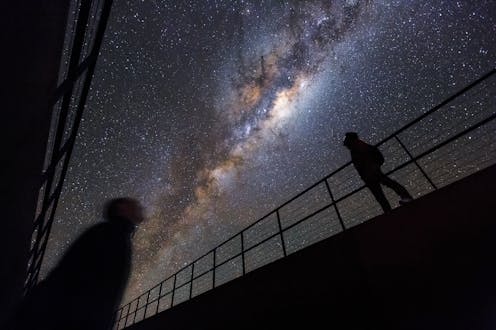
When you wish upon a star, is it already dead? An astronomer crunches the numbers

When you wish upon a star, Jiminy Cricket told us, your dreams come true. But according to an idea doing the rounds on social media, that may not be the case:

According to astronomy, when you wish upon a star you’re a million years too late. The star is dead, just like your dreams.

Is that really true? Did Jiminy Cricket lie to us?

As an astronomer, I’m happy to say that the stars we can see in the night sky are a lot closer and live a lot longer than you would think. It’s pretty unlikely you’ve accidentally wished upon a star that’s already dead.

Stars are closer than you think

When someone hits you with the depressing factoid that the stars we wish on are already dead, they usually start by saying something about how the stars are “millions of light years away”. This means the light from the star has been travelling for millions of years to reach your eyes, so by now the star is millions of years older and – supposedly – most likely dead.

But the stars you’re wishing on probably aren’t that far away. All the stars we can see with our eyes are inside our galaxy, the Milky Way. The Milky Way is approximately 100,000 light years across, and our Solar System is about 26,000 light years from the centre of the galaxy.

So if we could see the stars at the very far edge of the galaxy, they’d still only be about 74,000 light years away. That’s nowhere near a million light years away, let alone “millions of light years”.

A spiral of stars representing the Milky Way galaxy with a bright clump in the middle at the centre of the galaxy. The Sun is about half way between the centre and the edge of the galaxy.
An artist’s impression of the Milky Way galaxy showing the location of the Sun and its distance from the centre and the edges of the galaxy. NASA/JPL-Caltech/R. Hurt (SSC/Caltech)

Visible stars are even closer

In practice, the stars we can see aren’t even that far away. On a dark night, with no Moon and with good vision (which rules me out), the faintest star we can see with our eyes has a brightness of around 6.5 magnitudes.

Brighter stars have lower magnitudes, and dimmer stars have higher ones. The brightest star in the Southern Cross has a magnitude of 0.8 while the faintest star in the Southern Cross has a magnitude of 3.6.

The visible brightness limit of 6.5 magnitudes means we can only see stars out to around 10,000 light years from Earth. So if you happen to wish on one of the more distant stars, the light has travelled 10,000 years to hit your eye.

And if we assume wishes travel at the speed of light, it’ll take another 10,000 years to reach the star. So even the most distant visible star is only 20,000 years older by the time your wish reaches it.

So the question is: do stars live longer than 20,000 years?

An image of the Milky Way showing the pointer stars and the Southern Cross. The Milky Way looks like a wide, fuzzy stripe across the sky made of many stars. You can also see some darker patches of dust blocking some of the light.
Image of the Southern Cross and the ‘pointer stars’. The brightest star in the Southern Cross, Alpha Crucis or ACrux, is 321 light years away. The faintest star, Delta Crucis, is 228 light years away. The pointer stars are Alpha Centauri (around four light years away) and Beta Centauri (around 390 light years away), where Alpha Centauri is the brighter of the two. ESO/S. Brunier

Stars live longer than you think

The Yale Bright Star Catalogue contains 9,096 stars that are brighter than magnitude 7, roughly the limit of what our eyes can see. Many (40%) of the stars in the catalogue are so-called giant stars, which come in three varieties: normal giants, bright giants and super giants.

The more massive the star, the shorter its life. So these giant stars are here for a good time, not a long time.

Image of a very bright, blue star. The star is so bright that there are spokes coming out of it like a cross, these are caused by over exposure. There’s a little tiny blue star to the lower left.
Image of Sirius A, the brightest star in the night sky and second closest star to the Sun, and its fainter companion Sirius B. This image was taken using the Hubble Space Telescope. NASA/ESA/H. Bond (STScI) and M. Barstow (Univ. Leicester)

But in astronomy a “good time” is still at least a few hundred thousand years. Much longer than your wish needs to arrive at a star closer than 10,000 light years.

The rest of the visible stars are what are called main sequence (or mid-life) stars and sub-giant stars. These stick around a lot longer, up to a few billion years. So when it comes to wishes, age is just a (really big) number.

The best stars to wish upon

A bright orange dot (the star) sits at the centre of a blobby ring. Another dot is up and to the right of the ring.
Image of the third closest star to the Sun, Epsilon Eridani or ‘Ran’. The star is at the centre of the ring, which is a disk of debris disk around the star. ALMA (ESO/NAOJ/NRAO)/Mark Booth

If you’re still feeling a bit nervous about wishing upon a dead star, there are a few safe bets.

Alpha Centauri is the closest star to Earth and the fourth brightest star in the sky. Even better, it’s actually three stars and they’re only about four light years away. They’ll definitely last longer than the eight years needed for their light to reach you and your wish to reach them.

The brightest star in the sky, Sirius, is a main sequence star only 8.6 light years away. Epsilon Eridani is approximately ten light years away. It’s similar to our Sun and a little under a billion years old. Since Sirius and Epsilon Eridani are in their mid-life, they still have millions, maybe even billions, of years left to burn.

The safest star to send your wishes to? The Sun! The Sun is only eight light minutes away and it’ll be a main-sequence star for around 5 billion years yet.

Image of the Sun that looks like a bright orange sphere. It has a patchy texture. You can also see streaky bright loops and darker patches. Loops and streaks protrude from the edges. There’s a particularly bright blobby protrusion on the lower left hand s
Image of the Sun as a bright solar flare seen on the left side. NASA/Goddard/SDO

So when you wish upon a star, that star is less than 10,000 light years away and will probably live for at least hundreds of thousands of years, and maybe millions or even billions of years (just like your dreams).

Authors: Laura Nicole Driessen, Postdoctoral researcher in radio astronomy, University of Sydney

Read more https://theconversation.com/when-you-wish-upon-a-star-is-it-already-dead-an-astronomer-crunches-the-numbers-244915

Pool and Deck Design: How to Plan the Perfect Outdoor Living Space for Your Sydney Home

For many Australians, the backyard is where life happens. Summer barbecues, weekend swims and long evenings outdoors are all part of the lifestyle, ...

Is Solar Pool Heating Worth It? What Sydney Homeowners Should Know

There's nothing quite like a backyard pool on a hot Sydney day. But once autumn rolls in, many pools sit unused for months because the water is simp...

Planning a Luxury House Move: A Week-by-Week Timeline for Prestige Sydney Homes

Selling or buying a prestige home is a major milestone. Whether it's a waterfront residence in Birchgrove, a grand Federation home in Haberfield or ...

Downsizing or Upgrading Your Caravan? Here's How to Sell It Without the Hassle

Selling a caravan can feel like a major task, especially when you are unsure about its value, paperwork, or how to find a buyer. Whether you are dow...

The Best Overseas Adventure Holidays for Australians Who Love the Outdoors

Australia offers no shortage of incredible outdoor experiences, but sometimes the best way to satisfy your sense of adventure is to head overseas. A...

Cape Town Wine Shuttle: Winelands Tasting & Tours

Embark on an unforgettable journey through the picturesque Cape Winelands, where world-class wines and breathtaking scenery await. Our Cape Town Win...

Why Giant Rats Tail Grass Keeps Coming Back After Spraying

Giant Rats Tail Grass (GRT) is one of the most frustrating pasture weeds for farmers and lifestyle property owners. You spray an infested area, see th...

When Custom Cardboard Boxes Make Sense for Your Business

Custom cardboard boxes can be useful when a standard carton does not fit a product, packing method or presentation requirement particularly well. A ...

Bottle Label Printing: Key Factors for a Professional Finish

Why the Printing Method Matters When businesses need packaging or printed containers developed for a particular application, the right supplier can m...

Virtual Livestock Fencing and GPS Tracking: Improving Visibility Across Cattle Properties

What Virtual Livestock Fencing Means for Modern Cattle Management Managing cattle across extensive properties requires more than knowing where anim...

Sydney Pawnbrokers Explained: How Hocking Your Car Actually Works

Sometimes you need cash, and you need it soon. If you own a car, you may already have a way to get it. That's what people mean when they say they've...

Moving Interstate from the Gold Coast to Brisbane (or Back)? What Removalists Wish You Knew First

Have you talked to anyone who’s done the move? They say the same thing: the drive up the M1 is the easy part. It's everything around it that catches...

Why the Spring School Holidays Are a Great Time to Visit Coffs Harbour

The spring school holidays are a good time to spend a few days on the Coffs Coast. The weather is starting to warm up, there is plenty to do outdoor...

What to Do When an Older Car Is No Longer Worth Keeping in Melbourne

Ever looked at another repair quote and wondered whether your old car is still worth the trouble? It is a common turning point for Melbourne motoris...

Your Baby's First Year: A Local Guide to Feeding, Sleep, and When to Get Extra Support

Ask ten parents in a Brisbane mothers' group how their baby is feeding or sleeping, and expect ten different answers.  Someone's baby sleeps throug...

Kitchen and Laundry Makeover Ideas That Don't Require a Full Renovation

Full kitchen renos are expensive — and most people don't actually need one.  They need the kitchen to stop looking like it's stuck in 2009, or they...

How Technology Is Reshaping the Modern Australian Commercial Kitchen

The commercial kitchen has always been shaped by technology. Refrigeration changed how ingredients could be stored, modern ventilation transformed k...

The Number on a Roller Blind Fabric That Nobody Explains

Somewhere in the fabric book, next to the colour name, there is a percentage. Three per cent. Five per cent. Ten per cent. Nobody explains it, most c...
















