

‘What is it about shaking that’s so disempowering?’ A memoir of a lifelong tremor dissects modern medicine and an uncertain world
- Written by: Chloe Green, Lecturer in English, Australian National University
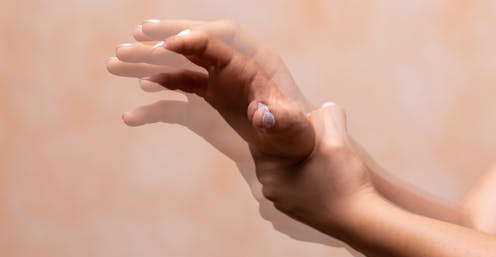
In this gripping new memoir by New South Wales journalist and author Sonya Voumard, a rare neurological condition becomes a way to examine the unpredictability of life.
How to tell the story of an illness without a metaphorical framework to decode it, without medical understanding or widespread cultural recognition? How to tell the story of an ill life without a clear beginning, middle, or end?
Review: Tremor, A Movement Disorder in a Disordered World – Sonya Voumard (Finlay Lloyd)
The memoir documents Voumard’s early life, including her father’s untimely passing in her youth, her decades-long career in journalism and corporate writing, and her embrace of her identity as both queer and disabled.
As Tremor details, Voumard felt her hands begin to shake in her childhood, a tremble she shared with her recently deceased father. Over time, as the tremor grows more potent, and more visible to others, she begins to search for an explanation, an underlying cause, and possibly a treatment.
After a chance encounter with a radiologist neighbour, Voumard is referred to Sydney’s St Vincent’s Hospital. She is diagnosed with dystonia, a movement disorder that also comes with muscle pain, fatigue, issues with balancing and vision problems, and which currently has no cure.
This late-in-life bombshell, while a relief in the sense that it provides a language for what was previously unspeakable, challenges her sense of self: is the tremor an alien and “unwelcome force within [her] body,” a link to her deceased father, or an essential part of Voumard’s identity?
Treating her tremor with regular injections of gabapentin, a drug used to treat epilepsy, as well as Botox injections to freeze the muscles which tremble, works to some degree, but in an attempt to effect long-lasting relief from her tremor Voumard pursues an experimental surgery. Known as a thalamotomy, this surgery directs radio waves to destroy the part of the brain responsible for the tremor in a form of deep brain stimulation.
The book is largely organised around Voumard’s preparation for, and recovery from, this surgery. It weaves this encounter with experimental medicine with reflections on a life lived outside the norm. Her life story, like her choice to opt for novel and experimental treatment for her tremors, is “a leap into the unknown”.

Women’s health and discrimination
In the lineage of other neurological memoirs, such as Siri Hustvedt’s The Shaking Woman and Katerina Bryant’s Hysteria, Voumard tells a story of a medical condition that evades clear boundaries and definitions. Dystonia brings with it a powerful sense of medical uncertainty, alongside the more evident physical symptoms.
Dystonia is more commonly observed in women, but as in many aspects of medicine, the gender bias of this condition has been largely overlooked.
Like many poorly understood medical conditions, it is associated with the spectre of psychosomatic illness, or the idea that the tremor “is all in your head”. This threat often attends women’s health, and delays or obstructs people receiving the treatment and care they need.
Before the pivotal encounter with her neurologist, Voumard describes a lifetime trailed by
the suspicion from (mainly male) practitioners that your symptoms are psychosomatic, that the condition is some sort of failure of womanhood, an unfulfilled yearning, a cloak for something else.
Refuting this suspicion brings her to an intersection between her individual story and disability politics, and to an understanding of how common this discrimination is.
Tremor describes the toll the years of trembling took on Voumard. Her search for a diagnosis is motivated by a desire for knowledge as much as it is for an end to her shaking. What outrages her most is the time it took her to even reach the right part of the medical system:
Why, I often wonder, did none of the many doctors, physios, osteos, chiros and acupuncturists who treated me, observed my body up close, with their years of university training and overseas conferences and keeping up to date with the latest literature, ever consider the possibility that my problem was neurological.
The silo-ing effect of modern medicine, in which specialists attend to their specialisation in the absence of holistic care, for Voumard produces a long history of medical observation without clear answers.
 Voumard today.
Hugh Stewart
Voumard today.
Hugh Stewart
As she asks how life would have been changed by an earlier encounter with a neurologist, she also details the emerging medical understanding of dystonia; linking her first tremors with the emergence of the condition as a medical entity.
Tremor positions Voumard as eternally out of step with medicine – part of the cutting edge and the experimental – and simultaneously part of the long history of medicine ignoring women’s health.
Fear of the unknown
Tremor builds on the creative-critical method Voumard utilised in her book The Media and the Massacre, which blended personal narrative and reporting about the Port Arthur massacre. Tremor uses Voumard’s personal experience, and those of the people she interviews, to think about the role shaking plays in everyday life.
She addresses how poorly understood conditions such as this one can challenge how society perceives of disability, both visible and invisible. Keenly aware of how her tremor is perceived, Voumard spends years trying to hide it in the workplace and from friends.
Thinking about how her tremor was perceived prior to her diagnosis, Voumard asks,
What is it about shaking that’s so disempowering? Is it because fear, rage, cold and fever are among its many negative causes. Shaking can also make you look weak, sick, nervous, addicted, not in control, lacking in confidence.
In this sense, shaking is a powerful index for many of the things our culture devalues or denies. By reclaiming her tremor, Voumard aims to disentangle this physical symptom from its cultural meanings.
Examining her tremor from the outside is no easy feat; Voumard is in many ways the product of a culture that stigmatises difference.
But by divorcing the public perception of her tremor from her own, in a surgical manoeuvre similar to her thalamotomy, Voumard seeks to create an alternative language for it, one which does not imply weakness or negativity.
Shaking implies change, unpredictability, and attention to the body, qualities that characterise our contemporary age as well as Voumard’s experience.
Global unpredictability
 Finlay Lloyd
As she interweaves her life story with broader geopolitical events, from the COVID-19 pandemic and lockdowns to the 2019 bushfires, she considers how much of life is governed by forces beyond our control.
Those geopolitical “tremors”, which shook the foundations of Australia and the world, make the stakes of dystonia clear: not only a private issue affecting a small portion of the population, but a way to re-imagine the unpredictability increasingly shaping our lives.
Voumard’s diagnosis helps puncture the culture of silence surrounding dystonia, and other poorly understood conditions. After telling her friends, she writes, none were surprised or plead ignorance of her tremor, but
some said they knew someone they thought might have it. One said her best friend’s hands shake so badly sometimes that she can’t pick up a cup. The friend won’t talk to her about it.
In memorialising her tremor, even as it has lessened post-surgery, Voumard reminds us stigma thrives in silence. Telling one’s story can be not only a tool for individuals to make sense of an insensible condition, but the best way to capture the full extent of medicalised dismissal and uncertainty. Tremor is an example of how to overcome the fear of the unknown, through bravery, empathy, and reflection.
Authors: Chloe Green, Lecturer in English, Australian National University
Finlay Lloyd
As she interweaves her life story with broader geopolitical events, from the COVID-19 pandemic and lockdowns to the 2019 bushfires, she considers how much of life is governed by forces beyond our control.
Those geopolitical “tremors”, which shook the foundations of Australia and the world, make the stakes of dystonia clear: not only a private issue affecting a small portion of the population, but a way to re-imagine the unpredictability increasingly shaping our lives.
Voumard’s diagnosis helps puncture the culture of silence surrounding dystonia, and other poorly understood conditions. After telling her friends, she writes, none were surprised or plead ignorance of her tremor, but
some said they knew someone they thought might have it. One said her best friend’s hands shake so badly sometimes that she can’t pick up a cup. The friend won’t talk to her about it.
In memorialising her tremor, even as it has lessened post-surgery, Voumard reminds us stigma thrives in silence. Telling one’s story can be not only a tool for individuals to make sense of an insensible condition, but the best way to capture the full extent of medicalised dismissal and uncertainty. Tremor is an example of how to overcome the fear of the unknown, through bravery, empathy, and reflection.
Authors: Chloe Green, Lecturer in English, Australian National University 

















