

Flying this holiday season? Here’s why air travel makes us so cranky – and what to do about it
- Written by: Milad Haghani, Senior Lecturer of Urban Risk & Resilience, UNSW Sydney
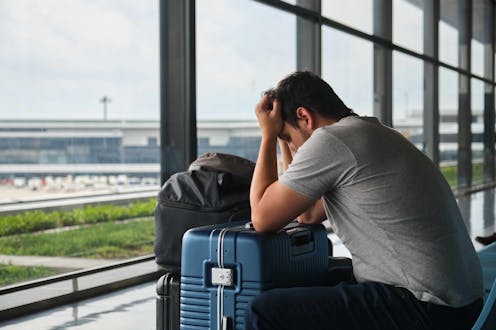
The holidays are coming, airports are packed and emotions are running high. You’ve probably seen it or even been part of it: that tense moment when a passenger snaps at a flight attendant, or a near-meltdown over a seat reclining too far. Why does flying seem to bring out the worst in us?
Airplanes are, quite literally, a pressure cooker for emotions. For many, airports and airplanes are synonymous with anxiety, which often begins well before they step into the terminal.
These environments combine stress, discomfort and a loss of control, often leaving even the calmest travellers feeling on edge.
Planes also make inequalities bleedingly obvious. We’ve all experienced the envy of walking through first-class cabins to reach economy.
It’s easy to see why air rage has become so common. In fact, reported incidents have skyrocketed in recent years, exacerbated by pandemic-related anxieties.
So, let’s have a look at the science behind why we get so cranky when we fly. But more importantly, what we can do about it.
Air rage is getting worse
In recent years, reports of unruly passenger behaviour around the world have surged. Perhaps the most comprehensive indicator is the data compiled by the United States’ Federal Aviation Administration, which show a clear connection to the pandemic effect.
In 2021, the administration recorded 5,973 incidents of unruly passenger behaviour. This is a staggering 492% increase compared to the year before.

To put this in perspective, the four-year average of such incidents for the period 2017–2020 was 901.75 (2017: 544, 2018: 889, 2019: 1,161, 2020: 1,009).
While the numbers have decreased since their peak in 2021, they remain significantly higher than pre-pandemic levels.
In 2022, the administration reported 2,455 incidents, followed by 2,076 in 2023, and 1,954 so far in 2024 (with final numbers for the year still pending).
These incidents in the US alone have led to 402 enforcement actions initiated in 2023, compared to a pre-pandemic high of 83 in a single year. Since 2021, fines totalling more than US$21 million (A$32 million) have been levied as a result of such incidents.
The issue is not limited to the United States (although the US seems to have a higher share of such cases).
The International Air Transport Association reported an increase in unruly passenger incidents globally, with one incident per 568 flights in 2022 – up from one per 835 flights in 2021.
The most common types of incidents include non-compliance, verbally abusive behaviour and intoxication. Notably, while non-compliance incidents initially fell after mask mandates were removed on most flights, the frequency began to rise again in 2022, ending the year 37% higher than in 2021.
Examples of non-compliance include:
smoking cigarettes, e-cigarettes, or vapes in the cabin or lavatories
failing to fasten seatbelts when instructed
exceeding carry-on baggage allowances or failing to store when required
consuming personal alcohol on board.
What’s behind the air rage phenomenon
Scholarly research has highlighted that the phenomenon arises from an interplay of stressors unique to aviation.
Environmental stressors
Research consistently identifies the physical environment of airplanes as a significant contributor to passenger frustration and antisocial behaviour.
Factors such as cramped seating, limited personal space and high-density cabin configurations exacerbate discomfort and feelings of confinement.
Psychological factors such as anxiety, claustrophobia and aviophobia (fear of flying) can also trigger an unusual behaviour that the passenger may not show in other social contexts.
 Fighting for use of the armrests is a common source of annoyance among plane passengers.
Shutterstock
Fighting for use of the armrests is a common source of annoyance among plane passengers.
Shutterstock
In some studies, physical discomfort, such as encroachments into personal space, has been found the leading trigger for anger among passengers.
Emotional triggers such as frustration over delays, long queues at the security check or unmet service expectations, can escalate minor grievances into disruptive outbursts.
Noise and hunger could further compound the situation. It can create a volatile atmosphere even before passengers acted out.
Research has also suggested that low-cost carriers, while not directly responsible for air rage, create environments conducive to disruptive behaviour due to reduced service levels, inadequate facilities and passenger stress from automation and cost-cutting measures.
Social stressors
The role of inequality within the cabin environment is another potent factor.
Research shows that airplanes serve as a microcosm of class-based society, with physical inequality (the presence of first-class cabins) and situational inequality (boarding through first-class sections) increasing the sense of frustration.
Interestingly, situational inequality can even affect first-class passengers, by highlighting their privileges, sometimes fostering a sense of entitlement that may lead to antisocial behaviour.
Alcohol use and nicotine withdrawal
Alcohol is a dominant precipitant of air rage incidents. Some studies have found that more than half of reported air rage cases involved alcohol intoxication, often fuelled by liberal airport alcohol policies and in-flight consumption.
Similarly, nicotine withdrawal was another factor, with nearly 9% of incidents attributed to smokers unable to satisfy their cravings during long flights.
 Maybe think twice before opting for the alcoholic options in-flight.
Shutterstock
Maybe think twice before opting for the alcoholic options in-flight.
Shutterstock
Sociodemographic influences
Empirical data suggest sociodemographic factors play a significant role in air rage incidents.
One study examining 228 air rage cases found nearly 90% of incidents involved male passengers, with younger adults, particularly those aged 30–39, being the most frequently implicated.
Cultural norms and expectations around air travel also influence behaviour. They shape how passengers respond to delays, discomfort, breaches of etiquette or perceived inequities.
What can be done?
In the UK, airlines and airport authorities have implemented measures, such as Edinburgh’s “No Excuse for Abuse” campaign, to address the rise in disruptive behaviour. Such initiatives remind passengers to treat staff and fellow travellers with respect, while emphasising a zero-tolerance approach to aggression.
But tackling air rage requires more than just slogans.
De-escalation techniques and early recognition of disruptive behaviour can help diffuse situations before they escalate. Studies suggest experienced and well-trained crew members are better equipped to handle such incidents.
 Nothing like the scuffle to get into overhead lockers to flare already high tensions.
Shutterstock
Nothing like the scuffle to get into overhead lockers to flare already high tensions.
Shutterstock
There are also simple things you can do to improve the flying experience.
You may choose to avoid overindulging in alcohol before or during the flight, even if it feels like a way to relax. Staying hydrated and opting for non-alcoholic beverages can help keep emotions in check.
Be mindful of others when reclining your seat, storing baggage, or navigating the aisle. A little courtesy can go a long way.
Reduce stress by arriving early, ensuring your documents are in order. Avoid rushing through the airport, which is often a recipe for heightened anxiety and irritability.
Travel can be stressful for everyone. Showing empathy and being polite, even in frustrating situations, can help de-escalate potential conflicts.
Ultimately, it may be helpful to remember that air travel isn’t always glamorous. Acknowledge that delays, discomfort and inconveniences are often part of the experience and accepting this reality can help reduce frustration.
Authors: Milad Haghani, Senior Lecturer of Urban Risk & Resilience, UNSW Sydney


















