

Let’s take the boat out! 5 tips on staying safe on the water if you fancy a drink
- Written by: Amy Peden, NHMRC Research Fellow, School of Population Health & co-founder UNSW Beach Safety Research Group, UNSW Sydney
Australia is a nation of boaters, with one of the world’s highest rates of boat ownership. There are about one million registered vessels in Australia and one in ten Australians has a boat licence.
While an estimated 18% of the Australian population go boating each year, 29% of boaters say they are weak swimmers or cannot swim in the ocean. This makes wearing a lifejacket and avoiding alcohol when boating even more important.
While we often hear about the dangers of combining alcohol and swimming, it can also be dangerous to have a few drinks on the water.
If you’re taking the boat out this summer, or going to a Christmas or New Year’s Eve party on a boat, here’s what to know if you plan to drink alcohol.
There are alcohol limits, but not everywhere
Almost all Australian jurisdictions set a blood alcohol concentration limit of 0.05 for a skipper operating a recreational boat (the same as for a car driver on a full licence).
However, the Northern Territory doesn’t have an alcohol limit for recreational skippers. This is concerning given the NT, in particular the Top End, has Australia’s highest drowning rates for all activities and second highest for boating-related drowning.
Nationally, 9% of the 323 drowning deaths last financial year in Australia were due to boating. Men are ten times more likely to drown in boating and watercraft-related incidents than women. Older age groups are typically more at risk, peaking among 65-74 year-olds.
Men and women were just as likely to drown where alcohol was involved in a boating incident. But men had significantly higher blood alcohol concentrations – an average 0.134 or almost three times the upper legal limit.
Along our coast, surfers and jetski riders are among those who died by drowning at our beaches, most commonly after drug and/or alcohol use.
At our rivers, 41% of boating and watercraft-related drowning deaths involved alcohol. In more than half of these deaths, there was a blood alcohol concentration of at least 0.05.

‘Boater’s hypnosis’ is risky
Our survey at rivers shows people think it’s riskier to drink alcohol and drive on the road than it is to drink and operate a boat.
This is despite researchers suggesting there are added challenges on the water, including direct exposure to sun, wind, glare, vibration, noise and wave motion. This can produce a kind of “boater’s hypnosis”, which can reduce reaction times and increase errors in how people change course (change direction on the water).
Boaters who are drunk make ten times more errors when changing course than those who are sober.
How about passengers?
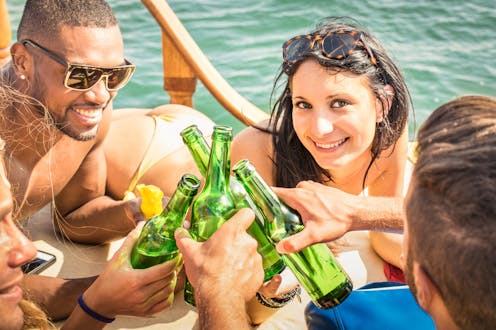
There’s no rule saying passengers need to be sober on board. But alcohol can lead to risk-taking behaviour and is regularly implicated in drowning deaths after falling or jumping from party boats and houseboats.
Drinking two standard drinks – for instance a large glass of wine or a can of craft beer – almost doubles the risk of most types of injuries.
Alcohol can make people overconfident in their capabilities, when objectively they are psychologically and physically impaired and less able to perform any activity.
Not knowing how alcohol can affect how well you swim, and thinking combining alcohol with water activities is normal and “Australian” can also fuel these behaviours.
 Not just skippers: passengers who drink are at risk too.
Shakirov Albert/Shutterstock
Not just skippers: passengers who drink are at risk too.
Shakirov Albert/Shutterstock
Don’t forget your lifejacket
People who drink alcohol while boating are also less likely to wear a lifejacket.
Where alcohol is involved in drownings on our waterways, there is a greater likelihood of intoxication with other drugs. This combination increases the potential for impaired decision making, reaction times and swimming ability, increasing the risk of drowning and injury.
Young people are also susceptible to risk-taking and peer pressure in and around the water, particularly if alcohol is involved.
Why aren’t more people aware of this?
Australia has drowning prevention campaigns about the dangers of alcohol and aquatic activity. But these campaigns aren’t specific to boating and most haven’t been evaluated.
So aside from legislation and enforcement, such as breath-testing skippers, we don’t know what works to create sustained change in people’s behaviour specific to drinking and boating.
 In the US state of Florida, skippers are reminded how to ‘boat responsibly’ by staying sober. Could this work in Australia?
Joni Hanebutt/Shutterstock
In the US state of Florida, skippers are reminded how to ‘boat responsibly’ by staying sober. Could this work in Australia?
Joni Hanebutt/Shutterstock
Tips to stay safe
If you plan to drink while boating, here are our top five tips:
1. Know the limit: in most states and territories skippers must have a blood alcohol concentration of 0.05 or below
2. Skippers beware: skippers are responsible for the safety of all on board, so it’s safer to avoid alcohol altogether while operating a boat
3. Passengers are at risk too: even drinking relatively small amounts of alcohol (for instance, a large glass of wine or can of craft beer) can make people overconfident, lead to risk taking, and doubles the risk of most types of injuries. If drinking heavily, these risks increase
4. Look out for your friends: encourage your friends to avoid drinking until back on shore, and keep an eye on those who are under the influence
5. Watch for children or other vulnerable people: stay sober if you have caring responsibilities, for instance being responsible for children or have elderly family or friends onboard.
Authors: Amy Peden, NHMRC Research Fellow, School of Population Health & co-founder UNSW Beach Safety Research Group, UNSW Sydney


















