

Modern Australian
The Times

Why Vanuatu should brace for even more aftershocks after this week’s deadly quakes: a seismologist explains

  • Written by Dee Ninis, Earthquake Scientist, Monash University
Why Vanuatu should brace for even more aftershocks after this week’s deadly quakes: a seismologist explains

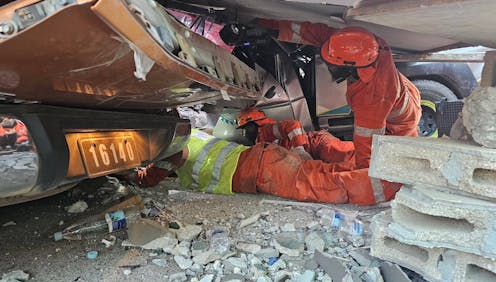
The death toll from Vanuatu’s earthquake disaster continues to rise, with international search and rescue operations underway to help people hit by the initial quake and its aftershocks.

On Tuesday afternoon, a powerful earthquake struck 30 kilometres off the west coast of Efate, the main island of Vanuatu. At a magnitude of 7.2 and a depth of just 50km, the earthquake damaged many buildings and injured dozens of people in Port Vila, the Pacific nation’s capital.

Since then, there have been numerous aftershocks at nearly the same location, including a magnitude 5.5 this morning, further adding to the devastation and injuries.

Based on previous experience, here’s what we might see next.

How long could the aftershocks continue?

At 7.2 magnitude, yesterday’s quake is considered a major earthquake.

The several aftershocks of magnitude 5 in the same area are typical of an aftershock sequence – the series of smaller earthquakes that tend to follow the large one, known as the mainshock.

In fact, for this particular earthquake at a magnitude over 7, we would expect at least a few aftershocks in the range of magnitude 6 as well. In a typical aftershock sequence, there would be ten times as many aftershocks in the magnitude 5 range, and ten times as many again in magnitude 4, and so on.

This pattern can continue for weeks to several months, or even longer, with the magnitude and frequency of earthquakes typically diminishing with time.

Could a bigger earthquake still occur?

There is a very small chance that an earthquake bigger than yesterday’s 7.2 might still occur. In this case, yesterday’s earthquake would have been a “foreshock” – a smaller earthquake preceding a larger one.

However, this is not very common. Only in about 5% of cases will a major earthquake of such magnitude be a foreshock to an ever larger one.

Does the Ring of Fire have anything to do with this?

Vanuatu sits within the Ring of Fire – a belt of tectonic activity that surrounds the Pacific Ocean, thanks to a series of plate boundaries around the Pacific plate.

Its name comes from the volcanoes associated with subduction along the margins. Subduction is when one tectonic plate is pulled beneath another.

The Pacific plate and the Australian plate meet to the immediate west of Vanuatu. The Australian Plate is being subducted – it dives beneath the Pacific plate at a rate of about 80 to 90 millimetres a year, which makes it quite a fast-moving plate boundary.

The Solomon Islands, Fiji and Tonga are also on this plate boundary, as is New Zealand to the south.

In regions prone to earthquakes due to subduction, it’s possible to have earthquakes above magnitude 8. However, there are none above this magnitude in historical records for the region of Vanuatu.

While yesterday’s earthquake will continue to produce aftershocks, these will occur in the vicinity of the mainshock.

Of course, earthquakes elsewhere on the plate boundary are always possible, but these distant events won’t be as a result of yesterday’s earthquake.

People inspect a collapsed building following an earthquake in Port Vila, Vanuatu, December 17 2024. EPA /Michael Thomson Handout

How often do earthquakes hit Vanuatu?

Earthquakes are common in Vanuatu, due to the aforementioned Ring of Fire. Since 1990, there have been 11 earthquakes with a magnitude greater than 7 within 200km of yesterday’s event.

In 2010, a 7.5 magnitude quake struck just 40km from Port Vila at a depth of 35km, generating a small tsunami. However, no deaths or injuries were reported.

The last time an earthquake sequence had a significant death toll in Vanuatu was in November 1999, when a shallow quake of magnitude 7.5 occurred off the coast of the volcanic island Ambrym, triggering a tsunami.

At this particular plate boundary, earthquakes can be as deep as 300km or so. The deeper the earthquake, the less damage it’s going to cause, because it’s further away from the surface and therefore causes weaker shaking.

That’s another reason why yesterday’s earthquake near Port Vila was so damaging – it was reasonably shallow for a plate boundary region, and produced very strong ground shaking.

Authors: Dee Ninis, Earthquake Scientist, Monash University

Read more https://theconversation.com/why-vanuatu-should-brace-for-even-more-aftershocks-after-this-weeks-deadly-quakes-a-seismologist-explains-246231

Celebration of Life vs Traditional Funeral: What's the Difference?

When saying goodbye to someone you love, there is no single way to honour their life. Every family has different traditions, beliefs, and preference...

Building Approval for Roofing Projects: What Homeowners Need to Know

Roofing projects are an important part of maintaining and protecting your home. Whether you're repairing storm damage, replacing an ageing roof, or ...

Chatswood Tutoring And Its Role In Academic Achievement

Academic success often requires more than classroom attendance alone. Students face increasing expectations as they progress through school, particu...

Why Laser Hair Removal Treatments Continue Growing In Popularity

Managing unwanted hair can become time-consuming and frustrating for many people, especially when shaving, waxing, and other temporary methods requi...

Choosing the Right Devices for a Flexible Workplace

For IT leaders managing large fleets, the device layer is where workforce productivity and security policy meet. The shift towards flexible and hybrid...

How Business Advisory Services Help Companies Achieve Sustainable Growth

Every business owner aims to build a profitable and sustainable organisation. While dedication, innovation, and hard work are important, achieving l...

Why Body Contouring Has Become A Popular Cosmetic Treatment

Many people maintain healthy lifestyles through regular exercise and balanced eating habits but still struggle with stubborn areas of fat that are d...

How to Choose the Right POS Hardware for Your Business in Australia

A lot of Australian business owners spend weeks researching POS software but buy hardware almost as an afterthought. That's a mistake. The wrong har...

Why Material Handling Hose Is Critical for Industrial Efficiency

A high-performance material handling hose is an essential component in industries that transport abrasive, dry, or bulk materials on a daily basis...

How to Choose the Right Lawyer in Melbourne for Your Situation

Choosing legal support can feel difficult, especially when the stakes are personal or business-related. The right lawyer in Melbourne should underst...

Hoteliers Look to Clever Value Adds to Increase Revenue

The Australian hospitality industry is still in recovery mode after a notoriously rough patch in recent years. While there has been a post-COVID tra...

Moving to Queensland? Here’s How to Prep Your Car for the Big Move North

There’s no sign of the northern migration slowing down, with thousands of southerners fleeing from chaotic lifestyles and cooler climates for a brig...

Diesel Shortage to Impact Trades and Contractors

Strait of Hormuz blockage affecting all major parts of trades and construction Trades and construction across residential, commercial and industria...

Why Holiday Home Owners Turn to Rental Management Agents

The Allure — and the Reality — of Renting Out Your Property Owning a holiday home is a dream for many Australians. Whether it's a beachside sha...

Why Finding Reliable Doctors In Bundoora Is Important For Long-Term Health

Access to quality healthcare plays an important role in maintaining overall wellbeing and managing health concerns early. Trusted Doctors in Bundoor...

Understanding the Different Types of Car Services: Minor vs Major

When it comes to car maintenance, one of the most important things every vehicle owner should understand is the difference between a minor and a maj...

How Superannuation and TPD Insurance Work Together

Superannuation is an essential part of financial planning in Australia. It is designed to provide individuals with income during retirement, helping...

Tiny Towns funding granted for Mt Hotham and Mt Buller upgrades

Alpine Resorts Victoria (ARV) has welcomed funding support from the Victorian Government’s  Tiny Towns Fund, with both Mt Hotham and Mt Buller se...
















