

Christmas can be challenging for people with hearing loss. Here are 7 ways you can help
- Written by: Katie Ekberg, Senior Lecturer, College of Nursing and Health Sciences, Flinders University
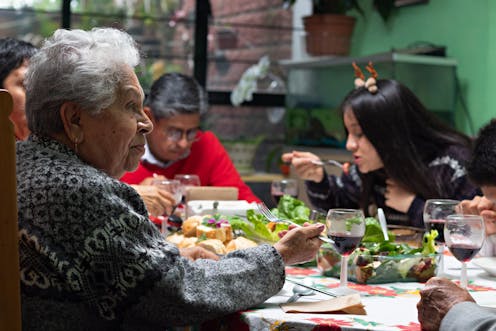
For many people, Christmas can be the most social time of the year. The holiday period is often filled with parties, lunches, dinners and celebrations of all kinds with family, friends and colleagues.
For adults with hearing loss, however, these social gatherings can bring unique challenges. Communicating with others can be difficult, particularly in group conversations. And the more background noise there is (for example, Christmas music or children playing), the harder it is.
For age-related or acquired hearing loss, hearing ability typically starts to decline from age 50 onwards. One in six Australians experience some hearing loss, so it’s possible someone around your Christmas dinner table will be struggling to hear.
Unfortunately, many adults with hearing loss suffer these challenges in silence. Our research shows adults with hearing loss often hide their hearing loss from others, even close family members and friends, because of feeling shame due to stigma.
But there are some things you can do to ensure a loved one with hearing loss is included this Christmas.
Stigma and stereotypes
Stigma is when someone is treated differently by others due to a particular physical or social attribute.
Across a series of studies, we conducted surveys and interviews with adults with hearing loss, their families and hearing care professionals to explore experiences of stigma for adults with hearing loss. Our research also included video recordings of real-life conversations between adults with hearing loss and their families and friends.
The results suggested people often associate hearing loss with negative stereotypes of ageing, disability, reduced intelligence, having a problem or weakness, and difference. For example, one participant with hearing loss told us:
Once they are aware that you can’t really comprehend or hear what they’re saying, they treat you different. And it’s not always positive, it’s quite often negative […] Even people who are familiar with you, my twin brother, he thinks that there’s something wrong with me because I can’t hear him properly.
Old age was the most common stereotype associated with hearing loss. For example, one adult with hearing loss commented:
I guess it’s just a sign of ageing. Like wearing glasses and grey hair.
But as hearing can start declining from middle age, many adults experiencing hearing difficulties do not fit this stereotype.
We see this stereotype appear in popular media as well. For example, in the TV show Bluey, the character Bingo dresses up as a “Can’t-Hear-Anything granny” in a number of episodes.
In our research, people with hearing loss reported feeling embarrassment, shame, frustration, sadness and fatigue from trying to manage their hearing difficulties during everyday conversations.
In the results of a survey currently under peer review, almost two-thirds felt other people laughed about or treated their hearing loss as a joke, often making them feel uncomfortable.
An example of this teasing can be seen in a real-life conversation we recorded with a grandfather with hearing loss and his extended family while having afternoon tea.
After the older man has ongoing trouble hearing his granddaughters, his wife teases him with the question “You got your hearing aids in Grandpa?”, which receives laughter from his son and granddaughters.
While this sort of teasing might seem light-hearted, it can cause someone with hearing loss to feel embarrassed when they have trouble hearing.
A key finding from our interview research was that adults with hearing loss respond to experiences of stigma by not telling others about their hearing loss.
Similarly, in an international survey of 331 adults with hearing loss, the results of which are yet to be published in a peer-reviewed journal, one in four had not told anyone about their hearing loss. Others only told certain people in specific circumstances.
There might, therefore, be family and friends at your Christmas gatherings facing the challenges of hearing loss without anyone knowing.
Supporting loved ones with hearing loss this Christmas
For adults with hearing loss, experiences of stigma can cause them to start to withdraw from social situations, participate less in conversations, and become more socially isolated and lonely.
But a greater awareness about hearing loss and inclusive communication can help tackle the stigma. Here are some simple ways you can be more inclusive of people with hearing loss this festive season:
Think about the location of your event – how noisy is it? When possible, choose restaurants and social settings that are quieter. Outdoor settings will generally be less noisy than indoor ones (apps such as The Ambient Menu can help you choose).
Turn down background noise if you can (for example, TV, radio, music).
Speak face-to-face as much as possible. This allows for lip-reading so that people are not just reliant on their hearing. If you know someone has difficulty hearing, move closer to them and talk clearly and slightly more slowly.
Arrange seating in a way that allows everyone to face each other. Round tables are best.
Give people the opportunity to choose where they are seated around a table or in a restaurant. Adults with hearing loss may position themselves in the middle of a table or next to specific people they need to hear.
If you are at an event with speeches, use a microphone when possible.
If you notice a person not joining in the conversation you could ask them if they can hear OK and, if not, what you can do to help.
Authors: Katie Ekberg, Senior Lecturer, College of Nursing and Health Sciences, Flinders University


















