

Yes, reindeer actually can have red noses – and other fascinating facts about this Christmas icon
- Written by: Julie Old, Associate Professor, Biology, Zoology, Animal Science, Western Sydney University
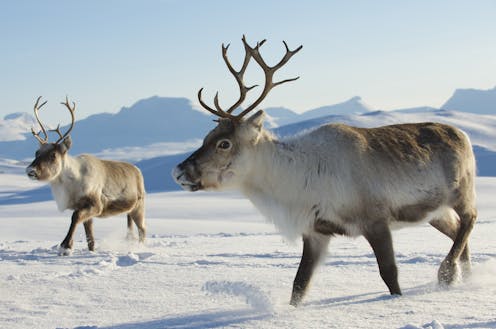
At this time of year, images of reindeer are everywhere. I’ve had a soft spot for reindeer ever since I was a little girl. Doesn’t everyone?
While I work on Australian mammals, especially marsupials such as wombats, I still find reindeer fascinating.
I’ve spent a great deal of time reading up about reindeer. Some of the research may interest you too.
So here’s everything you need to know about this iconic animal, including why they need antlers, why they really can have red noses and how their eyes change colour!

What do reindeer eat?
Reindeer (Rangifer tarandua) are herbivores, which means they eat plants. But because they live in the Arctic, where snow and ice covers the ground for most of the year, they can’t be too fussy.
Their diet mostly consists of lichen, a plant-like organism that grows on rocks and trees. They also eat grass, moss and fungus when they can get it. I’m sure they’d love a carrot or two, but they’re more likely to find only tough “vascular” shrubs and bushes in the Arctic.
Like rabbits and koalas, reindeer also eat droppings – specifically barnacle goose poo. Who knows, maybe eating goose droppings give reindeer special flying powers at Christmas time?
How do they keep warm?
We’ve all heard the Christmas song Rudolph the Red-Nosed Reindeer. Yet you may not realise reindeer really can have red noses!
Blood flow in the nose can increase or decrease to control heat exchange. So when reindeer need to cool down, their nose looks red because blood is pumped closer to the skin. It’s a bit like when fair-skinned people get hot and flushed.
Reindeer can also regulate the temperature of the skin on their legs by a similar mechanism, to conserve energy.
They build up very large fat reserves over the warmer months. Around 25% of these reserves are then used for energy in winter.
Reindeer can also break down their own protein for energy over winter.
Specialised hair acts to minimise heat loss. Reindeer fur is thickest in winter with more dense woollen underfur.
Hollow “guard hairs” stand out from the rest to provide both colour and insulation from the cold.
As reindeer fur is broader than other deer fur, with a larger hollow cavity, it probably also supports buoyancy. Perhaps it helps keep reindeer afloat when they cross lakes and rivers during migration. Maybe it could even make them lighter, just as birds have hollow bones, and enable flight.
But these cold climate specialists may suffer as the world warms. Last year researchers described how female reindeer responded to an extreme heatwave in Finland. The reindeer became less active as their body temperature increased and heart rate decreased, reducing the ability to build up their fat reserves.
Glittering eyes and fancy feet
Reindeer noses are not the only body part that changes colour. Part of the back of their eye shines a gold-turquoise colour in summer, and deep blue in winter.
The colour change corresponds to changes in the spacing of collagen fibres and pressure within the eye itself. It all has to do with making the most of the light at different times of the year.
In summer, reindeer have sponge-like footpads that help grip the soft ground. In winter, however, their footpads are smaller and the hoof rim is exposed, enabling reindeer to cut through snow and ice to find food.
Reindeer toes on the front feet play a braking role – making for easy landings on roofs perhaps – while toes on the back feet are used for pushing.
Antlers and herd dynamics
Reindeer are unique among all deer in that both males and females have antlers. But only females have antlers all year around.
The size of male reindeer (bull) antlers is second only to that of the moose. But relative to body size, reindeer antlers are the largest among living deer.
Bulls use their antlers and body size to win over females. Older males have larger antlers with more spiky projections.
Bull antler buds appear in March or April, become fully developed during summer then shed from August to September. Bulls also grow a mane and their neck thickens by this time.
The older males shed their antlers earlier than younger (or weaker) bulls, with antlers dropping off sometime between November and May.
Unlike bulls, cows need to keep their antlers throughout winter to compete for food and prevent unwanted attention from young bulls.
Young cows develop antlers early to earn a higher rank among the herd, which can be maintained for life.
The clicking sound from reindeer knees is a curious feature. It’s thought to come from the tendon within the knee when it slips over the bone.
The sound is likely to be louder in bigger reindeer with longer tendons, as observed in eland (Taurotragus oryx). So knee clicking can provide an acoustic signal to rivals, allowing combatants to determine if they want to engage in battle or not.
Survival of the species
Reindeer are essential to the health of the Arctic grasslands and forests, and have great cultural significance to the many Indigenous peoples of the regions in which they live.
Yet reindeer are vulnerable to extinction. The global population has declined from about 4.8 million to 2.9 million over a couple of decades.
People are largely to blame. Farming, mining, forestry, hunting and now climate change threaten the survival of the species.
Fortunately, Santa is not the only person to keep reindeer. Many are kept in captivity, ensuring this amazing species’ survival for a while yet.
Authors: Julie Old, Associate Professor, Biology, Zoology, Animal Science, Western Sydney University


















