Why do disinfectants only kill 99.9% of germs? Here’s the science
- Written by Hassan Vally, Associate Professor, Epidemiology, Deakin University
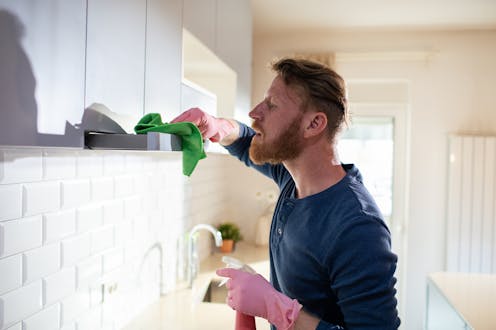
Have you ever wondered why most disinfectants indicate they kill 99.9% or 99.99% of germs, but never promise to wipe out all of them? Perhaps the thought has crossed your mind mid-way through cleaning your kitchen or bathroom.
Surely, in a world where science is able to do all sorts of amazing things, someone would have invented a disinfectant that is 100% effective?
The answer to this conundrum requires understanding a bit of microbiology and a bit of mathematics.
What is a disinfectant?
A disinfectant is a substance used to kill or inactivate bacteria, viruses and other microbes on inanimate objects.
There are literally millions of microbes on surfaces and objects in our domestic environment. While most microbes are not harmful (and some are even good for us) a small proportion can make us sick.
Although disinfection can include physical interventions such as heat treatment or the use of UV light, typically when we think of disinfectants we are referring to the use of chemicals to kill microbes on surfaces or objects.
Chemical disinfectants often contain active ingredients such as alcohols, chlorine compounds and hydrogen peroxide which can target vital components of different microbes to kill them.
The maths of microbial elimination
In the past few years we’ve all become familiar with the concept of exponential growth in the context of the spread of COVID cases.
This is where numbers grow at an ever-accelerating rate, which can lead to an explosion in the size of something very quickly. For example, if a colony of 100 bacteria doubles every hour, in 24 hours’ time the population of bacteria would be more than 1.5 billion.
Conversely, the killing or inactivating of microbes follows a logarithmic decay pattern, which is essentially the opposite of exponential growth. Here, while the number of microbes decreases over time, the rate of death becomes slower as the number of microbes becomes smaller.
For example, if a particular disinfectant kills 90% of bacteria every minute, after one minute, only 10% of the original bacteria will remain. After the next minute, 10% of that remaining 10% (or 1% of the original amount) will remain, and so on.
Because of this logarithmic decay pattern, it’s not possible to ever claim you can kill 100% of any microbial population. You can only ever scientifically say that you are able to reduce the microbial load by a proportion of the initial population. This is why most disinfectants sold for domestic use indicate they kill 99.9% of germs.
Other products such as hand sanitisers and disinfectant wipes, which also often purport to kill 99.9% of germs, follow the same principle.
Real-world implications
As with a lot of science, things get a bit more complicated in the real world than they are in the laboratory. There are a number of other factors to consider when assessing how well a disinfectant is likely to remove microbes from a surface.
One of these factors is the size of the initial microbial population that you’re trying to get rid of. That is, the more contaminated a surface is, the harder the disinfectant needs to work to eliminate the microbes.
If for example you were to start off with only 100 microbes on a surface or object, and you removed 99.9% of these using a disinfectant, you could have a lot of confidence that you have effectively removed all the microbes from that surface or object (called sterilisation).
In contrast, if you have a large initial microbial population of hundreds of millions or billions of microbes contaminating a surface, even reducing the microbial load by 99.9% may still mean there are potentially millions of microbes remaining on the surface.
Time is is a key factor that determines how effectively microbes are killed. So exposing a highly contaminated surface to disinfectant for a longer period is one way to ensure you kill more of the microbial population.
This is why if you look closely at the labels of many common household disinfectants, they will often suggest that to disinfect you should apply the product then wait a specified time before wiping clean. So always consult the label on the product you’re using.
Other factors such as temperature, humidity and the type of surface also influence how well a disinfectant works outside the lab.
Similarly, microbes in the real world may be either more or less sensitive to disinfection than those used for testing in the lab.
Disinfectants are one part infection control
The sensible use of disinfectants plays an important role in our daily lives in reducing our exposure to pathogens (microbes that cause illness). They can therefore reduce our chances of getting sick.
The fact disinfectants can’t be shown to be 100% effective from a scientific perspective in no way detracts from their importance in infection control. But their use should always be complemented by other infection control practices, such as hand washing, to reduce the risk of infection.
Authors: Hassan Vally, Associate Professor, Epidemiology, Deakin University
Read more https://theconversation.com/why-do-disinfectants-only-kill-99-9-of-germs-heres-the-science-241127