

the great antiwar novel whose barbs still strike home, even in times of peace
- Written by: Jamie Q. Roberts, Lecturer in Politics and International Relations, University of Sydney
In our Guide to the Classics series, experts explain key works of literature
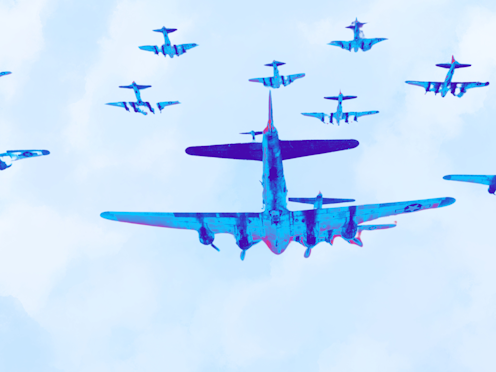
Joseph Heller’s Catch-22 (1961) is a satirical antiwar novel about an American bomber squadron stationed in Italy in the second world war. It exposes the horrors of war, but, even more, it is about the inept and immoral military bureaucracy and the grim relationships between men and women within the war. Its barbs still strike home, even in times of relative peace.
This is because Heller was not just writing against war. “Frankly, I think the whole society is nuts,” he once said – “and the question is: What does a sane man do in an insane society?”
The novel doesn’t exactly have a plot. For the most part, its 42 chapters circle around episodes and characters. It is not until you are some way in that you begin to get a feel for its content and method.
The novel needs a second pass to catch everything you missed the first time, such as the first mention of the central “Snowden” episode, or the extent to which various characters are morally compromised, or the way the protagonist Yossarian replies “pretty good” whenever anyone asks him how he is (he is far from pretty good).

 Joseph Heller in 1998.
Todd Plitt/AAP
Bureaucracy versus humanity
One of the most successful aspects of Catch-22 is the way the inhuman military bureaucracy is juxtaposed with various human moments.
One involves McWatt, a pilot, who is one of those fearless wartime characters like Lieutenant Colonel Kilgore in Apocalypse Now.
Kilgore makes his men surf in the middle of battle, and has the famous line: “I love the smell of napalm in the morning.” McWatt is always buzzing the base and flying dangerously low during bombing runs. After an incident where Yossarian tries to choke McWatt for flying too low, Yossarian asks him: “Aren’t you ever afraid?” McWatt replies: “Maybe I ought to be […] I guess I just don’t have brains enough.”
Later in the novel, McWatt is flying low over the sea, approaching the base. Shockingly, the propeller of his plane kills a young soldier standing on a pontoon. McWatt flies around for a while. Then we read:
He dipped his wings once in salute, decided oh well, what the hell, and flew into a mountain.
McWatt’s sudden demise inclines us to see his erstwhile fearlessness more as a nihilistic death wish: something driven by trauma, not character.
The most intense episode in the novel is the death of the radio-gunner Snowden. After their plane is hit by flak, Yossarian tries but fails to save Snowden’s life.
The most comprehensive retelling of the episode occurs in the climactic second-last chapter, which gives a detailed account of Yossarian competently and tenderly treating Snowden’s leg wound. It seems as if Snowden will be saved, though incongruously he keeps saying “I’m cold”. The crushing moment comes when Yossarian realises he has missed that a piece of shrapnel has penetrated Snowden’s flak vest, spilling out his entrails.
There are the many other smaller human moments, such as when the sensitive and moral chaplain is talking with Yossarian. I love this part:
‘Have you ever […] been in a situation which you felt you had been in before, even though you knew you were experiencing it for the first time?’ Yossarian nodded perfunctorily, and the chaplain’s breath quickened in anticipation as he made ready to join his will power with Yossarian’s in a prodigious effort to rip away at last the voluminous black folds shrouding the eternal mysteries of existence.
The chaplain, who is the object of the first line of the novel – “It was love at first sight” (this is from Yossarian’s perspective) – is also with Yossarian at the end, and shares in his defiance.
A man’s world
Then there is the sex. Numerous bleak sexual relationships between men and women occur in Rome – often in brothels – but also on the military base, for example between Yossarian and Nurse Duckett.
At best, the women in Catch-22 are opportunistic. Nurse Duckett breaks off her relationship with Yossarian because she prefers the financial stability of a doctor. Doc Daneeka’s wife seems a little too ready to move on after he is wrongly reported dead and she receives a substantial payout.
But much of the time the women – often prostitutes – seem numb about what is happening to them. We read descriptions like this one, when a prostitute is rejected by several men:
She seemed more fatigued than disappointed. Now she sat resting in vacuous indolence, watching the card game with dull curiosity as she gathered her recalcitrant energies for the tedious chore of donning the rest of her clothing and going back to work.
I said that as I approached the end of the novel I was racing through the pages, searching for anything redeeming. It is easy to identify with everyman Yossarian. He has been traumatised by the war. He speaks plainly when few do. He shows great humanity, particularly when he tries to save Snowden. Ultimately, he refuses to lie, even though doing so will give him a way out of the war.
Yet he, like the other soldiers, is a user and abuser of women.
Towards the end, after Nurse Duckett has broken it off with him, Yossarian travels to Rome, desperately seeking women he has known before.
He has sex with two prostitutes. On one savage page we read, among other horrors: “He banged a thin streetwalker with a wet cough […] but that was no fun at all.” And directly after:
He woke up disappointed and banged a sassy, short, chubby girl he found in the apartment […] but that was only a little better, and he chased her away when he’d finished.
We can say that Yossarian’s treatment of women is a symptom of the war. But my sense is that the novel is also making the deeper point that in our insane society men’s treatment of women doesn’t figure in our assessment of their character. Yossarian himself, in the climactic chapter The Eternal City, reflects: “It was a man’s world.”
To strengthen my point: at the time of writing, the Wikipedia entry for Catch-22, which is strong in most respects, says nothing about the relationships between men and women in the novel.
Joseph Heller in 1998.
Todd Plitt/AAP
Bureaucracy versus humanity
One of the most successful aspects of Catch-22 is the way the inhuman military bureaucracy is juxtaposed with various human moments.
One involves McWatt, a pilot, who is one of those fearless wartime characters like Lieutenant Colonel Kilgore in Apocalypse Now.
Kilgore makes his men surf in the middle of battle, and has the famous line: “I love the smell of napalm in the morning.” McWatt is always buzzing the base and flying dangerously low during bombing runs. After an incident where Yossarian tries to choke McWatt for flying too low, Yossarian asks him: “Aren’t you ever afraid?” McWatt replies: “Maybe I ought to be […] I guess I just don’t have brains enough.”
Later in the novel, McWatt is flying low over the sea, approaching the base. Shockingly, the propeller of his plane kills a young soldier standing on a pontoon. McWatt flies around for a while. Then we read:
He dipped his wings once in salute, decided oh well, what the hell, and flew into a mountain.
McWatt’s sudden demise inclines us to see his erstwhile fearlessness more as a nihilistic death wish: something driven by trauma, not character.
The most intense episode in the novel is the death of the radio-gunner Snowden. After their plane is hit by flak, Yossarian tries but fails to save Snowden’s life.
The most comprehensive retelling of the episode occurs in the climactic second-last chapter, which gives a detailed account of Yossarian competently and tenderly treating Snowden’s leg wound. It seems as if Snowden will be saved, though incongruously he keeps saying “I’m cold”. The crushing moment comes when Yossarian realises he has missed that a piece of shrapnel has penetrated Snowden’s flak vest, spilling out his entrails.
There are the many other smaller human moments, such as when the sensitive and moral chaplain is talking with Yossarian. I love this part:
‘Have you ever […] been in a situation which you felt you had been in before, even though you knew you were experiencing it for the first time?’ Yossarian nodded perfunctorily, and the chaplain’s breath quickened in anticipation as he made ready to join his will power with Yossarian’s in a prodigious effort to rip away at last the voluminous black folds shrouding the eternal mysteries of existence.
The chaplain, who is the object of the first line of the novel – “It was love at first sight” (this is from Yossarian’s perspective) – is also with Yossarian at the end, and shares in his defiance.
A man’s world
Then there is the sex. Numerous bleak sexual relationships between men and women occur in Rome – often in brothels – but also on the military base, for example between Yossarian and Nurse Duckett.
At best, the women in Catch-22 are opportunistic. Nurse Duckett breaks off her relationship with Yossarian because she prefers the financial stability of a doctor. Doc Daneeka’s wife seems a little too ready to move on after he is wrongly reported dead and she receives a substantial payout.
But much of the time the women – often prostitutes – seem numb about what is happening to them. We read descriptions like this one, when a prostitute is rejected by several men:
She seemed more fatigued than disappointed. Now she sat resting in vacuous indolence, watching the card game with dull curiosity as she gathered her recalcitrant energies for the tedious chore of donning the rest of her clothing and going back to work.
I said that as I approached the end of the novel I was racing through the pages, searching for anything redeeming. It is easy to identify with everyman Yossarian. He has been traumatised by the war. He speaks plainly when few do. He shows great humanity, particularly when he tries to save Snowden. Ultimately, he refuses to lie, even though doing so will give him a way out of the war.
Yet he, like the other soldiers, is a user and abuser of women.
Towards the end, after Nurse Duckett has broken it off with him, Yossarian travels to Rome, desperately seeking women he has known before.
He has sex with two prostitutes. On one savage page we read, among other horrors: “He banged a thin streetwalker with a wet cough […] but that was no fun at all.” And directly after:
He woke up disappointed and banged a sassy, short, chubby girl he found in the apartment […] but that was only a little better, and he chased her away when he’d finished.
We can say that Yossarian’s treatment of women is a symptom of the war. But my sense is that the novel is also making the deeper point that in our insane society men’s treatment of women doesn’t figure in our assessment of their character. Yossarian himself, in the climactic chapter The Eternal City, reflects: “It was a man’s world.”
To strengthen my point: at the time of writing, the Wikipedia entry for Catch-22, which is strong in most respects, says nothing about the relationships between men and women in the novel.
 Alan Arkin as Yossarian in the 1970 film adaptation of Catch-22.
Ralf Liebhold/Shutterstock
Catch-22 also drives home a more unspeakable point. Yossarian reflects on why a particular prostitute likes a particular officer. He says the officer, “treats her like dirt” and reflects: “Anyone can get a girl that way.” As Annie Lennox sings: “Some of them want to abuse you, some of them want to be abused.” Nice guys finish last.
Yet there is a glimmer of redemption. At the end of the novel, Yossarian is committed to rescuing a young girl: the sister of “Nately’s whore”, a prostitute his naive friend Nately is in love with.
Significantly, after she is told of Nately’s death on a mission, Nately’s whore blames Yossarian and spends the remainder of the novel trying to kill him. The last lines of the novel are
Nately’s whore was hiding just outside the door. The knife came down, missing him by inches, and he took off.
Her wordless and implacable rage feels like the return of the repressed for all the women in the novel. It is a fury that cannot be articulated, because the truth is too dark – but it can nonetheless be embodied.
The phrase “catch-22” has entered common usage to describe a situation where someone is trapped by contradictory rules. Many subsequent movies and shows are thematically and tonally similar to Heller’s novel – for example, Stanley Kubrick’s satirical Dr Strangelove or: How I Learned to Stop Worrying and Love the Bomb (1964).
And while movies like Apocalypse Now, Platoon (1986) and Full Metal Jacket (1987) are not humorous, we can see in them similar critiques of the violence of war, the treatment of women, and the wartime bureaucracy that makes it all possible. As Captain Willard says in Apocalypse Now: “The bullshit piled up so fast in Vietnam, you needed wings to stay above it.”
The bullshit depicted in Catch-22 is legion. As it is, alas, in our own institutions and organisations today.
Authors: Jamie Q. Roberts, Lecturer in Politics and International Relations, University of Sydney
Alan Arkin as Yossarian in the 1970 film adaptation of Catch-22.
Ralf Liebhold/Shutterstock
Catch-22 also drives home a more unspeakable point. Yossarian reflects on why a particular prostitute likes a particular officer. He says the officer, “treats her like dirt” and reflects: “Anyone can get a girl that way.” As Annie Lennox sings: “Some of them want to abuse you, some of them want to be abused.” Nice guys finish last.
Yet there is a glimmer of redemption. At the end of the novel, Yossarian is committed to rescuing a young girl: the sister of “Nately’s whore”, a prostitute his naive friend Nately is in love with.
Significantly, after she is told of Nately’s death on a mission, Nately’s whore blames Yossarian and spends the remainder of the novel trying to kill him. The last lines of the novel are
Nately’s whore was hiding just outside the door. The knife came down, missing him by inches, and he took off.
Her wordless and implacable rage feels like the return of the repressed for all the women in the novel. It is a fury that cannot be articulated, because the truth is too dark – but it can nonetheless be embodied.
The phrase “catch-22” has entered common usage to describe a situation where someone is trapped by contradictory rules. Many subsequent movies and shows are thematically and tonally similar to Heller’s novel – for example, Stanley Kubrick’s satirical Dr Strangelove or: How I Learned to Stop Worrying and Love the Bomb (1964).
And while movies like Apocalypse Now, Platoon (1986) and Full Metal Jacket (1987) are not humorous, we can see in them similar critiques of the violence of war, the treatment of women, and the wartime bureaucracy that makes it all possible. As Captain Willard says in Apocalypse Now: “The bullshit piled up so fast in Vietnam, you needed wings to stay above it.”
The bullshit depicted in Catch-22 is legion. As it is, alas, in our own institutions and organisations today.
Authors: Jamie Q. Roberts, Lecturer in Politics and International Relations, University of Sydney 
















