

Why is one half of Mars so different to the other? ‘Marsquakes’ may have just revealed the answer
- Written by: Hrvoje Tkalčić, Professor, Head of Geophysics, Director of Warramunga Array, Australian National University
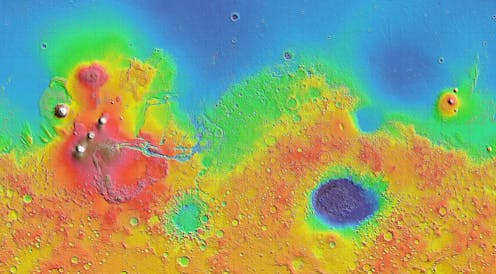
Mars is home to perhaps the greatest mystery of the Solar System: the so-called Martian dichotomy, which has baffled scientists since it was discovered in the 1970s.
The southern highlands of Mars (which cover about two-thirds of the planet’s surface) rise as much as five or six kilometres higher than the northern lowlands. Nowhere else in the Solar System do we see such a large, sharp contrast at this scale.
What caused this dramatic difference? Scientists have been split on whether it resulted from external factors – such as a collision with a huge, moon-sized asteroid – or internal ones, such as the flow of heat through the planet’s molten interior.
In new research published in Geophysical Research Letters, we analysed marsquakes detected by NASA’s Insight lander, located near the border separating the two sides of the dichotomy. Studying how the marsquake vibrations travel revealed evidence that the origin of the Martian dichotomy lies deep inside the red planet.
The Martian dichotomy
Altitude isn’t the only difference between the two sides of the Martian dichotomy.
The southern highlands are pocked with craters and streaked with frozen flows of volcanic lava. In contrast, the surface of the northern lowlands is smooth and flat, almost free of visible scars and other significant features.
From geophysical and astronomical measurements, we also know the crust of Mars is significantly thicker beneath the southern highlands. What’s more, the southern rocks are magnetised (suggesting they date to an ancient era when Mars had a global magnetic field), while those of the northern lowlands are not.
The Martian dichotomy was discovered in the 1970s, when images from the Viking probes showed a difference in height and in density of impact craters.

The surface density of craters (the number of craters per unit area) can be used to calculate the age of surface rocks – the older the surface, the more craters. So the southern highlands appear to be older than the northern lowlands.
Scientists also believe there was once a vast ocean of liquid water on Mars, likely in the same region as the northern lowlands.
There is a lot of debate about this because the existence or absence of sediments, landforms, and certain minerals that form when the land is covered by an ocean are used as the primary evidence for and against. The existence of liquid water is a prerequisite for life, so it is not difficult to understand the interest of the scientific community and space agencies in this problem.
Outer space or inner forces?
The origin of the Martian dichotomy has been a long-standing puzzle in planetary science. What kind of gradual or violent natural process, phenomenon, cosmic force, or catastrophe in the early phase of Mars (given the age of the rocks on the surface) could offer an answer to this question?
Two main hypotheses have emerged.
First is the so-called endogenic hypothesis. This argues that the difference in heat transfer through the rising of warmer and sinking of cooler material inside the Martian mantle led to a visible dichotomy on its surface.
Second is the exogenic hypothesis, according to which the cause of the dichotomy comes from space. This would mean the catastrophic impact of either a single moon-sized body or several smaller bodies, reshaping the planet’s surface.
Marsquakes
On Earth, we can use data from hundreds and even thousands of seismometers to triangulate the location of an earthquake.
On Mars, we only have data from a single instrument on the Insight lander. To find the location of a marsquake, we have to rely on measuring the difference in arrival time between different kinds of vibrations (called P and S waves).
This lets us calculate the distance to the marsquake. We can also determine the direction to the quake by looking at the movement of particles on the ground.
 The Insight lander carried a seismograph to measure marsquakes and other vibrations.
NASA / JPL-Caltech
The Insight lander carried a seismograph to measure marsquakes and other vibrations.
NASA / JPL-Caltech
Once we had made a system for pinpointing marsquakes from Insight data, we checked it against known events such as meteoroid impacts spotted by satellite cameras. We found our methods reliably pointed to a cluster of marsquakes in the Terra Cimmeria region in the southern highlands.
Next we studied how S waves lost energy as they travelled through the rock of the southern highlands. We also made similar calculations for earlier observed quakes in the Cerberus Fossae region of the northern lowlands.
Comparing these two showed that the waves lost energy more quickly in the southern highlands. The most likely explanation is that the rock beneath the southern highlands is hotter than in the north.
What quakes tell us about the dichotomy
This temperature difference between the two halves of the dichotomy supports the idea that the split was caused by internal forces on Mars, not some external impact.
The full explanation of why is quite complex. To simplify, scientists have made models of how the dichotomy could have formed based on an initial unevenness in the crust of Mars way back in time.
At one point, Mars had moving tectonic plates like Earth does. The movement of these plates and the molten rock beneath them could have created something like the dichotomy – which was then frozen in place when the tectonic plates stopped moving to form what scientists call a “stagnant lid” on the planet’s molten interior.
These events may have then enabled patterns of convection in the molten rock that can explain the dichotomy we see today, with upwelling benath the southern highlands and downwelling beneath the northern lowlands.
Our marsquake evidence for a temperature difference across the dichotomy is consistent with these models.
To conclusively answer the question of what caused the Martian dichotomy, we will need more marsquake data, as well as detailed models of how Mars formed and comparisons with Earth and other planets. However, our study reveals an important new piece of the puzzle.
Authors: Hrvoje Tkalčić, Professor, Head of Geophysics, Director of Warramunga Array, Australian National University

















