

1080 baits are used to kill foxes, cats and dingoes – but other animals can be more likely to eat them
- Written by: Rachel Mason, PhD candidate in Conservation Biology, Deakin University
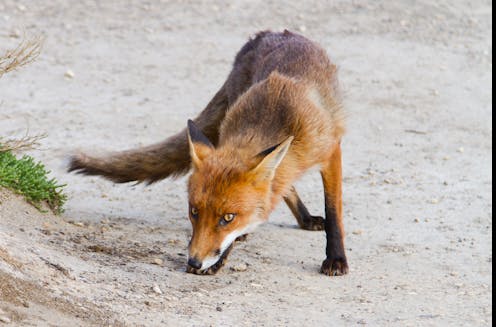
Around the world, humans routinely kill carnivores to protect livestock and game, increase human safety and conserve native wildlife. Unfortunately, killing carnivores often creates new problems including population booms of native and invasive prey species such as rabbits, kangaroos, goats and deer. More herbivores can mean more damage to crops and native vegetation.
In many parts of Australia, dingoes, foxes and – to a lesser degree – feral cats are routinely poisoned with 1080 (sodium fluoroacetate) to protect livestock and native animals. Predator baiting is sometimes done intensively to help threatened wildlife populations recover after disasters such as the 2019–20 megafires.
Despite widespread use, predator baiting with 1080 is controversial for social, cultural, environmental and economic reasons. Recent opponents include farmers whose livestock protection dogs died in agony after eating 1080 baits.
In southeastern states, land managers may use techniques such as burying the poisoned baits to ensure carnivores are most likely to dig up and eat them. But our new research shows these techniques may not be working as intended.

Why do we use 1080 bait?
Invasive predators such as foxes and cats have driven many native species to the edge. Their silent, stealthy hunting is implicated in dozens of extinctions of small animals.
That means poison baits can be an important conservation tool to control numbers of foxes and feral cats and give native species a better chance of survival. But baiting comes with the risk that other animals will eat it.
In Australia, 1080 has long been seen as a kind of “wonder poison” – a chemical deadly to introduced species that many native animals are highly resistant to. The toxin is derived from “poison pea” plants of the Gastrolobium genus, mostly found in regions of Western Australia. Many native animals in these regions have evolved a high tolerance to the poison.
Quokkas have been recorded eating up to 95% of baited meat deployed to control foxes, while goannas are adept at finding and eating poisoned baits. These species are resistant to the poison, and aren’t normally harmed by consuming baits.
But southeastern Australia has no species of poison pea, meaning native animals in this region may be more susceptible to 1080 than elsewhere.
Which animals actually eat the bait?
Our research suggests a huge number of poison baits buried according to best practice methods are potentially being dug up and eaten by other animals.
To find out which animals might be doing this, we buried non-toxic liver baits in dirt mounds, a method currently considered to be best practice. Then we set up remote motion-sensing cameras at our sites in the semi-arid Wyperfeld National Park in northwestern Victoria and recorded what happened for 70 days.
What did we find? Foxes and dingoes accounted for just 12% of the baits dug up or eaten. Of the 146 interactions with baits, 88% were non-target species – primarily, native mice species such as Mitchell’s hopping mouse (Notomys mitchellii) and silky mice (Pseudomys apodemoides).
The single dingo which took the bait dug it up only after 60 days. Foxes took the bait 17 times, but they were typically slow to do so too, averaging 41 days. By contrast, native mice dug up baits after an average of 13 days.
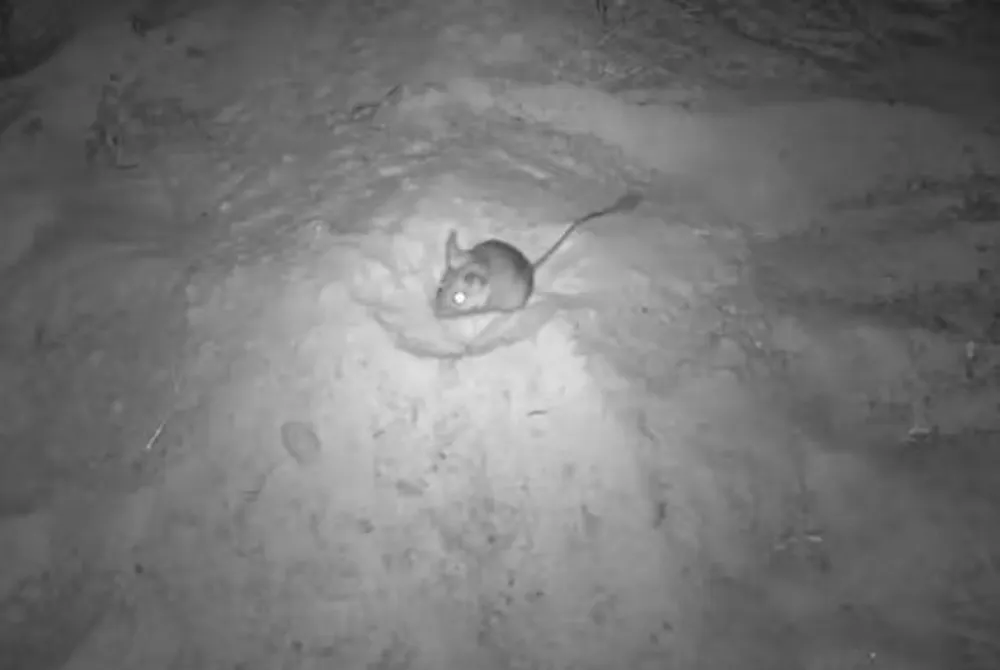 Our footage captured native mice such as this Mitchell’s hopping mouse digging up the mounds and eating many of the baits.
Rachel Mason/Deakin University, CC BY-NC-ND
Our footage captured native mice such as this Mitchell’s hopping mouse digging up the mounds and eating many of the baits.
Rachel Mason/Deakin University, CC BY-NC-ND
We also saw western grey kangaroos dig up and eat baits. Echidnas, rabbits and house mice often unearthed baits and left them uneaten on the surface, making them available to be found and consumed by other animals.
In sites with denser vegetation, we found native mice were more likely to dig up and eat the baits. But they were less likely to do so in open areas.
 Dingoes and foxes (target species, in orange) did not dig up many baits relative to non-target species (in blue).
Rachel Mason/Deakin University, CC BY-NC-ND
Dingoes and foxes (target species, in orange) did not dig up many baits relative to non-target species (in blue).
Rachel Mason/Deakin University, CC BY-NC-ND
What about dingoes?
Baiting for dingoes and “wild dogs” is still done routinely, even though DNA testing shows the canids roaming Australia are mostly pure dingo. Recent research has shown that dingoes are largely avoiding breeding with domestic dogs. The “wild dogs” being poisoned to protect lambs and other livestock are almost all dingoes.
This poses a major problem for baiting programs. While dingoes are susceptible to 1080 poison, they have lived in Australia for thousands of years. Aside from humans, dingoes are the top terrestrial predator everywhere outside Tasmania. To many First Nations people, these canids are culturally important and are often considered kin.
Graziers have long seen dingoes as a threat, given these predators can take sheep, goats, cattle and other livestock. But there are now non-lethal and highly effective predator-smart methods to safeguard livestock, such as predator-proof fencing and guardian animals such as Maremma dogs. These methods reduce livestock losses without the need to kill dingoes.
Keeping dingoes alive can often actually benefit graziers, as dingoes scare off or eat competing herbivores such as kangaroos and feral goats.
 Shepherd dog breeds such as Maremma dogs have been bred to guard sheep from wild predators.
Marco Branchi/Shutterstock
Shepherd dog breeds such as Maremma dogs have been bred to guard sheep from wild predators.
Marco Branchi/Shutterstock
What does this mean for baiting?
Our research shows predator baiting has the potential to harm more native species than previously realised. That means baiting programs must be conducted carefully according to local conditions and the wildlife present.
More targeted methods for controlling predator species are being developed. Feral cats are now being targeted with machines which spray poisonous gel on their fur which cats will groom off, leaving other animals unharmed.
Using 1080 to control invasive predators has undoubtedly helped to save many native species. Even so, we must continue to evaluate the best approaches for predator control and wildlife conservation in Australia.
As the biodiversity crisis deepens and more species march towards extinction, we must find ways of better targeting our methods of control to protect livestock and safeguard native species – including the dingo.
Authors: Rachel Mason, PhD candidate in Conservation Biology, Deakin University

















