

NZ’s climate policies are no longer enough to keep warming at 1.5°C – here’s what needs to happen
- Written by: Robert McLachlan, Professor in Applied Mathematics, Te Kunenga ki Pūrehuroa – Massey University
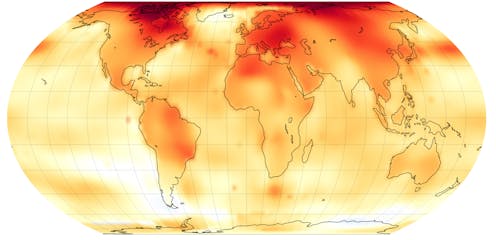
It’s now official. Last year was the warmest year on record globally and the first to exceed 1.5°C above pre-industrial levels. This doesn’t mean it’s too late to rein in further warming, but the ambition required rises with each delay in action.
New Zealand is no exception. Current climate policies are no longer a sufficient contribution to the global effort to keep warming at 1.5°C, according to the Climate Change Commission’s first review of the country’s 2050 climate target.
New Zealand’s current 2050 target has two components. Methane emissions from livestock must be cut by 24% to 47% below 2017 levels and emissions of all other greenhouse gases must reach net zero. But the commission has made three main recommendations to raise ambition:
a net negative target for emissions of long-lived gases (carbon dioxide and nitrous oxide) by removing 20 million tonnes more from the atmosphere than is released each year
a higher target range for biogenic methane emissions to reach at least 35% to 47% below 2017 levels
-
and the inclusion of emissions from international shipping and aviation.
The commission says these changes would bring New Zealand closer to “net zero for all gases”, in line with what is needed to achieve the goals of the Paris Agreement.
The 2050 target review was the last effort for the commission’s outgoing founding chair, Rod Carr, who has become a significant voice for climate action. In his closing words to parliament, he said:
Those who continue to promote the combustion of fossil fuels in the open air without permanent carbon capture and storage are, in my view, committing a crime against humanity.
New Zealand lags behind other countries
The 2050 target is a critical component of New Zealand’s climate response. Under the 2019 Climate Change Response (Zero Carbon) Amendment Act, the commission is charged with reviewing the 2050 target every five years.
The threshold for recommending a change is high. The commission must consider nine key areas and find “significant” developments that justify recommending a different target.
It found three significant changes occurred since the current target was set in 2019.
1. Global action is ahead of New Zealand
While other countries’ current policies, pledges or targets are not sufficient to keep temperature rise at 1.5°C, many countries now have more ambitious targets than New Zealand.
Australia, Japan, US, Canada, EU and Ireland all adopted full net-zero targets in 2021. Finland and Germany have or are considering net negative targets. Among countries with high biogenic methane emissions, several now have full net-zero targets.
2. Scientific understanding of climate change has changed
Climate impacts are appearing sooner and with more severity than the scientific community understood when the target was set in 2019.
3. The burden shifts to future generations
The increased risks and impacts of climate change have implications for inter-generational equity. Delaying action shifts costs and risks to future generations.
The commission’s report also explores New Zealand’s reliance on large-scale commercial exotic afforestation to meet its climate targets. This is one reason why Climate Action Tracker rates New Zealand’s response as highly insufficient and commensurate with a 4°C world.
Carbon in trees is part of the biosphere and will never be stored as permanently as fossil carbon. To take a case in point, Cyclone Gabrielle in 2023 (made worse by climate change) damaged forests, farms and infrastructure, and removed the social licence for forestry in the region.
How the recommended target was set
The commission’s work is tightly prescribed by law. It looked at four possible ways of sharing the global 1.5°C task: equal per capita emissions, national capacity, responsibility for historic warming and the right of all peoples to sustainable development.
New Zealand’s current target does not meet any of these standards, but the commission says the new target would at least meet the “national capacity” criterion and would be feasible and acceptable. However, it would still see New Zealand contributing two to three times its share of global warming this century.
The commission’s assessment is independent of any global warming metrics such as GWP100 (currently the UN standard). Instead, the commission computed New Zealand’s historical and future contribution to temperature rise directly. Both commonly used historical baselines, 1850 and 1990, yield similar results.
New Zealand’s government is currently particularly at odds with the commission’s recommendation on biogenic methane. It appointed a separate advisory panel last year which put forward a target consistent with causing “no additional warming” to the planet from agricultural methane emissions.
But the commission rejects this idea, finding that unless the rest of New Zealand’s target were to be strengthened significantly, this would not be consistent with the Paris Agreement or the country’s own climate law.
International aviation and shipping emissions
In a quirk of climate diplomacy, international aviation and shipping emissions were excluded from the original 2050 target. But as the commission points out, they most definitely contribute to global warming and are covered by the temperature target of the Paris Agreement.
Other countries are moving in these areas and the International Civil Aviation and maritime organisations have net zero 2050 goals in place. Air New Zealand and the global shipping giant Maersk both support including these emissions in the 2050 target, which the commission finds to be achievable under multiple different pathways.
New Zealand’s dependence on shipping and air transport is a challenge. The commission puts the combined emissions from these sectors at 6.7 megatonnes – 20% of total CO₂ emissions and close to all industrial or all passenger car emissions. The aviation industry in particular is planning for growth, which, unless addressed, will blow the 1.5°C carbon budget both for New Zealand and globally.
Drawing on “net zero pathways” prepared by the international aviation and shipping industries, the commission finds that including these sources in New Zealand’s revised 2050 target would be achievable. The sectors would not necessarily have to enter the Emissions Trading Scheme, but the status quo (under which these sectors do not attract GST, fuel tax or a carbon charge) is inequitable with other sources of economic activity.
The author acknowledges the assistance and contribution by Paul Callister.
Authors: Robert McLachlan, Professor in Applied Mathematics, Te Kunenga ki Pūrehuroa – Massey University

















