

high-tech drones may soon be fighting bushfires in Australia
- Written by: Marta Yebra, Professor of Environmental Engineering, Australian National University
Picture this. It’s a summer evening in Australia. A dry lightning storm is about to sweep across remote, tinder-dry bushland. The next day is forecast to be hot and windy. A lightning strike tonight could spark a fire that grows into a catastrophic blaze tomorrow.
Fire authorities deploy drones to chase the storm. The drones detect spots where lightning strikes have ignited the bush – perhaps smouldering tree roots, or smoke pouring from a tree hollow. The drones stay aloft throughout the night, identifying new ignitions and monitoring those that progress to small fires.
Larger drones are dispatched through the night. They drop retardant on the burning bush to slow the flames. The small drones continue to supply data to human fire crews. By dawn, the crews are armed with precise information and ready to act. They suppress the small fires in the early morning, before the winds arrive. What could have turned into a raging megablaze is confined to a few hectares.
This is not science fiction. It is a feasible vision for using drone technology to manage bushfires in Australia, outlined in the federal government’s recent roadmap, which we authored.
So let’s take a look at how drones can help Australia fight bushfires, and the obstacles to be overcome before it becomes reality.
Stopping fires when they’re small
The current fire season marks five years since the Black Summer bushfires devastated southeast Australia in 2019–20. This summer, fires have burned in Victoria’s Grampians region and around Western Australia’s Wedge Island.
And the devastating fires in Los Angeles provide yet another example of how terrifying huge bushfires can be.
The sooner a fire is detected, the easier it is to control and extinguish. Fires that start in remote bush may go unnoticed for hours or days.
Studies show lightning is the primary cause of large bushfires in Australia. Fire outbreaks must be detected and suppressed quickly, while still small, so they don’t become large and uncontrollable. That’s where drones can be very useful.
What is a fire-fighting drone?
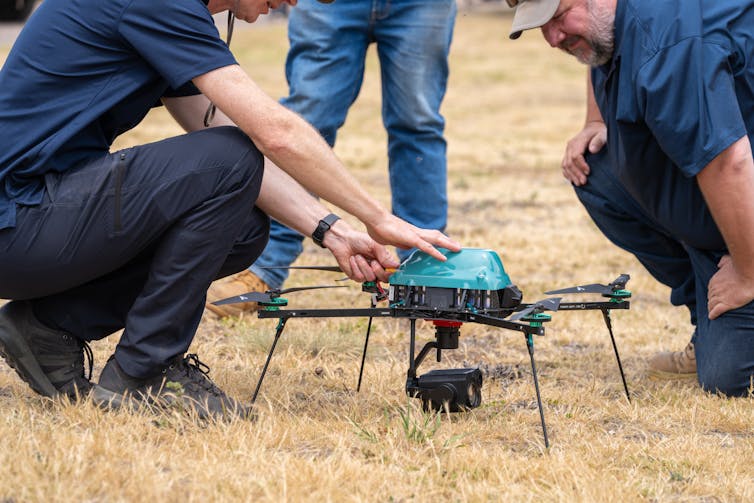
Drones are aerial vehicles that can fly on autopilot under human supervision. Those used to fight fires may carry cameras and thermal detectors, provide communications links, or hold water or retardant to douse flames.
Drone technology extends the capabilities of existing human-crewed aircraft when fighting fires.
For example, technology allowing human crews to fight fires at night is still in its infancy. Humans cannot work for days without rest, and may get bored looking for signs of fire over the same ground time and again.
Drones do not have these limitations. They operate by satellite navigation and function well at night or when visibility is limited. Drones can easily fly at night, and all night, then fly the next day, too.
The below footage shows the BRCoE Scout Drone detecting a small spot fire from more than 800 metres away. The fire was lit by firefighters to simulate a lighting strike ignition. In the infrared camera view (lower left), the small fire stands out clearly against the cooler temperature of the bush.
Multiple drones can be coordinated to cover a large area or stay close to an ignition. They can deliver fire retardants in remote locations, and with remarkable accuracy.
And crucially, losing a drone to bad weather or mechanical failure does not compare to the tragedy of losing an aircraft crewed with firefighters.
Fire agencies are already trialling and using drone technology. For example, Australian Federal Police and the Australian Capital Territory Rural Fire Service used drones to spot fires during the Black Summer fires, after smoke and poor visibility grounded crewed aircraft.
The New South Wales Rural Fire Service last year conducted a trial using drones to monitor grass and bushfires in the state’s west. And Noosa Council in Queensland is investigating if drones can help survey an area after a bushfire to provide data on the extent of damage.
A few things to consider
Despite the obvious advantages, using drones to battle fires is challenging.
For example, many systems cannot operate in the high winds and intense heat found near fire zones.
Smaller drones, although portable, lack endurance and cannot carry heavy loads such as high-end thermal sensors and cameras. And work is needed to improve reliability, such as making drones waterproof and ensuring cables and connectors can’t unplug during flight.
Drones produce a vast stream of data such as video, thermal images and information about temperature and wind speed. This data must be processed quickly in a fire emergency. Doing this requires reliable communication links and powerful computers.
Firefighting drones require human workers to support their operation, including remote pilots, service crews, and workers on landing fields. This incurs labour costs – albeit far lower than using human-crewed aircraft.
Expanding drone technology will require investment in infrastructure such as operation centres, landing facilities and maintenance hubs. But this infrastructure can be shared with other sectors using drones, such as land management and surveying.
In a warmer world, innovation is vital
Our roadmap outlines essential steps to ensure drone technology fulfils its potential. They include:
streamlining regulatory approvals to lower the bar for companies to operate commercial drones remotely
adequate infrastructure investment
fostering collaboration between the first responders, such as rural fire services, and technology companies developing drones.
Drones are not the only technology promising to revolutionise efforts to fight bushfires. Others include satellite technology monitoring vegetation flammability, and using artificial intelligence to detect fire outbreaks.
As fire seasons grow longer and more intense, innovation is not just an opportunity – it’s a necessity. Added to Australia’s existing resources, drone technologies have the potential to help safeguards lives, communities and ecosystems.
Authors: Marta Yebra, Professor of Environmental Engineering, Australian National University

















