

The last time it was legal, exports of sea sand destroyed dozens of Indonesian islands. Now, the ban is being lifted
- Written by: Bioantika, PhD Candidate, Global Centre for Mineral Security, Sustainable Minerals Institute, The University of Queensland
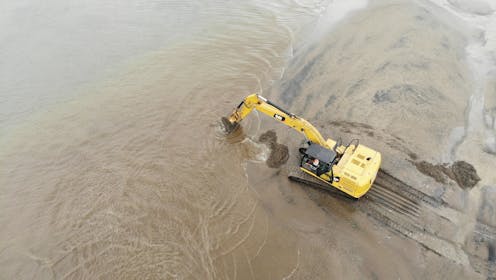
Over 20 years ago, then Indonesian president Megawati Soekarnoputri banned the export of sea sand from her archipelago nation.
The ban was in response to the widespread environmental and economic damage it was causing. Unchecked sea sand exports destroyed 26 sand islands in Riau Province in Sumatra. In western Java’s Banten Province, sand mining eroded the shoreline and destroyed coral reefs. Even after the ban, illegal sand mining continued but at a lesser rate.
Where did the sand go? By and large, Singapore. As Indonesian islands shrank, its tiny but rich neighbour grew. Sea sand from Indonesia and other nations has been used to expand Singapore’s land area by 24%.
Before the trade was banned in 2002, more than 50 million tonnes of sand a year were shipped to Singapore. With Indonesian sand restricted, Singapore imported sand from Malaysia instead, until that nation, too, banned it in 2019.
But now sea sand mining is set to return to Indonesia. In 2023, then-president Joko Widodo lifted the ban. Last year, the government listed seven areas around Indonesia where sand mining could resume. Up to 17 billion cubic metres of sand would be legally permitted to be extracted.
This is bad news for the environment – and for fishers who will see their catches fall. The good news is there are emerging alternatives, such as sand from a clean by-product or co-product of metal-ore mining.

Why has the ban been lifted?
In defending the move, Widodo claimed renewed extraction would only be legal for sea-floor sediment, not sand, and removed to benefit ship movement.
Mining expert Andang Bachtiar has pointed out the seven areas listed for extraction are not known for muddy sediment. Rather, some are relics of ancient rivers, full of sand ideal for coastal reclamation. As he told the Indonesia Business Post:
Some 20,000 to 10,000 years ago, ancient rivers ran across the Sunda Shelf, forming the sand that we see today. This old sand is better suited for coastal reclamation than the mud, clay, or silt that rivers currently carry […] The mining of prehistoric sand in shallow water has nothing to do with the silting of rivers today
Criticism of the government’s plans has come from environmental organisations and coastal communities worried about damage to fisheries.
What will the damage be?
Extracting sea sand is done with dredging ships, which grab or suck up the sand from the bottom and store it. It’s a destructive process, removing habitat for fish, invertebrates and plant life.
It also creates clouds of sediment, which can settle on nearby coral reefs or make the water murky.
An estimated 2.7 million Indonesians fish for a living and the nation of over 17,000 islands is one of the most reliant on fish in the world. But dredging for sea sand can trash fisheries.

During the decades when sea sand mining was legal, dozens of islands in Riau Province disappeared due to sand extraction. Removing sand changes waves and currents, meaning islands can be eaten away.
While sand mining is lucrative, the profits pale in comparison to the indirect costs. Analysis by Indonesian thinktank CELIOS estimates restarting exports will be a net loss to the domestic economy, with gains for business and government more than offset by losses to fishery catches and jobs.
While we don’t know where Indonesian sea sand would be sold, we do know Singapore’s demand for sand is ongoing. By 2030, the goverment’s goal is to be 30% larger than it was at independence. Over the last 20 years, Singapore has imported more than half a billion tonnes of sand.
Globally, the world now uses 50 billion tonnes of sand, gravel, and crushed stone a year.
 Millions of tonnes of sea sand have been used to make more land in Singapore.
NataliaCatalina.com/Shutterstock
Millions of tonnes of sea sand have been used to make more land in Singapore.
NataliaCatalina.com/Shutterstock
There are better alternatives
Sand is the second most-used commodity in the world, after water. According to a 2022 study, the world could run out of construction-grade sand by 2050. This is why the United Nations now considers sand extraction a crisis.
The world will need alternatives. These can include crushed rock, recycled aggregates, recycled materials, and byproducts of industrial and mining processes. Our research team has explored one option in depth: OreSand, a type of manufactured sand resulting from the processing of mineral ores.
This option is already being used to a limited extent. In 2023, for instance, Brazilian iron mining giant Vale produced a million tonnes of OreSand with plans to expand further.
 Sand can be produced from mining waste. Pictured is a pile of ore sand manufactured by iron ore company Vale in Brazil.
Author provided, CC BY-NC-ND
Sand can be produced from mining waste. Pictured is a pile of ore sand manufactured by iron ore company Vale in Brazil.
Author provided, CC BY-NC-ND
Indonesia could produce sand in the same way, given its large mining sector in metals such as nickel and copper. Adding a process to extract sand would conserve land and reducing the need for dedicated tailings dams or dumps.
If Indonesia continues to green light sea sand extraction, it will soon see the damage done – not only to the environment, but to the fishers who will see their livelihood upended.
Authors: Bioantika, PhD Candidate, Global Centre for Mineral Security, Sustainable Minerals Institute, The University of Queensland

















