

How we’re recovering priceless audio and lost languages from old decaying tapes
- Written by: Nick Thieberger, Associate Professor in Linguistics and a Chief Investigator in the Centre of Excellence for the Dynamics of Language, The University of Melbourne
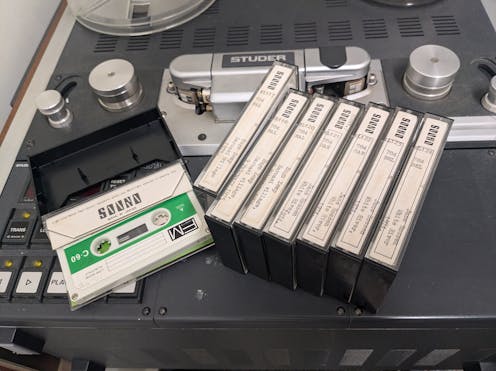
Remember cassettes? If you’re old enough, you might remember dropping one into a player, only to have it screech at you when you pressed “play”. We’ve fixed that problem. But why would we bother?
Before the iPod came along, people recorded their favourite tunes straight from the radio. Some of us made home recordings with our sibling and grandparents – precious childhood snippets.
And a few of us even have recordings from that time we travelled to a village in Vanuatu, some 40 years ago, and heard the locals performing in a language that no longer exists.
In the field of linguistics, such recordings are beyond priceless – yet often out of reach, due to the degradation of old cassettes over time. With a new tool, we are able to repair those tapes, and in doing so can recover the stories, songs and memories they hold.
A digital humanities telescope
Our digital archive, PARADISEC (Pacific and Regional Archive for Digital Sources in Endangered Cultures) contains thousands of hours of audio – mainly from musicological or linguistic fieldwork. This audio represents some 1,360 languages, with a major focus on languages of the Pacific and Papua New Guinea.
The PARADISEC research project was started in 2003 as a collaboration between the universities of Melbourne and Sydney, and the Australian National University.
Like a humanities telescope, PARADISEC allows us to learn more about the language diversity around us, as we explained in a 2016 Conversation article.
Lubing the screech
While many of the tapes we get are in good condition and can be readily played and digitised, others need special care, and the removal of mould and dirt.
We work with colleagues at agencies such as the Solomon Islands National Museum, for whom we recently repaired a set of cassettes that were previously unplayable and just screeched. We’ll be taking those cassettes, now repaired and digitised, back to Honiara in February and expect to pick up more for further treatment.
Screeching happens when a tape is dried out and can’t move through the mechanism easily. The screeching covers the audio signal we want to capture.
In 2019, my colleague Sam King built (with the help of his colleague Doug Smith) a cassette-lubricating machine while working at the Australian Institute of Aboriginal and Torres Strait Islander Studies. This machine – likely the first of its kind in Australia – allowed us to play many previously unplayable tapes.
Last year, Sam built two versions of an updated machine called the LM-3032 Tape Restorator for PARADISEC, improving on the previous model. Between hand building some parts, 3D printing others and writing code for the controllers, it took him more than a year.

Preserving culture and heritage
The LM-3032 Tape Restorator works by applying cyclomethicone (a silicone-based solvent used in cosmetics) to the length of a tape. This leaves behind an extremely thin film of lubrication that allows smoother playback, making digitisation possible. See more details here.
Tests have shown this process has no negative long-term effects on the tape. In fact, tapes treated with this method five years ago still play without issues.
This technological wizardry allows us to salvage precious analogue recordings before it’s too late. For many languages, these may be the only known recordings – stored on a single cassette, in a single location, and virtually inaccessible. Some of the primary research records digitised by PARADISEC have survived long periods of neglect in offices, garages and attics.
The audio below is from a tape that was kept at Fitzroy Crossing in the Kimberley for 40 years. It features beautiful singing in the local Walmajarri language, with guitar accompaniment. The first seven seconds are from the untreated tape, while the rest is from the treated version.
Our experience has shown community members truly value finding records in their own languages, and we’re committed to making this process easier for them.
Here’s one testimonial from E’ava Geita, Papua New Guinea’s current acting Solicitor General. In 2015, Geita was overjoyed to hear digitised records capturing PNG’s Koita language:
If only you witnessed and captured the reaction in me going through the recordings at home! It is quite an amazing experience! From feeling of awe to emotion to deep excitement! The feeling of knowing that your language has been documented or recorded in a structured way, kept safely somewhere in the world, hearing it spoken 50–60 years ago and by some people you haven’t seen but whose names you only hear in history is quite incredible. It is most heartwarming to know that it is possible to sustain the life of my language. Thank you once again for the opportunity to listen to the records.
Acknowlegement: I’d like to thank Sam King for the technical information provided in this article.
Authors: Nick Thieberger, Associate Professor in Linguistics and a Chief Investigator in the Centre of Excellence for the Dynamics of Language, The University of Melbourne


















