

Supersonic jets are making a comeback – but despite the hype, don’t expect to book yet
- Written by: Chris James, UQ Amplify Senior Lecturer, Centre for Hypersonics, School of Mechanical and Mining Engineering, The University of Queensland
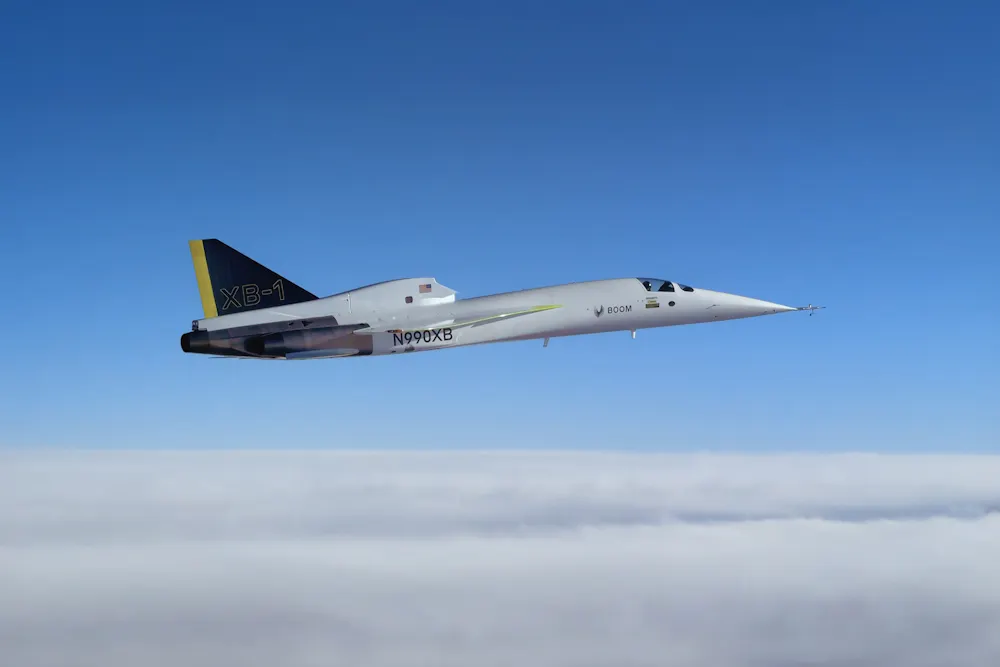
Late last week, American company Boom Supersonic flew faster than the speed of sound with its XB-1 supersonic demonstrator aircraft. It’s now the first piloted non-military aircraft to break the sound barrier since the Concorde was retired from service in 2003.
It’s the first step in Boom’s ambitious goal to have supersonic airliners carry passengers by 2029.
But what exactly is supersonic travel? There are good reasons why it’s not more common, despite the hype.
What is supersonic flight?
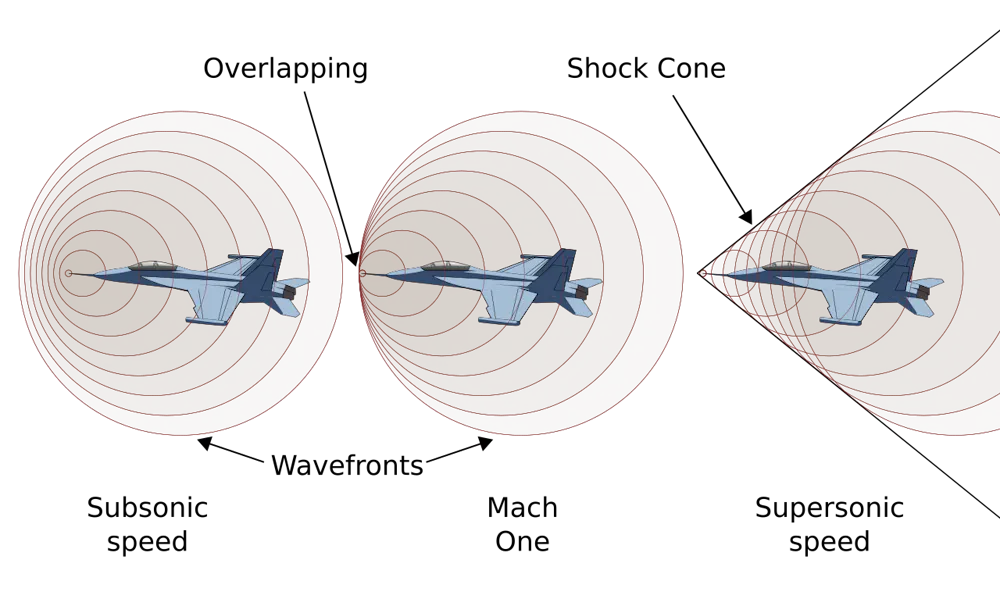
The Mach number is defined as a plane’s speed divided by the speed that sound waves move through the air. To “break the sound barrier” means to fly faster than the speed of sound, with Mach numbers greater than 1.
The Mach number is an important ratio: as a plane flies, it disturbs the air in front of it. These disturbances move at the speed of sound. In supersonic flight these disturbances combine to form shock waves around the vehicle.
When people say you can see a fighter jet before you hear it, they’re referring to supersonic flight: fighter jets can travel at around Mach 2.
The sound from the fighter jet is trapped inside its shock wave; until the shock wave moves to your position on the ground, you won’t hear the plane.
The allure of supersonic travel
For efficiency reasons, most passenger jets cruise slightly slower than the speed of sound, at around Mach 0.8 (this is subsonic flight).
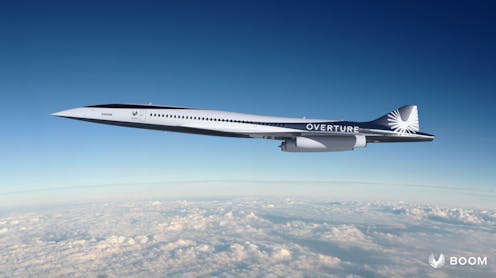
Boom plans to build an airliner called Overture that can fly at Mach 1.7. Flying supersonically can drastically decrease flight times. The company claims a trip from New York to Rome on Overture could take just four hours and 40 minutes, instead of eight hours.
Boom isn’t the only company working on this lofty goal. American firm Spike Aerospace is also developing a supersonic business jet, with the tagline “delivering the world in half the time”.
This is the value proposition of supersonic passenger travel.
In limited ways, it did already exist in the 20th century. However, due to timing, bad luck and the laws of physics, it didn’t continue.
Remember the Concorde?
Designs for supersonic airliners began in the mid-20th century, and by the 1970s we had supersonic passenger flight.
There was the little-known Russian Tupolev-144 and Concorde, a Franco-British supersonic airliner operated by British Airways and Air France from 1976 to 2003.
Concorde had a capacity of up to 128 passengers and cruised at Mach 2. It regularly travelled from London to New York in around three hours. The flights were expensive, mainly shuttling business people and the rich and famous.
 British Airways Concorde in flight.
Wikimedia Commons/Eduard Marmet, CC BY-SA
British Airways Concorde in flight.
Wikimedia Commons/Eduard Marmet, CC BY-SA
Why supersonic passenger flight didn’t take off
Concorde was designed in the 1960s when it seemed like supersonic passenger transport was going to be the next big thing.
Instead, the Boeing 747 entered commercial service in 1970. Cheap, large and efficient airliners like it blew Concorde out of the water.
Designed to cruise efficiently at supersonic speeds, Concorde was extremely fuel inefficient when taking off and accelerating. Concorde’s expensive, “gas guzzling” nature was a complaint levelled against it for most of its lifetime.
A catastrophic 1973 Paris air show crash of the competing Russian airliner, Tupolev Tu-144, also shifted public perception on supersonic flight safety at a time when many airlines were considering whether or not to purchase Concordes.
Only 20 Concordes were manufactured out of the planned 100. It is still disputed today whether Concorde ever made money for the airlines who operated it.
 Illustration of a shock wave propagating from a supersonic aeroplane and hitting the ground to produce a sonic boom.
Cmglee/Wikimedia Commons, CC BY-SA
Illustration of a shock wave propagating from a supersonic aeroplane and hitting the ground to produce a sonic boom.
Cmglee/Wikimedia Commons, CC BY-SA
Noise is a real problem for supersonic flight
Remember the fighter jets? When a plane travels supersonically, its shock waves propagate to the ground, causing loud disturbances called sonic booms. In extreme cases they can shatter windows and damage buildings.
In the early 1970s, sonic boom concerns led the United States government to ban supersonic passenger flight over land in the US. This hurt the Concorde’s potential market, hence its only two regular routes were trans-Atlantic flights principally over the water.
The Concorde was also a very loud plane at take off, since it needed a lot of thrust to leave the ground.
Video footage of the final Concorde takeoff from New York’s JFK airport.The future of supersonic travel
A future for supersonic travel relies on solving some or all of the issues Concorde faced.
NASA and Lockheed Martin’s Quesst project aims to show sonic boom can be dissipated to manageable levels. They plan to fly their X-59 supersonic aircraft over US cities and gauge responses from citizens.
Quesst aims to use the geometry of the X-59, with a long elongated nose, to dissipate sonic booms to a weak “thump”, hopefully allowing supersonic airliners to travel over land in the future.
 NASA’s X-59 quiet supersonic research aircraft.
NASA/Steve Freeman
NASA’s X-59 quiet supersonic research aircraft.
NASA/Steve Freeman
Spike Aerospace’s Spike S-512 Diplomat concept also aims to be a “quiet” supersonic aircraft with a less disruptive sonic boom.
Can Boom surpass Concorde?
Boom Supersonic don’t plan to fly supersonically over land. Their plan is to fly over land at Mach 0.94, which they claim will allow 20% faster overland travel than standard passenger airliners, even subsonically.
They also claim the design of their engines will ensure Overture is no louder than modern subsonic airliners when it takes off.
 Rendering of Boom Supersonic’s Overture supersonic airliner on the runway.
Boom Supersonic
Rendering of Boom Supersonic’s Overture supersonic airliner on the runway.
Boom Supersonic
In terms of gas guzzling, they plan to use up to 100% sustainable aviation fuel to reduce emissions and their carbon footprint.
Concorde was made of aluminium using design tools available in the 1960s. Modern design methods and modern aerospace materials such as titanium and carbon fibre should also allow Overture and similar craft to weigh much less than Concorde, improving efficiency.
While Boom are currently receiving a lot of interest, with orders from many airlines, Concorde did have similar commitment before it become available. Most of it didn’t eventuate.
Additionally, Concorde was the product of an analogue era when the idea of flying to London or New York for the day for an important business meeting seemed like a necessary thing. In a world of remote work and video meetings, is there still a need for a supersonic airliner in the 2020s?
For now, supersonic airliners like Overture are likely to remain in the realm of the rich and famous, like Concorde did. But with modern technological advances, it will be interesting to see whether supersonic passenger travel once again becomes reality – or even goes mainstream. Only time will tell.
Authors: Chris James, UQ Amplify Senior Lecturer, Centre for Hypersonics, School of Mechanical and Mining Engineering, The University of Queensland





















