

3.5 kilometres underwater, scientists found a staggeringly energetic particle from outer space
- Written by: Luke Barnes, Lecturer in Physics, Western Sydney University
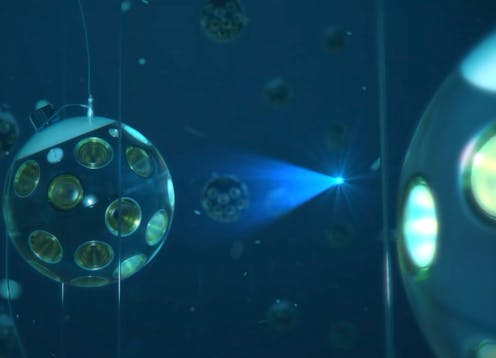
Three and a half kilometres beneath the Mediterranean Sea, around 80km off the coast of Sicily, lies half of a very unusual telescope called KM3NeT.
The enormous device is still under construction, but today the telescope’s scientific team announced they have already detected a particle from outer space with a staggering amount of energy.
In fact, as the team report in Nature, they found the most energetic neutrino anyone has ever seen – and it represents a tremendous leap forward in exploring the uncharted waters of the extreme universe.
To explain why it’s such a remarkable discovery, we need to understand what KM3NeT is, what it’s looking for, and what it saw.
What is KM3NeT?
KM3NeT is a gigantic deep sea telescope being built by an international collaboration of more than 300 scientists and engineers from 21 countries.
At the site off Sicily, and another off the coast of Provence in France, KM3NeT will be made up of more than 6,000 light detectors hanging in the pitch-black depths. When the telescope is complete, it will cover about a cubic kilometre of sea.

Down deep, KM3NeT is shielded from ordinary sources of light, such as the Sun. It is also shielded from other particles like electrons and protons, which are absorbed by the water long before they reach the detectors. So what does it see?
What is KM3NeT looking for?
Of all the particles that physicists have discovered, only the elusive neutrino can reach all the way down to KM3NeT.
The neutrino is an elementary particle with no electric charge and only a very tiny mass. It interacts with matter so weakly that it can pass through kilometres of ocean – and even thousands of kilometres of Earth itself – to reach the detector. That’s why KM3NeT is at the bottom of the sea: to see neutrinos, and only neutrinos.
But won’t the neutrinos pass through the detector, too? Yes, almost all of them.

But very rarely, a neutrino will crash right into a water molecule. When it does, it can pack an enormous punch.
The energy of the neutrino can create many more particles. As these particles blast through the water, they create a bluish glow. That’s what KM3NeT detectors see.
By analysing this bluish light, and by timing each flash, scientists can reconstruct the original energy of the neutrino, and the direction from which it came. (Either that, or they’ve just clocked one of those deep-sea glowing fish travelling at nearly the speed of light.)
The most energetic neutrino ever detected
On February 13 2023, KM3NeT detected a neutrino travelling so fast it had 30 times more energy than any previously detected.
The amount of energy is 220 petaelectronvolts, but that doesn’t mean much to a non-particle physicist. It’s hard to imagine, but let’s try.
The neutrino had 100 trillion times more energy than a typical particle at the centre of the Sun. It’s a trillion times more energy than medical X-rays, and ten billion times more than the most dangerous radioactive particles. Earth’s biggest particle accelerators can’t produce a particle with even one ten thousandth of this energy.
Short story: it’s a lot of energy for one particle.
Making neutrinos in space
Neutrinos interact with matter very weakly, so how could a single neutrino have been given so much energy? What sort of cosmic event could create such a particle?
That’s the exciting part: we don’t know.
We know there are colossal explosions in the universe, such as supernovas: when a star exhausts its fuel and collapses. And there are gamma ray bursts, which are even more energetic explosions of supermassive stars, or collisions of neutron stars. These create extremely energetic neutrinos.
But there are other candidates. Supermassive black holes at the centre of galaxies have millions to billions of times as much mass as the Sun.
As matter is swallowed by these black holes, it is accelerated to extreme speeds, and becomes wrapped around intense magnetic fields. The particles that aren’t swallowed can be shot out at extreme speeds. These “active galactic nuclei” are another way that the universe could create extreme neutrinos.
Third, the neutrinos could be created more locally (cosmically speaking). Explosions and active galactic nuclei also create cosmic rays: extremely energetic protons and electrons.
These could stream across the universe towards us, before colliding with a particle of light along the way. That collision can create an energetic neutrino.
How can we find the source?
Here’s where the Australian connection comes in. KM3NeT tells us this neutrino came from a particular spot in the southern sky.
If it came from an extreme explosion or an active galactic nucleus, we might hope to spot the source with other telescopes. In particular, both supernova remnants and active galactic nuclei can be spotted using radio waves.
Australia has the biggest radio telescopes in the southern hemisphere. The Australian Square Kilometre Array Pathfinder (ASKAP) has mapped a lot of the southern sky, and found many supernova remnants and active galactic nuclei.
My colleagues and I at Western Sydney University are using ASKAP to follow up on KM3NeT detections like this one. For this particular neutrino, there are no obvious candidates in the radio sky that it came from.
However, KM3NeT doesn’t provide a very accurate position, so we can’t be completely sure. We’ll keep looking.
KM3NeT is still under construction, and ASKAP continues to survey the sky. Our window on the extreme universe is just opening up.
Authors: Luke Barnes, Lecturer in Physics, Western Sydney University


















