

Having dense breasts is linked to cancer. But advice about breast density can depend on where you live
- Written by: Jennifer Stone, Principal Research Fellow, School of Population and Global Health, The University of Western Australia
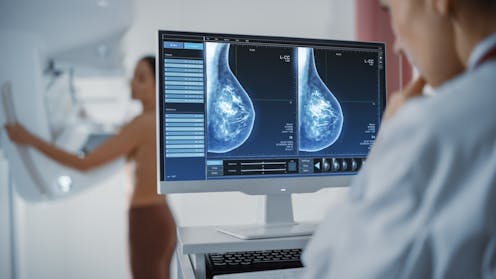
Having dense breasts is a clear risk factor for breast cancer. It can also make cancers hard to spot on mammograms.
Yet you might not be aware you have dense breasts, even after mammographic screening.
In Australia, advice for women with dense breasts and their health-care professionals can be inconsistent and confusing.
This is because there’s not currently consensus on whether women who have dense breasts, but no symptoms, benefit from further imaging such as ultrasounds. Concerns include potential cost of these tests and the risk they can produce false positives.
What is breast density?
Breasts are made up of fatty tissue and fibroglandular tissue (including glands that make milk, held together by fibrous tissue).
On a mammogram – an x-ray of the breast – fibroglandular tissue appears white and fatty tissue appears dark. The white areas are referred to as breast density.
A higher proportion of fibroglandular tissue means your breasts are dense.
There are four categories to classify breast density:
- A: almost entirely fatty
- B: scattered areas of fibroglandular density
- C: heterogeneously or consistently dense
- D: extremely dense.
Breast density is very common. Around 40% of women aged 40–74 are estimated to have “dense breasts”, meaning they fall in category C or D.
What’s the link to cancer?
Breast density is associated with the risk of breast cancer in two ways.
First, breast density usually decreases with age. But if a woman has high breast density for her age, it increases her likelihood of breast cancer.
One study looked at the risk of breast cancer over the age of 50. It found there was a 6.2% risk for the one-third of women with the lowest density. For the 5% with the highest density, the risk was 14.7%.
Second, breast density “masks” cancers if they develop. Both cancers and breast density appear white on a mammogram, making cancers very hard to see.
Breast cancer screening saves lives through early detection and improved treatment options. But we don’t yet know if telling women about their breast density leads to earlier cancer detection, or lives saved.
In Australia, screening mammography is free for all women* aged 40 and older. This is run through BreastScreen Australia, a joint national, state and territory initiative. Those aged 50-74 are invited to have a mammogram, but it’s available for free without a referral from age 40.
However, the messages Australian women currently receive about breast density – and whether it’s recorded – depends on where they live.
What does the advice say?
In 2023, the Royal Australian and New Zealand College of Radiologists updated its position statement to recommend breast density is recorded during screening and diagnostic tests in Australia and New Zealand.
Meanwhile BreastScreen Australia says it “should not routinely record breast density or provide supplemental testing for women with dense breasts”. However this position statement is from 2020 and is currently under review.
Some state and territory BreastScreen programs, including in Western Australia, South Australia and soon Victoria, notify women if they have dense breasts. Victoria is currently at an early stage of its roll-out.
While the messaging regarding breast density differs by state, none currently recommend further imaging for women with dense breasts without speaking to a doctor about individual risk.
What are the issues?
Providing recommendations for women with dense breasts is difficult.
The European Society of Breast Imaging recommends women with extremely dense breasts aged 50–70 receive an MRI every two to four years, in addition to screening mammography. This is based on a large randomised controlled trial from the Netherlands.
But the Royal Australian and New Zealand College of Radiologists describes this recommendation as “aspirational”, acknowledging cost, staffing and accessibility as challenges.
That is, it is not feasible to provide a supplemental MRI for everyone in the screening population in category D with extremely dense breasts (around 10%).
Further, there is no consensus on appropriate screening recommendations for women in the category C (heterogeneous density).
We need a national approach to breast density reporting in Australia and to do better at identifying who is most likely to benefit from further testing.
BreastScreen Australia is currently undergoing a review of its policy and funding.
One of its goals is to enable a nationally consistent approach to breast screening practices. Hopefully breast density reporting, including funding to support national implementation, will be a priority.
*This includes those recorded female at birth and who are gender diverse.
Authors: Jennifer Stone, Principal Research Fellow, School of Population and Global Health, The University of Western Australia


















