

Julianne Moore’s children’s book about redheads is under ‘review’. What’s happening with US book bans under Trump?
- Written by: Sarah Mokrzycki, Sessional Academic, Children's Literature and Creative Writing, Victoria University
Actor Julianne Moore’s picture book, Freckleface Strawberry, was recently removed for “compliance review” from schools serving the families of US military and civilian defence personnel.
The review, conducted by the US Department of Defense, is designed to ensure the books in its schools don’t contravene President Trump’s two executive orders regarding “gender ideology” and “racial indoctrination”, reported CNN.
As part of the week-long review, in which access to all library books was denied, Moore’s book about a redheaded girl who learns to accept her freckles was flagged alongside others as “potentially related to gender ideology or discriminatory equity ideology topics”.
While books are challenged much more often than they are successfully banned, last year 10,000 books were banned from public schools across America: almost triple the amount in 2023.

The Pentagon has issued a list of books, or chapters from books, to be immediately pulled from Department of Defense schools. It includes course material on gender and sexuality for high-school students and a lesson for fifth graders about how immigration affects the US.
Moore, whose father was a Vietnam veteran, and who grew up attending a Department of Defense School, has expressed her “great shock”. She drew attention to her book’s removal in an Instagram post.
Trump’s direct ban on “teaching ‘gender ideology’ and ‘critical race theory’ in the classroom” marks a new front in the censorship battles. If picture books about redheaded girls with freckles can be removed (even temporarily) for being problematically “ideological”, where will these book bans take the US – now and in the future?
The Trump presidency, with its new language of censorship, has just begun.
Publishers file joint lawsuit against book banning
Earlier this month, the so-called “Big Five” publishing houses – Penguin Random House, Hachette Book Group, HarperCollins, Macmillan Publishers and Simon & Schuster – filed a joint lawsuit challenging the banning of books in US schools and public libraries.

Their suit challenges Idaho’s House Bill 710, which became law on July 1 2024. It requires libraries to move materials considered harmful to children to an area for adults only, and forbids anyone under 18 from accessing library books with “sexual content”.
(The Big Five are joined by Sourcebooks, the Authors Guild and the Donnelly Public Library District, as well as several authors, a teacher, two students and two parents.)
Nihar Malaviya, chief executive officer of Penguin Random House, called the Idaho bill “blatantly discriminatory, broad and vague”.
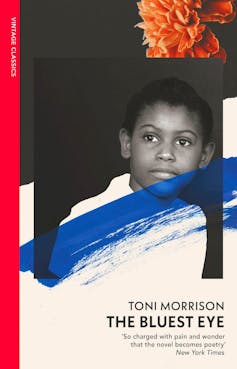
Classics like Margaret Atwood’s The Handmaid’s Tale, Maya Angelou’s I Know Why the Caged Bird Sings, Kurt Vonnegut’s Slaughterhouse Five, and Toni Morrison’s The Bluest Eye are among the “harmful” books being banned under the bill.
Historic publisher lawsuits
Malaviya said the Idaho lawsuit is “the third historic lawsuit” Penguin Random House has “initiated against book banning in just over a year”.
It follows a 2023 lawsuit by Penguin Random House and PEN America (as well as five authors and two parents) against a Florida school board and district. PEN America called it a “first-of-its-kind challenge to unlawful censorship”.
 Penguin Random House has initiated three historic lawsuits against book banning in just over a year.
Ted Shaffrey/AAP
Penguin Random House has initiated three historic lawsuits against book banning in just over a year.
Ted Shaffrey/AAP
This earlier lawsuit argued the removal or restriction of books about “race, racism and LGBTQ identities”, and those by non-white and/or LGBTQ authors, violated the US constitution’s First Amendment (protecting free speech) and the Equal Protection clause of the 14th Amendment.
The case is ongoing, though late last year a federal judge urged the Florida County to settle: as of September, it had spent over US$440,000 (and counting) of taxpayer money on attorney fees.
Banning ‘any act’ of homosexuality
Under “Obscene materials” in Section 1 of the Idaho bill, “sexual conduct” is defined as:
any act of masturbation, homosexuality, sexual intercourse, or physical contact with a person’s clothed or unclothed genitals, pubic area, buttocks or, if such person be a female, the breast.
Unlike masturbation, intercourse, and groin-touching, “homosexuality” refers to sexual orientation. Just as being heterosexual is an orientation – not a sex act – so is homosexuality.
Its inclusion speaks volumes about the sexualisation of the LGBTQIA+ community, and how queerness is misrepresented as “inherently sexual and predatory”.
 Banning ‘any act’ of homosexuality forbids – and sexualises – queerness.
Karolina Grabowska/Pexels
Banning ‘any act’ of homosexuality forbids – and sexualises – queerness.
Karolina Grabowska/Pexels
In Utah in 2022, the Alpine School District pulled 52 books from their library shelves: 21 of them contained queer characters or themes. Schools were accused of stocking “pornography” in their libraries.
“When you look at what actually gets challenged in school, some of it has sex in it and some of it just has queer people,” responded Richard Price, a political scientist studying the history of queer censorship.
When “homosexuality” is forbidden, as in the Ohio bill, it forbids the very existence of LGBTQIA+ people themselves. It means being gay is, in and of itself, “obscene”.
Book bans can increase exposure to harm
The American Library Association acknowledges book challenges are often made “to protect others, frequently children, from difficult ideas and information” – but concludes book bans are still harmful.
Book challenges – the “attempt to remove or restrict materials” – are most often made by parents. Others who challenge the collections of libraries or schools include political and religious groups, library administrations and schools.
Book bans inhibit children and teenagers from “critical thinking in a safe, supportive environment”, shows a report from the National Library of Medicine. This makes young people more likely to seek information from “unmonitored, unsafe sources, without the support of trusted adults”.
In essence, book bans actually increase the risk of children’s exposure to the “unsuitable” topics the bans are trying to protect them from.
 Book bans often aim to protect kids, but actually increase their exposure to risk.
Kindelmedia/Pexels
Book bans often aim to protect kids, but actually increase their exposure to risk.
Kindelmedia/Pexels
While book bans at a community level are usually misinformed, rather than malicious, those implemented by government policy are “tools that politicians use to control a political narrative” and dictate “whose history, identities, and voices matter”, says The Center for American Progress.
Book bans are not new – but nor is resistance
In 213 BCE, Chinese emperor Qin Shi Huang burned books to “consolidate power” and keep education “under governmental control”. The Nazis infamously burned books to promote their political agenda against Jews and “un-German” political and artistic expression.
The Nationalist government of South Africa used a 1957 inquiry into “undesirable publications” as an “excuse” to “destroy books and pamphlets critical of its policies”, for over two decades.
In other words, book bans are nothing new. But neither is resistance to the political control of knowledge.
In the words of Helen Keller, whose own books were burned by the Nazi regime:
History has taught you nothing if you think you can kill ideas. Tyrants have tried to do that often before, and the ideas have risen up in their might and destroyed them.
Authors: Sarah Mokrzycki, Sessional Academic, Children's Literature and Creative Writing, Victoria University


















