

From satire to serious journalism – how The New Yorker has shaped a century of thought
- Written by: Emily Baulch, Research Assistant, Discipline of Media and Communications, University of Sydney
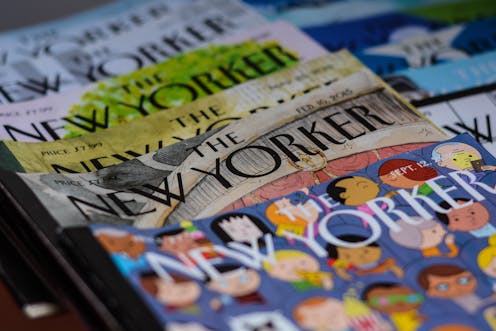
Australian subscribers to the print edition of The New Yorker will know the feeling: it arrives once a week, or sometimes, as buses do, in pairs.
You may briefly regret the environmental impact of all that paper, but once it’s unwrapped it’s a source of anticipation. You check out the cover, read Shouts and Murmurs, and flip through the cartoons.
You might even tackle the book reviews or dive into an article. But most of all, you inhale the history of a century of brilliantly edited and stainlessly written essays.

100 years, thousands of issues, countless stories
The New Yorker has evolved alongside a century of monumental change. From the roaring 20s to the age unfolding, it has been a steadfast investigator of history, covering wars, political upheavals, cultural shifts and social revolutions.
The magazine has published some of the most influential writers of the 20th and 21st centuries, including Truman Capote, Ernest Hemingway, Jamaica Kincaid, Fiona McFarlane and Hiromi Kawakami – offering a platform for literary giants and fresh voices alike.
It has also fostered the growth of renowned editors such as William Shawn, Robert Gottlieb and Tina Brown, all of whom helped shape it into an institution.

When The New Yorker was founded in 1925 by Harold Ross, it was a lighthearted, satirical magazine designed for the city’s social elite. Early issues leaned into what articles editor Susan Morrison called a “fizziness and café society […] vibe.”
Originally focused on humour and satire, the magazine gradually developed into a serious publication known for long-form journalism, in-depth political analysis and high-calibre fiction.
World War II marked a turning point. The war demanded serious, in-depth reporting, and The New Yorker rose to the challenge.
As Morrison observes:
It was the war which really helped The New Yorker find its feet in terms of important non-fiction reporting […] with many more substantial writers on staff able to cover subjects at length and in detail and with authority.
The shift towards serious investigative journalism was evident in the groundbreaking 1946 publication of John Hersey’s Hiroshima, which took up an entire issue. The approach of dedicating extensive space to a single subject was repeated at key historical moments, such as the death of Princess Diana and the September 11 attacks on the World Trade Center.
 A special issue was released on September 15 1997 to memorialise Princess Diana.
The New Yorker
A special issue was released on September 15 1997 to memorialise Princess Diana.
The New Yorker
Compelling readers to slow down and engage
With some 47 issues delivered annually, The New Yorker demands readers carve out time to engage deeply with a range of hard-hitting topics. Its style of slow investigative journalism can’t be consumed in a few seconds while scrolling through social media.
Alongside its seriousness, it retains some of its effervescence through comics and extraordinary breadth, drawing readers into unexpected topics – neuroscience, fountains, squirrels – through meticulously crafted narratives.
The magazine continues in this dual function tradition, reflecting the nuance of the wider world within its covers. The tension between the immense depth and breadth of content and the finite time of readers adds to its allure. It’s a challenge for those willing to invest the time to peruse and digest its pages.
David Remnick, editor since 1998, has guided the magazine with a vision that blends tradition and innovation. In his own words, the goal is to
persist in our commitment to the joys of what Ross first envisaged as a comic weekly. But we are particularly committed to the far richer publication that emerged over time: a journal of record and imagination, reportage and poetry, words and art, commentary on the moment and reflections on the age.
 Pulitzer Prize-winning author David Remnick was named editor of the magazine on July 13 1998, succeeding Tina Brown.
AP/Mary Altaffer
Pulitzer Prize-winning author David Remnick was named editor of the magazine on July 13 1998, succeeding Tina Brown.
AP/Mary Altaffer
The elegant trappings of a storied past
While the approach to content has evolved, some aspects of The New Yorker have remained consistent. Its visual identity, for instance, has been remarkably stable: famously done in an illustrative style, and unadorned by headlines or teasers.
The vintage aesthetic of the illustrative covers traces its origins back to 1925. The magazine employs a mix of in-house artists and freelance illustrators, with a history of collaboration with notable artists including Saul Steinberg and Art Spiegelman.
 Art Spiegelman’s cover for the March 8 1999 issue of The New Yorker alludes to the controversial 1999 killing of unarmed Guinean immigrant Amadou Diallo by four New York City police officers.
AP/The New Yorker, Art Spiegelman
Art Spiegelman’s cover for the March 8 1999 issue of The New Yorker alludes to the controversial 1999 killing of unarmed Guinean immigrant Amadou Diallo by four New York City police officers.
AP/The New Yorker, Art Spiegelman
Over time, the cover art has maintained a focus on bold, thought-provoking imagery that addresses timely issues. Many covers have become cultural history, such as the black-on-black 9/11 cover.
Today, the New Yorker’s pared-back style conveys a quiet authority. It’s not swayed by fleeting trends, but remains steadfast in its dedication to art and culture, and its origins.
More than a magazine
Subscribing to The New Yorker isn’t just a matter of interest; it’s an act of intellectual self-definition. Our media choices are powerful tools in our process of self-creation.
Popular cultural and media theorists, such as John Fiske and John Hartley, to name a few, have explored how media shapes and reflects our sense of self.
The New Yorker has built an enviable devotion among its readers. Their homes are filled with stacks of old issues, unopened, standing as testament to their ongoing relationship with the publication.
 To subscribe to the magazine is to participate in a cultural shorthand – an aspiration toward intellectual engagement.
Shutterstock
To subscribe to the magazine is to participate in a cultural shorthand – an aspiration toward intellectual engagement.
Shutterstock
Owning the magazine also signals an affiliation with a specific reading class, regardless of whether the content is ever read. The very act of displaying The New Yorker fashions an image of sophistication, intellectualism and cultural awareness.
But the stacks come with a distinct kind of guilt, too. What does it say about you that you haven’t made time to stay up to date with one of the world’s most famous outlets for investigative journalism and cutting-edge fiction?
This tension speaks to the dual nature of The New Yorker experience: holding onto a subscription signals a commitment to personal growth, yet unread magazines reflect the complexity of modern life – where time for deep, reflective reading competes with daily obligations and the instant gratification offered by digital media.
The New Yorker’s significance isn’t just about the quality of its investigative journalism or the breadth of its storytelling; it’s about identity. To subscribe is to participate in a cultural shorthand – an aspiration toward intellectual engagement.
And who knows, if you hold onto your copies long enough, perhaps they’ll become valuable relics commanding prices in the thousands, much like the first issue does today.
Authors: Emily Baulch, Research Assistant, Discipline of Media and Communications, University of Sydney


















