

Joan Lindsay published Picnic at Hanging Rock at 71. Her writing life presents its own mysteries
- Written by: David Carter, Professor Emeritus, Australian Literature, The University of Queensland
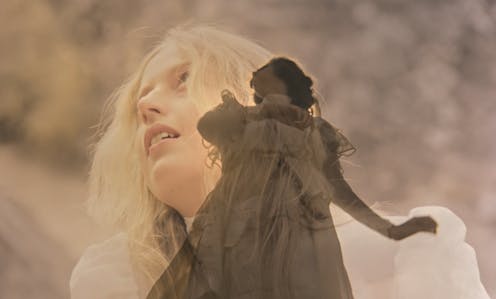
Brenda Niall’s new book, as its full title announces, is a biographical account of the “hidden life” of novelist Joan Lindsay, best known as the author of Picnic at Hanging Rock.
It adds to Niall’s work on writers and artists including Martin Boyd and the Boyd family, Ethel Turner and Mary Grant Bruce, Georgiana McCrae, and Mary and Elizabeth Durack.
The book joins a growing list of Australian literary biographies – if we can use the term “biography” for a complex case like this one.
Review: Joan Lindsay: The Hidden Life of the Woman who wrote Picnic at Hanging Rock – Brenda Niall (Text Publishing)
Big-name biographies from recent years include Brigitta Olubas on Shirley Hazzard, Bernadette Brennan on Helen Garner and Gillian Mears, Nathan Hobby on Katharine Susannah Prichard, Suzanne Falkiner on Randolph Stow, and Jill Roe on Miles Franklin. Catherine Lumby and Matthew Lamb have written separately about Frank Moorhouse.
Many other examples could be given. Alison Alexander has published a biography of romance author Marie Bjelke-Petersen. Sylvia Martin has written books on Aileen Palmer, Ida Lesson, and Mary Fullerton, Mabel Singleton and Miles Franklin. Patricia Clarke has written about Louisa Atkinson, Tasma (the pen name of novelist Jessie Couvreur) and Rosa Praed.


The success of Peter Weir’s 1975 film adaptation extends and complicates the story. Niall evokes Lindsay’s curious, critical engagement with the making of the film and its reception.
But Niall also wants to tell a larger story about Lindsay’s life. She writes of Lindsay’s studies, her practice of painting and its partial abandonment, her art criticism, her marriage to Daryl Lindsay, director of the National Gallery of Victoria, and her life at their home, Mulberry Hill.
Discretion, silences and underachievement appear to have marked much of Lindsay’s creative and, perhaps, intimate life. The word “mystery” recurs throughout Niall’s book. It is applied to aspects of Lindsay’s childhood and her marriage – about which she almost never spoke or wrote – her lack of children, her ambitions and failures, and her unwillingness to talk about such dimensions of her creative life.
The “mysteries” seem finally to have forced their way to expression in Picnic at Hanging Rock, with its famously enigmatic story about a group of schoolgirls vanishing without trace. Niall’s book makes this point. The (often unspoken) issues and aspirations in Lindsay’s earlier life are linked to the unresolved mysteries of the novel.
Art and marriage
Joan Lindsay (née Weigall) was a gifted child from an affluent family. She was a model high school student, who showed early abilities in writing, and later a committed art student at the National Gallery of Victoria School, where she met Frederick McCubbin and was influenced by the imagery of his landscape paintings.
She was distant from her anglophile mother and her two lively older sisters. Her father appears to have been an interesting figure, but also remains something of a “mystery” in this story. The lack of a close family or domestic grounding is presented as significant for Lindsay’s later life.
The National Gallery school, its community of younger artists and students, and related journeys to artists’ camps made a great difference to Joan. An early exhibition of her landscapes was well reviewed. Writer and artist Maie Ryan, who would become the wife of Richard Casey, future deputy prime minister and Australian governor-general, was an important colleague and collaborator. They shared an inner-Melbourne art studio in the early 1920s.
 Joan and Daryl Lindsay in 1925.
State Library of Victoria Collections, via Wikimedia Commons
Joan and Daryl Lindsay in 1925.
State Library of Victoria Collections, via Wikimedia Commons
Daryl Lindsay is another mystery in the book. Younger brother of artist and critic Lionel Lindsay and bohemian artist and writer Norman Lindsay, Daryl was the ninth child and sixth son in the Lindsay family and a “loner since boyhood”. He pursued multiple jobs, from banking to jackerooing, but began sketching during the first world war in France, then in a hospital in England, where he was tasked with drawing the facial injuries of wounded soldiers.
Fortunately, he met Henry Tonks, a teacher at the Slade School of Art, and Tonks offered him a place in the Slade’s drawing classes. London seemed to offer a world of possibility for an emerging artist.
The rapid courtship between Joan and Daryl in London is another puzzle. They were married in early 1922, just over eight weeks after Joan had departed from Melbourne. They spent their time there visiting galleries. Joan also clicked with Tonks, who painted her, showing “a yearning, a sense of mystery, a visionary inner life”. This interesting work is reproduced in Niall’s book.
Artists, politicians and powerful friends
When the couple returned to Melbourne, Daryl began work as a commercial illustrator, producing work for advertising, newspapers and magazines. Joan tried a range of journalistic writing — interviews, essays, travel pieces and some reviews of art exhibitions. Niall suggests she had the potential to become a professional art critic, although such roles almost always went to men.
The Lindsays were well connected to other Melbourne artists and influential figures who might buy their paintings. Sir John Longstaff, Dame Nellie Melba and Sir Baldwin Spencer, an influential collector of Australian art, were acquaintances.
In 1926, a joint exhibition drew targeted praise for Joan’s paintings, though in Sydney Daryl’s work was highlighted. With the likely equation of one winner and one loser in such events, Joan decided that Daryl would be the painter. She would be a writer. Much of her artwork stopped at this early point. Only one of her paintings is reproduced in the biography.
Niall charts the major steps in the couple’s life. The key move was their purchase in 1925 of the house they called Mulberry Hill on Victoria’s Mornington Peninsula. A generous renovation added “a second story, an imposing entrance in American colonial style, a stable block, and a big garden that would become Joan’s chief occupation”. The house also gained a large dining room, a drawing room, a studio, and a small room that became Joan’s “scribbling room”.
Mulberry Hill would become a place for visiting artists, politicians and celebrities (alongside its egg-laying hens), often to Daryl’s annoyance. The family of artist Rick Amor would later become residents.
Daryl had a gift for making friends, none more significant than newspaper proprietor Keith Murdoch. He had already performed some unpaid work in London with agents of the National Gallery of Victoria’s Felton Bequest. Back in Australia, Murdoch’s influence led to a curator position for Daryl and eventually his promotion to gallery director.
Daryl broke with the restraints of earlier directors. He was more favourable towards Australian art, though his preferences were also seen by some as “backward-looking”, and were dramatically opposed by the Heide group, centred around John and Sunday Reed.
Joan also had a role at the gallery, a three-day per week position, but extraordinarily one that was unpaid. It nevertheless gave her space in the gallery and an important role as a writer, especially as co-author of Masterpieces of the National Gallery of Victoria (1949), writing on Australian art.
 Cover of the first edition of Picnic at Hanging Rock (1967).
A buried career
I see I have spent much of this review describing aspects of the life of Joan Lindsay and her marriage, rather than on Niall’s book as a study of Joan Lindsay’s character and creativity. The book notes the mysteries or puzzles in Lindsay’s life, her discretion or repression of unhappiness in her marriage, and her buried career. But it does not always analyse them.
The couple’s childless marriage and their very different perceptions of their lives in London versus Melbourne are considered. Joan was more at home in Melbourne, creating an active domestic space at Mulberry Hill. Niall underscores that Lindsay’s “deep creative spirit” was almost extinguished “by her role as wife and hostess”. Lindsay’s separation from existing literary circles is also underscored.
Picnic at Hanging Rock is presented as “an expression of Joan’s awareness of the colonial dilemma of not belonging”. Yet its connections to earlier (and ongoing) mysteries in Lindsay’s life, and her preference for “time without clocks” (as her 1962 memoir put it), are suggestive without always being compelling.
The story of her life with Daryl and her uneven, then spectacular participation in the writing life does, however, add to our understanding of cultural networks – and their negatives – in mid-20th century Australia.
Authors: David Carter, Professor Emeritus, Australian Literature, The University of Queensland



















