

A 380-million-year-old fossil ‘fish’ from Scotland has been discovered in Australia
- Written by: Gavin Charles Young, Departmental Visitor, Materials Physics, Research School of Physics, Australian National University
Queensland is renowned for its fossils of Australia’s largest back-boned animals – dinosaurs, of course, like the Jurassic Rhoetosaurus, the Cretaceous Wintonotitan, and other large sauropods.
However, our new paper published in the journal National Science Review documents the smallest vertebrate fossil animal described so far from the state.
It’s a highly enigmatic tiny “fish” from a remote location close to the Northern Territory border. It lived in the shallow margins of a marine environment about 400 million years ago.
A scattering of its skeletal elements was preserved in a small limestone outcrop at the southern end of the Toomba Range, on the edge of the Simpson Desert.
Palaeospondylus, a fossil enigma
Our paper describes a new species of the genus Palaeospondylus, only the second known. Remarkably, for the last 135 years, Palaeospondylus has been represented by a single species that lived in northern Scotland, on the other side of the world from our discovery.
Unlike nearly all fossil fish of that age, Palaeospondylus was “naked”, lacking external dermal bones and scales. But it did have a mineralised internal skeleton.
It is the oldest example from the fossil record to show a segmented vertebral column (a sort of backbone), hence its name – Greek for “ancient vertebra”.

The type species Palaeospondylus gunni is known from thousands of fairly complete specimens, almost all from a single flagstone quarry.
When first described in 1890, it attracted a flurry of competing interpretations in Europe and North America. Which group of animals did it belong to?
Since its discovery, it has been assigned to almost all major jawless and jawed vertebrate groups. All specimens were compressed, making the skeletal elements “melt” together. Imagination has always played a great role in trying to identify its parts.
Even after the advent of 3D scanning, three recent studies reached different conclusions. According to those, Palaeospondylus was related either to chondrichthyans (sharks), or tetrapods (the land vertebrates). Or maybe it was a stem jawed vertebrate – branching separately from the base of the evolutionary tree for all vertebrates with jaws.
The Queensland Palaeospondylus
The story of discovery of our new Queensland species, Palaeospondylus australis, began in 1977.
In the 1960s, geologist Reg Sprigg had predicted oil and gas beneath the northern Simpson Desert. The Bureau of Mineral Resources was conducting seismic surveys and microfossil sampling across the Georgina Basin, immediately to the north.
Microfossils are tiny fossils that can only be studied with a microscope, but are crucial to determining the age of the rock. Numerous sedimentary rock samples are collected, preferably limestones, because these can be dissolved in acid. The insoluble microfossils can then be identified and studied in the acid residues.
In 1977, I collected bits of limestone from an obscure gully in the Cravens Peak Beds, the sandstone forming the main ridge of the Toomba Range. Surprisingly, these produced a rich collection of Devonian fish microfossils. This was the first evidence that an arm of the sea had extended into central Australia during the Early Devonian (about 400 million years ago).

In the 2000s, palaeontologist Carole Burrow at the Queensland Museum was investigating the internal structure of Devonian fish microfossils to assist in dating the rocks.
In the Cravens Peak samples, she noticed some distinctively shaped, tiny elements composed of an unusual honeycomb-like tissue. Carole hypothesised this could be a new species of Palaeospondylus, the only record from outside Scotland.
So, in 2006, we organised another field trip to this remote location.
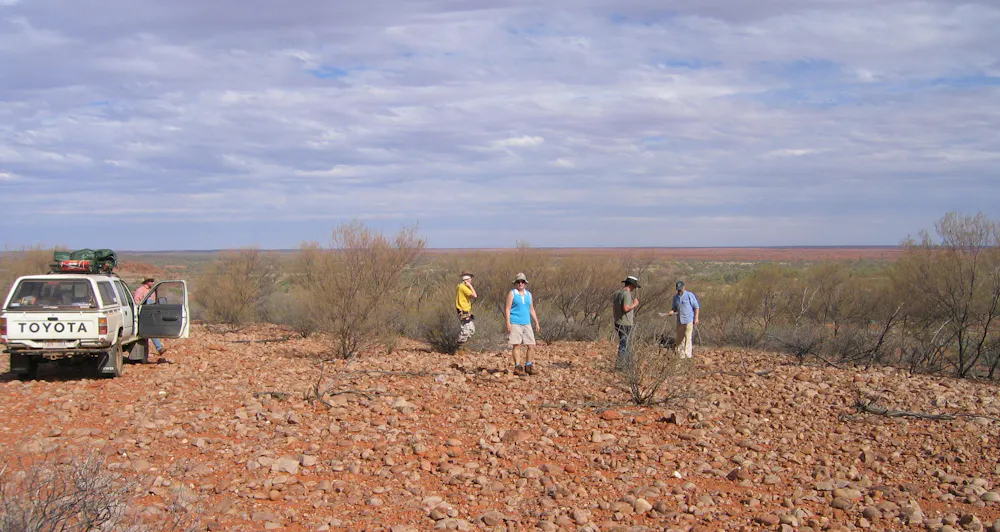 The 2006 field trip participants (Tim Senden, Tim Holland, Carole Burrow, John Long, Gavin Young) looking south from the end of the Toomba Range, the last rock outcrop for around 500 km across the Simpson Desert.
Bruce Burrow
The 2006 field trip participants (Tim Senden, Tim Holland, Carole Burrow, John Long, Gavin Young) looking south from the end of the Toomba Range, the last rock outcrop for around 500 km across the Simpson Desert.
Bruce Burrow
Returning to the Queensland Museum after our field trip, Carole’s colleague from the Netherlands, palaeontologist Jan den Blaauwen, sent her new images showing similar honeycomb-like structure in the Scottish Palaeospondylus gunni.
Carole was acid-etching the newly collected samples so she could extract any microfossils. Luckily, she noticed a slightly larger specimen appearing on the rock surface (although still tiny, only about 3.6 millimetres long). It was highly interesting because it seemed bilaterally symmetrical.
Could this be a braincase (the bony capsule inside the skull that encloses the brain)? She immediately stopped acid etching before it disintegrated into crumbs.
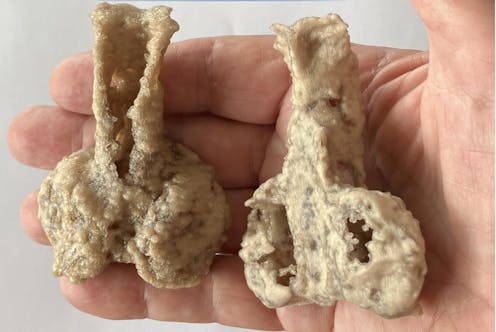
 Palaeospondylus australis holotype, QMF 52826, ventral braincase exposed on the limestone surface by acid etching (left), and trimmed for CT scanning (right).
Carole Burrow, Gavin Young
Palaeospondylus australis holotype, QMF 52826, ventral braincase exposed on the limestone surface by acid etching (left), and trimmed for CT scanning (right).
Carole Burrow, Gavin Young
The first uncrushed braincase
At the Australian National University, our sample was carefully trimmed before CT scanning, revealing the first uncrushed braincase of Palaeospondylus known to science.
It’s now the holotype – defining type specimen – for our new species. And we have about 400 other elements with the same honeycomb structure which belong to it, too.
The unique uncrushed preservation of this braincase, revealed by CT scanning and 3D printing techniques, provides the first details of brain structure in this tiny animal from 400 million years ago.
These include the shape of the cranial cavity and inner ear canals, the position of the pituitary gland and optic nerve openings, and details of the carotid arteries and jugular veins for blood supply to the brain.
 3D scan image, the first view of the upper braincase surface of Palaeospondylus, showing the large opening into the cranial cavity.
Jing Lu/Insitute of Vertebrate Paleontology and Paleoanthropology, Beijing
3D scan image, the first view of the upper braincase surface of Palaeospondylus, showing the large opening into the cranial cavity.
Jing Lu/Insitute of Vertebrate Paleontology and Paleoanthropology, Beijing
More questions remain
It is noteworthy that our curiosity-driven research into ancient brain morphology can be traced back to economically driven geological surveys of nearly 50 years ago, conducted to support exploration for oil and gas across central Australia.
As with any research result, there are now new questions to be investigated. The honeycomb tissue seems unique to Palaeospondylus, but could be a precursor to calcified cartilage of some other groups, including modern sharks.
Alternatively, it could be an early evolutionary stage for the spongy tissue (endochondral bone) filling the inside of most bones in modern land vertebrates, including humans.
The unique holotype of our new species clearly shows that previous interpretations of the crushed Scottish material included many structures that were not part of the braincase.
We’ve also now demonstrated that a recent study in the leading science journal Nature, which proposed that Palaeospondylus was closely related to our tetrapod ancestors, relied on many erroneous interpretations of braincase structure.
Of one thing we can be sure – Palaeospondylus was not a stem tetrapod.
Acknowledgements: Carole Burrow from Queensland Museum contributed greatly to this article.
Authors: Gavin Charles Young, Departmental Visitor, Materials Physics, Research School of Physics, Australian National University


















