

Giant glaciers pulverised Earth’s ancient rocks, setting the stage for complex life
- Written by: Chris Kirkland, Professor of Geochronology, Curtin University
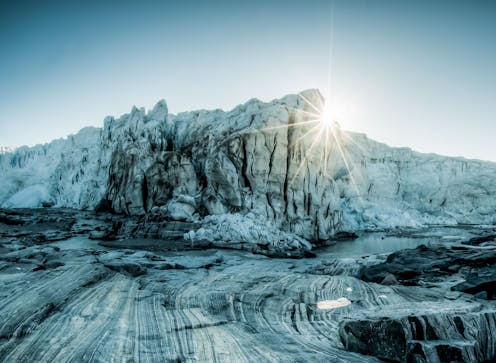
Imagine floating in space, gazing on a frozen white orb. The ball hangs in the void, lonely and gleaming in the light from its star. From pole to equator, the sphere is covered in a thick crust of ice. In orbit around the white planet is a single cratered moon.
You are gazing on Earth in the Cryogenian period, 700 million years ago. This is about three times as long ago as the earliest dinosaurs roamed – but still not long in the scheme of Earth’s mind-bending 4.5 billion years of history.
During the Cryogenian, our planet was plunged into a series of deep freezes when enormous glaciers flowed across the globe.
In new research published in Geology, we show that these crushing rivers of ice, sometimes kilometres deep, pulverised the planet’s rocky surface like enormous bulldozers. When the ice eventually thawed, the ground-up minerals washed into the oceans where they may have provided the nutrients needed for the evolution of complex life.
Into the fridge
According to the Snowball Earth hypothesis, Earth underwent at least two extreme global glaciations during the Cryogenian. Traces of these events can be seen across the globe in sedimentary rocks formed under glacial conditions, strongly suggesting that ice spread from the poles to reach the equatorial region.
Nobody is sure exactly what triggered these deep-freeze events, though scientists have proposed a range of possibilities. One key may have been a significant decline in atmospheric greenhouse gases, particularly carbon dioxide (CO₂).

The CO₂ levels in the atmosphere may have fallen because of increased weathering of rocks situated on a large tropical continent that existed at the time. When continents are positioned in tropical regions, warm, moist conditions accelerate chemical weathering, pulling CO₂ out of the atmosphere, locking it away in carbonate minerals.
Tectonic activity during the breakup of continents that happened during this period may have also played a part. It could have created conditions such as shallow seas, leading to more removal of CO₂ from the air.
As ice sheets advanced toward the tropics, they reflected more sunlight back into space, leading to further cooling. These processes together caused ice to spread rapidly until the planet was almost entirely frozen.
How did Snowball Earth end?
Volcanic activity may have played a crucial role in ending these ice ages. As glaciers covered the planet, interactions between Earth’s crust, oceans and atmosphere slowed dramatically. As a result, when volcanic eruptions injected CO₂ into the atmosphere, it would not have been re-absorbed but rather accumulated over millions of years.
These high levels of CO₂ created a runaway greenhouse effect, warming the planet and eventually melting the ice. The resulting thaw caused rapid sea level rise and an influx of nutrients into the oceans.

Distinct rock formations were created during this abrupt climate change, as the chemistry of the oceans responded to the new conditions. The surge of nutrients may have contributed to a cascade of biological changes, possibly setting the stage for the rise of complex life.
Many scientists have considered the idea that changing atmospheric conditions on the thawing of Snowball Earth led to changes in ocean chemistry. In our new research, we found that material scraped off the continents during the thaw may also have played a role.
Snowball to slushball, glacial bulldozer to planetary power hose
We studied sections of rock, from older to younger, through the snowball period to melt down. By doing this, we built up a picture of what the glaciers and the subsequent river systems were doing to the crust of our planet.
We explored minerals with these sequences of rock and found consistent distinctive changes during periods of time when snowball events started and also when thawing occurred.
 A cartoon block diagram of a snowball vs greenhouse world, showing the effect of glaciers and their melting for Earth’s chemistry.
Kirkland / Geology
A cartoon block diagram of a snowball vs greenhouse world, showing the effect of glaciers and their melting for Earth’s chemistry.
Kirkland / Geology
Snowball Earth events were associated with a pronounced increase in older, deeper crust being exposed and ground down under kilometres of ice.
As the glaciers retreated during thaw periods, massive outflows of melt water transported mineral grains that had been trapped and stabilised under the ice. Once exposed to liquid water, fragile minerals dissolved, releasing chemicals.
This process – like the changes in the atmosphere – would have changed the chemistry of the oceans. The glacial retreat help shaped the distribution of elements critical to ocean ecosystems.
Lessons from the past
The timescales of Earth’s natural processes are important to keep in mind. Over thousands, millions and billions of years, processes such as plate tectonics, erosion, and atmospheric cycles will continue to shape the planet’s future.
On shorter timescales, however, human activities have become the dominant force driving climate change.
While Earth itself will endure, the survival of complex human societies depends on our actions today. We are passengers on an extraordinary “spaceship Earth”, a planet that recycles its chemical building blocks through dynamic geochemical cycles, using matter originally forged in ancient stars.
These processes regulate Earth’s surface and sustain life, even as our planet’s fate is tied to the evolution of the Sun and the cosmos. Humanity, uniquely among Earth’s species, has developed the tools and systems to mitigate existential threats such as climate change, famine, war and even asteroid impacts, yet the effective use of these capabilities remains in our hands.
The deep past provides a guide on how chemical cycles on our planet operate. Whether we will be wise enough to use this information is yet to be seen.
Authors: Chris Kirkland, Professor of Geochronology, Curtin University



















