

how making sand from ore could solve a looming crisis
- Written by: Daniel Franks, Professor and Director - Global Centre for Mineral Security, The University of Queensland
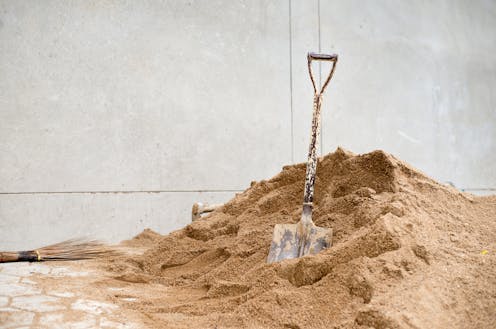
Every year, the world consumes around 50 billion tonnes of sand, gravel and crushed stone. The astonishing scale of this demand is hard to comprehend – 12.5 million Olympic sized swimming pools per year – making it the most-used solid material by humans.
Most of us don’t see the sand and gravel all around us. It’s hidden in concrete footpaths and buildings, the glass in our windows and in the microchips that drive our technology.
Demand is set to increase further – even as the extraction of sand and gravel from rivers, lakes, beaches and oceans is triggering an environmental crisis.
Sand does renew naturally, but in many regions, natural sand supplies are being depleted far faster than they can be replenished. Desert sand often has grains too round for use in construction and deserts are usually far from cities, while sand alternatives made by crushing rock are energy- and emissions-intensive.
But there’s a major opportunity here, as we outline in our new research. Every year, the mining industry crushes and discards billions of tonnes of the same minerals as waste during the process of mining metals. By volume, mining waste is the single largest source of waste we make.
There’s nothing magical about sand. It’s made up of particles of weathered rock. Gravel is larger particles. Our research has found companies mining metals can get more out of their ores, by processing the ore to produce sand as well.
This would solve two problems at once: how to avoid mining waste and how to tackle the sand crisis. We dub this “nose-to-tail” mining, following the trend in gastronomy to use every part of an animal.

The failings of tailings
The metal sulphides, oxides and carbonates which can be turned into iron, copper and other metals are only a small fraction of the huge volumes of ore which have to be processed. Every year, the world produces about 13 billion tonnes of tailings – the ground-up rock left over after valuable metals are extracted – and another 72 billion tonnes of waste rock, which has been blasted but not ground up.
For decades, scientists have dreamed of using tailings as a substitute for natural sand. Tailings are often rich in silicates, the principal component of sand.
But to date, the reality has been disappointing. More than 18,000 research papers have been published on the topic in the last 25 years. But only a handful of mines have found ways to repurpose and sell tailings.
Why? First, tailings rarely meet the strict specifications required for construction materials, such as the size of the particles, the mineral composition and the durability.
Second, they come with a stigma. Tailings often contain hazardous substances liberated during mining. This makes governments and consumers understandably cautious about using mining waste in homes and our built environment.
Neither of these problems is insurmountable. In our research, we propose a new solution: manufacture sand directly from ore.
Converting rock into metal is a complex, multi-step process which differs by type of metal and by type of ore. After crushing, the minerals in the ore are typically separated using flotation, where the metal-containing sulphide minerals attach to tiny bubbles that float up through the slurry of rock and water.
At this stage, leftover ore is normally separated out to be disposed of as waste. But if we continue to process the ore, such as by spinning it in a cyclone, impurities can be removed and the right particle size and shape can be achieved to meet the specifications for sand.
We have dubbed this “ore-sand”, to distinguish it from tailings. It’s not made from waste tailings – it’s a deliberate product of the ore.

More from ore
This isn’t just theory. At the iron ore mine Brucutu in Brazil, the mining company Vale is already producing one million tonnes of ore-sand annually. The sand is used in road construction, brickmaking and concrete.
The move came from tragedy. In 2015 and 2019, the dams constructed to store tailings at two of Vale’s iron ore mines collapsed, triggering deadly mudflows. Hundreds of people died – many of them company employees – and the environmental consequences are ongoing.
In response, the company funded researchers (such as our group) to find ways to reduce reliance on tailings dams in favour of better alternatives.
Following our work with Vale we investigated the possibility of making ore-sand from other types of mineral ores, such as copper and gold. We have run successful trials at Newmont’s Cadia copper-gold mine in Australia. Here, using innovative methods we have produced a coarser ore-sand which doesn’t require as much blending with other sand.
 Ore-sand is already being produced and sold at Vale’s Brucutu iron ore mine in Brazil.
Vale, Author provided (no reuse)
Ore-sand is already being produced and sold at Vale’s Brucutu iron ore mine in Brazil.
Vale, Author provided (no reuse)
Ore-sand processing makes the most sense for mines located close to cities. This is for two reasons: to avoid the risk of tailings dams to people living nearby, and to reduce the transport costs of moving sand long distances.
Our earlier research showed almost half the world’s sand consumption happens within 100 kilometres of a mine which could produce ore-sand as well as metals. Since metal mining already requires intensive crushing and grinding, we found ore-sand can be produced with lower energy consumption and carbon emissions than the extraction of conventional sands.
The challenge of scale
For any new idea or industry, the hardest part is to go from early trials to widespread adoption. It won’t be easy to make ore-sand a reality.
Inertia is one reason. Mining companies have well-established processes. It takes time and work to introduce new methods.
Industry buy-in and collaboration, supportive government policies and market acceptance will be needed. Major sand buyers such as the construction industry need to be able to test and trust the product.
The upside is real, though. Ore-sand offers us a rare chance to tackle two hard environmental problems at once, by slashing the staggering volume of mining waste and reducing the need for potentially dangerous tailings dams, and offering a better alternative to destructive sand extraction.
Authors: Daniel Franks, Professor and Director - Global Centre for Mineral Security, The University of Queensland


















