

a winter deciduous Australian tree
- Written by: Gregory Moore, Doctor of Botany, University of Melbourne
Sign up to the Beating Around the Bush newsletter here, and suggest a plant we should cover at batb@theconversation.edu.au.
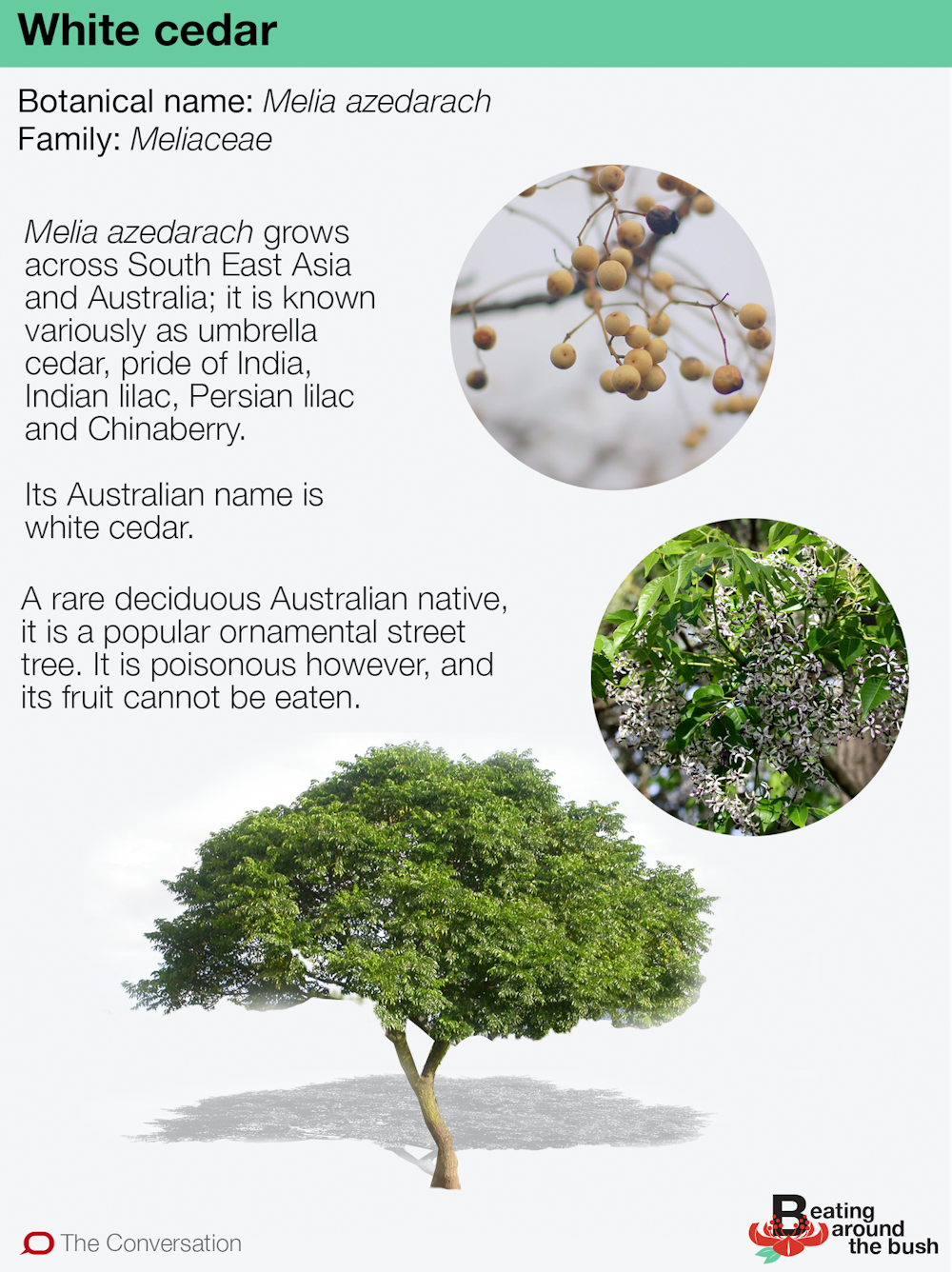
White cedar (Melia azedarach) grows naturally across Queensland and northern New South Wales, but is widely planted as an ornamental tree all over Australia. It also grows across much of Asia, and belongs to the mahogany family.
This wide dispersal sees the species given a very wide and diverse range of common names, including: umbrella cedar, pride of India, Indian lilac, Persian lilac, and Chinaberry. It Australia it is known as white cedar due to its soft general-purpose timber.
The name Melia was the Greek name given to the ash tree, which has similar foliage, and azedarach means “poisonous tree” – parts of it are toxic.
Read more: This centuries-old river red gum is a local legend – here's why it's worth fighting for
White cedar is something of a rarity among Australian native trees, as it loses its leaves in winter or early autumn. Winter deciduous trees are highly valued in landscape design as they provide all the benefits of summer shade, but allow winter light.
 The Conversation
While Australia has an abundance of evergreen tree species and a variety of summer deciduous trees that lose their leaves in summer when water is scarce, we have few winter deciduous native trees. White cedar fits the bill beautifully, and despite a few shortcomings has some very attractive traits.
White cedar is usually a small spreading tree with a rounded canopy up to about 6m in height, but under the right conditions trees can be more than 20m tall, with a canopy spread of 10m or more. They have quite dense foliage composed of dark compound leaves up to 500mm long, which transition from dark green to a pale yellow in autumn.
As a winter deciduous tree they are a very popular native tree that has been widely planted as street trees and in domestic gardens, where specimens of 10-12m are common. The trees are often considered to be short-lived (around 20 years), but in gardens and where irrigation is available some may live for 40 years or longer.
Good specimens of white cedar have many small flowers (20mm) that are white with purple/blue stripes and a wonderful, almost citrus-like scent. The fruits are about 15mm in diameter and bright orange in colour. They are usually retained over winter and so the trees provide a seasonal smorgasbord – shade in summer, autumn foliage colour, orange fruits in winter, and attractive scented flowers in spring.
Many specimens are prolific in their production of fruits and seeds, which readily germinate, underscoring the weed potential of the species under the right circumstances. They can be an invasive species in some parts of Asia and Africa.
Unfortunately as the fruits mature and dry they become as hard as ball bearings. If you mow over them they can fire from under a mower like bullets, and if they land on a hard paved surface they can be a tripping hazard for people who unexpectedly find themselves skating. The fruits and foliage can also be quite toxic if eaten. So this would appear to put a bit a dampener on the use of the tree. However, in recent years non-fruiting varieties of white cedar have become available and these have proven popular as street and garden trees.
A toxic treat
Many parts of the tree are toxic - interestingly, though, not the fleshy part of the fruit. It has evolved to be attractive to the birds that disperse seed. However the seeds are very poisonous, and as few as 6 or 8 seeds can be fatal for children. Fortunately, the seeds are very hard and do not taste very pleasant, so the risk of humans eating them is quite low.
Despite this, white cedar has been widely used as a medicinal plant by indigenous cultures, especially for intestinal parasites. The seeds have been widely used to make beads by indigenous peoples in Asia and Australia, and in some places the tree is called the bead tree.
An easy grower
One of the good things about white cedar is they are easily grown, and cope quite well with the low rainfall in many parts of Australia. They also tolerate a variety of soil types, which is why they have been so widely and successfully spread.
The trees are quite resistant to termite damage and their poison does protect them from grazing mammals and some insects. They can be prone to root problems and it is not uncommon for their trunks to break off at ground level, especially if they have been poorly propagated or planted, which can be a big problem when they are planted as a street tree.
Read more:
Built like buildings, boab trees are life-savers with a chequered past
Although they are related to mahogany, their wood can be quite brittle and easily broken, which means care should be taken when pruning or working on them. When the wood dries it shatters easily and can send shards in all directions when you try to snap it. In Australia the wood can range from light cream to dark brown in colour, and while it is quite a useful wood for carving and furniture, it is not widely used.
As a winter deciduous native tree of smallish stature, with many attractive characteristics, the white cedar really is an Australian rarity, despite how widely it occurs or is planted.
The Conversation
While Australia has an abundance of evergreen tree species and a variety of summer deciduous trees that lose their leaves in summer when water is scarce, we have few winter deciduous native trees. White cedar fits the bill beautifully, and despite a few shortcomings has some very attractive traits.
White cedar is usually a small spreading tree with a rounded canopy up to about 6m in height, but under the right conditions trees can be more than 20m tall, with a canopy spread of 10m or more. They have quite dense foliage composed of dark compound leaves up to 500mm long, which transition from dark green to a pale yellow in autumn.
As a winter deciduous tree they are a very popular native tree that has been widely planted as street trees and in domestic gardens, where specimens of 10-12m are common. The trees are often considered to be short-lived (around 20 years), but in gardens and where irrigation is available some may live for 40 years or longer.
Good specimens of white cedar have many small flowers (20mm) that are white with purple/blue stripes and a wonderful, almost citrus-like scent. The fruits are about 15mm in diameter and bright orange in colour. They are usually retained over winter and so the trees provide a seasonal smorgasbord – shade in summer, autumn foliage colour, orange fruits in winter, and attractive scented flowers in spring.
Many specimens are prolific in their production of fruits and seeds, which readily germinate, underscoring the weed potential of the species under the right circumstances. They can be an invasive species in some parts of Asia and Africa.
Unfortunately as the fruits mature and dry they become as hard as ball bearings. If you mow over them they can fire from under a mower like bullets, and if they land on a hard paved surface they can be a tripping hazard for people who unexpectedly find themselves skating. The fruits and foliage can also be quite toxic if eaten. So this would appear to put a bit a dampener on the use of the tree. However, in recent years non-fruiting varieties of white cedar have become available and these have proven popular as street and garden trees.
A toxic treat
Many parts of the tree are toxic - interestingly, though, not the fleshy part of the fruit. It has evolved to be attractive to the birds that disperse seed. However the seeds are very poisonous, and as few as 6 or 8 seeds can be fatal for children. Fortunately, the seeds are very hard and do not taste very pleasant, so the risk of humans eating them is quite low.
Despite this, white cedar has been widely used as a medicinal plant by indigenous cultures, especially for intestinal parasites. The seeds have been widely used to make beads by indigenous peoples in Asia and Australia, and in some places the tree is called the bead tree.
An easy grower
One of the good things about white cedar is they are easily grown, and cope quite well with the low rainfall in many parts of Australia. They also tolerate a variety of soil types, which is why they have been so widely and successfully spread.
The trees are quite resistant to termite damage and their poison does protect them from grazing mammals and some insects. They can be prone to root problems and it is not uncommon for their trunks to break off at ground level, especially if they have been poorly propagated or planted, which can be a big problem when they are planted as a street tree.
Read more:
Built like buildings, boab trees are life-savers with a chequered past
Although they are related to mahogany, their wood can be quite brittle and easily broken, which means care should be taken when pruning or working on them. When the wood dries it shatters easily and can send shards in all directions when you try to snap it. In Australia the wood can range from light cream to dark brown in colour, and while it is quite a useful wood for carving and furniture, it is not widely used.
As a winter deciduous native tree of smallish stature, with many attractive characteristics, the white cedar really is an Australian rarity, despite how widely it occurs or is planted.
 Sign up to Beating Around the Bush, a series that profiles native plants: part gardening column, part dispatches from country, entirely Australian.
Authors: Gregory Moore, Doctor of Botany, University of Melbourne
Read more http://theconversation.com/white-cedar-is-a-rare-bird-a-winter-deciduous-australian-tree-118837


















