

short-term thinking, political concentration and policy flip-flops
- Written by: Kate Nicholls, Senior Lecturer, School of Social Sciences and Public Policy, Auckland University of Technology
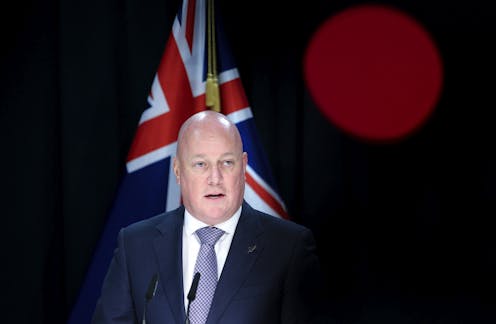
Economic growth took centre stage during Prime Minister Christopher Luxon’s recent State of the Nation speech.
Yet in amongst the discussion and criticism of the government’s plans, many have got locked into a one-dimensional debate centred on reducing regulation to encourage economic growth.
This ignores a deeper discussion on the actual sources of New Zealand’s economic growth in the 21st century and, potentially, what we need to do to shift from one model of growth to another.
What drives growth?
Emerging partly out of the 2007–09 global financial crisis, thinking about economic growth has become dominated by something known as the growth model framework.
The framework contrasts countries such as Germany that base their growth on exports – partly through wage restraint – with those in which growth is led by consumption. This group includes the United Kingdom, the United States and New Zealand.
New Zealand’s growth model
How can this framework be used to understand economic growth in our local context?
New Zealand’s economy is dominated by domestic demand – with the service industry making up around two-thirds of the gross domestic product, putting us squarely in the consumption-led camp.
Local analysts have often reflected on the drivers and pitfalls of this growth model, revolving as it does around property investment and related industries such as banking and insurance.
And yet, this is not how we tend to think of ourselves at all.
Whether aspirational or wishful thinking, countless political speeches and policy documents refer to New Zealand as something of an export platform, a trading nation, or a (potential) knowledge-based innovator on the world stage.
The politics of New Zealand’s growth model
It is also difficult to imagine a New Zealand political leader standing up to announce how proud they are to be overseeing a service and consumption-driven economy.
In fact, it could be argued the past couple of decades have represented a series of failures to shift the growth model from where we are to where we want to be.
What is more, many of the barriers to doing so are political rather than strictly economic.
The growth model perspective identifies not only the varied national growth strategies but also the coalition of political and business groups that support each model.
Possible – but difficult – change
Shifts in national growth models can occur. But doing so requires forging a consensus around a new or evolving growth model through political institutions or through the expansion of the growth coalition’s base to include new economic players including, in some cases, trade unions.
Ireland, for example, underwent a major shift from the late 1980s toward a growth model infused with foreign direct investment. This happened, in part, through social partnership, where most aspects of public policy were negotiated between state, business and organised labour, along with some input from the community and voluntary sector. It was also due to an overwhelmingly centrist political culture and it’s structure of government.
Sweden’s gradual shift toward more information-technology intensive manufacturing and the Netherlands’ to business services and finance, representing more balanced or mixed growth models, can also be traced to consensus-driven politics.
Barriers to change
Back in Aotearoa New Zealand, we face a series of political barriers to similar change.
Above all, politics in New Zealand is notably short-term in nature, driven by a host of factors including the three-year electoral term. There is also an absence of an Irish or Swedish-style social partnership-type tradition in which key societal groups are included in policy negotiations that survive changes of government.
Compounding this, power in New Zealand politics is still concentrated in the hands of the incumbent government despite the adoption of the mixed member proportional (MMP) system. This means a considerable degree of ideological yo-yoing and policy flip-flops.
Most difficult perhaps is finding a way to override entrenched economic interests with a vested interest in the status quo.
For example, while there is widespread support for a capital gains tax in New Zealand, implementing one has proven out of political reach.
This is likely due, in part, to the oversized role that property plays in our economy, but also because we lack consensus-forging institutions through which to channel a will to change.
Somehow broadening the base of support may help to address this issue, as will ensuring that the government is able to exercise its own autonomy – connected to economic interests yet able to rise above rather than relying on them to make change happen.
Authors: Kate Nicholls, Senior Lecturer, School of Social Sciences and Public Policy, Auckland University of Technology


















