

Leakage is a risk with carbon storage projects – NZ’s new framework must be clear on how to deal with this liability
- Written by: David Dempsey, Associate Professor in Natural Resources Engineering, University of Canterbury
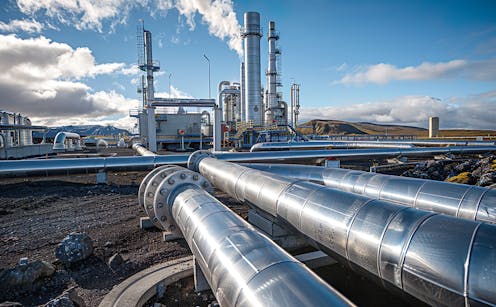
The government recently announced a framework to regulate carbon capture, utilisation and storage (CCUS) by New Zealand companies.
Energy and Climate Change Minister Simon Watts outlined new rules that would allow emitters to capture their carbon dioxide (CO₂) emissions and inject them underground for permanent disposal. They would then avoid having to pay for those emissions under the Emissions Trading Scheme.
Globally, CCUS is currently used mostly by coal or gas-fired power stations, liquefied natural gas plants and petroleum refineries. There are 41 commercial operations around the world, and they capture about 40 million tonnes of CO₂ annually.
Our peers (Australia, the United States and the European Union) already have CCUS frameworks and storage projects. The Intergovernmental Panel on Climate Change acknowledges CCUS’s role in curbing emissions, but highlights challenges in scaling and technology readiness.
New Zealand faces the challenge of reducing emissions from strategic industries such as steel, concrete, fossil fuels and their derivatives (methanol, ammonia). CCUS has been tabled as an interim solution, strongly supported by the fossil fuel industry. However, critics warn it could reduce incentives to phase out fossil fuels.
The government argues its CCUS framework aligns New Zealand with international standards. This claim has merit insofar as successful climate action is likely to require international collaboration and technology transfer.
CCUS in New Zealand could enable reinjection of CO₂ produced from the Kapuni gas field in Taranaki, with “utilisation” involving diverting some of the gas for use in the food and beverage or horticulture industries.
However, leakage of CO₂ from long-term disposal sites is a major technical risk and New Zealand’s framework must be clear on how it would deal with this liability.
Lake Boehmer and how things might go wrong
Rules for CCUS projects generally require operators to monitor, report and remedy any leakage of CO₂. But because the industry is young, it is useful to take a broader look at geological leakage in the past to reveal how future challenges play out.
Lake Boehmer, in the the Permian Basin of West Texas, wasn’t always there. But 20 years ago an old irrigation well started leaking saltwater and hasn’t stopped since.
The well was drilled in 1951 by an oil and gas company. No oil was discovered so the well was handed over to the landowner for irrigation. The well produced water, but also poisonous hydrogen sulphide, enough to kill a farmhand in 1953.
In the 1990s, the well started leaking. Water from a deep aquifer had pushed its way up alongside the well through geological layers of salt. The water dissolved the salt, worsening the leak, and emerged from underground three times saltier than seawater.
The Railroad Commission, which regulates the oil and gas industry in Texas, says they are not liable to plug the well because they only have jurisdiction over oil wells. The original operator, which is claimed to have promised to plug the well “any time it becomes polluted with mineral water”, is no longer in business. No one can find the landowner.
After 20 years, Lake Boehmer has grown to 60 acres. Its shore is rimmed in salt crystals and the odd dead bird from hydrogen sulphide exposure. No one can agree who should fix it.
Could something similar happen with CCUS? Exacerbating factors in the Boehmer case include deterioration of an aged well – it’s almost 50 years since leakage started – and the absence of a backstop party as the final holder of liability. Both could happen with CCUS under the wrong circumstances.
Better ways of dealing with leakage
The Decatur CCUS project in the US state of Illinois has been injecting CO₂ produced from corn ethanol two kilometres deep into sandstone. Over about a decade, 4.5 million tonnes of CO₂ has been injected – emissions diverted from the atmosphere.
The US government imposes strict monitoring rules on CCUS projects. Special monitoring wells are drilled into the disposal aquifer to measure pressure changes and how far the CO₂ has travelled.
Unfortunately, one of these wells started to leak, possibly due to corrosion. It allowed about 8,000 tonnes of CO₂ to escape into overlying geological layers.
This is rightly concerning, but to put it into perspective, the size of the leak is 0.2% of the injected CO₂ volume and none of it has escaped to the atmosphere or shallow groundwater. The leak was detected, the US Environmental Protection Agency (EPA) intervened, issuing a notice that the leak be remediated, and the company plugged the well.
This illustrates a functioning CCUS framework. Monitoring requirements ensured the leak was discovered and the regulator was empowered to dictate remedial action.
However, critics have questioned the timeliness of the operator’s disclosure. The site remains on hold but may resume operations if the EPA is satisfied with the fix.
Lessons for New Zealand
A proposal circulated last year suggests the government will model its legislation on Australia and the EU, with CCUS operators being responsible for leaks during disposal operations and for a time after site closure.
This is like the Decatur situation. It makes sense for operators to fix leaks because they have the technical expertise and are the direct financial beneficiaries of emissions disposal.
It gets trickier on generational time frames. Companies can go out of business or might leave the country. In these cases, the government is liable for long-term leakage and may seek financial security from the operator to cover future costs.
A leak arising decades after closure could be more difficult to detect and costly to fix, especially if held up by a protracted fight around liability. This is the Lake Boehmer example.
Some CCUS seems inevitable if the world is to meet climate targets. It is therefore important to prepare for the possibility of a leak by having robust practices and clear responsibility.
Although it may seem unfair to burden future generations with looking after CO₂ disposal sites, we argue it is preferable to a legacy that has those same climate-warming gases in the atmosphere.
Authors: David Dempsey, Associate Professor in Natural Resources Engineering, University of Canterbury


















