

Retailers will soon need a licence to sell cigarettes. But more is needed to control the illegal trade
- Written by: Coral Gartner, Director, NHMRC Centre of Research Excellence on Achieving the Tobacco Endgame, The University of Queensland
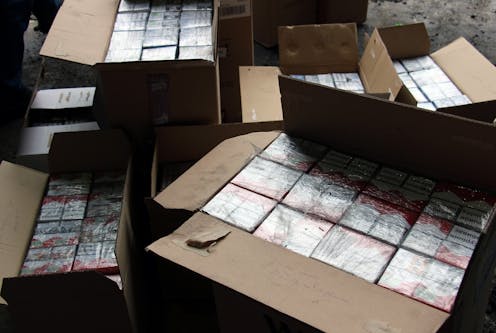
Dubbed “the tobacco wars”, the illegal trade in untaxed tobacco products is reportedly booming in Australia.
Some people see buying these cheap cigarettes as a way to save money. But as this week’s ABC Four Corners reported, it comes at great cost to the community, with fire-bombings, murder, serious crimes funded by illegal sales and a loss of crucial government funding for community services.
In all states and territories in Australia, retail outlets already or will soon need to have a licence to sell cigarettes.
But there aren’t restrictions on the number of licensed outlets.
And our new research shows the number of tobacconists, including those suspected of organised crime, is growing.
How many Australians smoke?
Australia has been a leader in tobacco control: introducing plain packaging, preventing most forms of tobacco advertising and promotion, and setting high tax rates to discourage people, especially youth, from buying tobacco.
These measures have helped reduce smoking to around one in ten people.
But tobacco use is still a leading cause of preventable disease in Australia.
Research suggests people who live in areas with a greater number of tobacco retailers are more likely to smoke. Having a greater number of tobacco retailers can reduce the price through competition and increase impulse buying, making it more difficult to quit smoking.
Disadvantaged areas of Australia have a higher number of tobacco retailers compared to wealthier areas.
Some tobacconists still target children
The Australian government recognises the need to reduce the availability of tobacco.
However, when we reviewed the tobacco control laws throughout Australia, we found there are no restrictions on the number of tobacco retailers or where they can operate. This increases the challenge of monitoring them.
There are also minimal restrictions on the types of retailers that can sell tobacco, or what other products specialist tobacconists can sell. People under 18 years are also allowed to enter specialist tobacconists without adult supervision.
This has led to examples such as toy stores selling tobacco, and tobacconists having window displays featuring toys and promoting confectionery. Some Australian tobacconists have even painted their shopfronts in children’s cartoon characters.
This makes tobacco easy to buy and makes it seem like a “normal” consumer product, rather than an addictive, deadly substance.
Retailers need licences – but these aren’t capped
Crimes related to selling untaxed tobacco illegally increased substantially from about 2018. There has also been an increase in the number of tobacconist stores. Between July 2022 and June 2023, we estimated the number of tobacconists in Queensland had risen by 18.5%.
Without tobacco retailer licensing, regulators do not have accurate records of who is selling tobacco, where it is being sold and they have fewer options for dealing with retailers who break the law.
The three most populated states (representing 77% of the Australian population) have not had a tobacco retailer licensing scheme until recently (Queensland, from September 2024) or are currently establishing a scheme (Victoria and New South Wales). All other states and territories had pre-existing licensing schemes.
But like all states and territories with current licence schemes, neither NSW or Victoria have capped the number of licences that will be issued.
Restrictions on the number and locations of tobacco licensees was recommended by the Victorian Public Accounts and Estimates Committee in response to an inquiry into vaping and tobacco controls, but this was not adopted.
Retailers need to adapt to low tobacco sales
Removing operators from the tobacco retailing sector who are illegally selling untaxed products is crucial to reducing the illicit tobacco trade and associated violence.
Some tobacconists have described a downturn in their business turnover as some customers switched to buying illegally supplied untaxed products. This has reduced their commercial viability.
However, tobacco sales have been in decline for many years also because adults are quitting smoking and fewer youth are starting. When the Australian government reaches its next target of less than 5% of the population smoking, tobacco retail sales will be even lower.
Retailers need to be prepared for a drop in their tobacco sales as fewer Australians smoke. They may also need government support to adapt their businesses. This could include advice on alternative products and services, or financial support to exit the industry, as was offered to tobacco growers in the 1990s.
A long-term alternative to tobacco retail
In the longer term, more reforms are needed to deal with the fundamental problems that arise from retail stores selling tobacco as a commercial product for profit.
One option is pharmaceutical-like regulation of tobacco. This would ensure everyone who buys it receives health education about the risks and advice on how to quit.
Another option is non-profit supply, such as has been used for supplying cannabis in other countries. This would see tobacco supplied through non-profit enterprises. Commercial tobacco companies would no longer be involved in marketing or promoting these products.
Expanding access to free help to quit smoking should also be a priority. More than 70% of smokers would like to quit within the next one to two years. They should be supported to do so.
Authors: Coral Gartner, Director, NHMRC Centre of Research Excellence on Achieving the Tobacco Endgame, The University of Queensland


















