

Fires used to terrify city residents. New research suggests climate change could see this fear return
- Written by: David Bowman, Professor of Pyrogeography and Fire Science, University of Tasmania
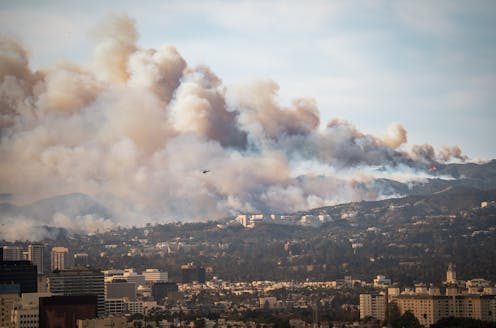
For centuries, fire was one of the major fears for city-dwellers. Dense cities built largely of wood could – and did – burn. In 1666, a fire in a bakery went on to destroy two-thirds of the city of London, leaving 85% of residents homeless. In 1871, fire burned out huge areas of Chicago. In World War II, bombing raids by Allied forces largely destroyed cities such as Dresden in Germany and Tokyo in Japan.
The threat of large-scale urban fires drove authorities to spend more on urban firefighting and require buildings to use less flammable material. Fire alarms, fire engines and automatic sprinklers have done much to reduce the chance of uncontrolled spread.
But will our sense of safety endure in the age of climate change? In January, we saw swathes of Los Angeles burn – even in the northern winter. Driven by low humidity and high winds, numerous large fires encroached on the city, destroying outlying suburbs. Climate change made the fires worse, according to climate scientists.
Now we have new research on the question of whether climate change will make large city fires more likely. A research team from China, Singapore and Australia have gathered a decade’s worth of data on fires from almost 3,000 cities in 20 nations, home to one-fifth of the world’s population.
The researchers found for every 1°C increase in air temperature, outdoor fires (rubbish and landfill) increase 4.7% and vehicle fires 2.5%. If the world accelerates its burning of fossil fuels under a high emissions scenario compatible with a 4.3°C temperature rise by century’s end, outdoor fires in cities would soar 22% and vehicle fires 11%. But building fires are projected to actually fall 5%. Thankfully, this emissions scenario is now less likely.

What did this research find?
To make these findings, the researchers aggregated the fire incident data from 2,847 cities located in 20 countries over the 2011–20 decade and analysed them to see how air temperature influences the frequency of three types of fires: outdoor, structural and vehicle. They found a strong correlation.
Of the 20 nations, New Zealand looks likely to have the highest increase in fires, soaring 140% over 2020 figures by 2100.
When we think of fires in a city, we usually think of structural fires – a building going up in flames.
The research suggests building fires would actually decrease 5% by 2100. This is unexpected, and might suggest uncertainty about this finding.
Interestingly, this research found the fewest structural fires occurred at air temperatures of 24°C, a temperature which humans find optimal. When it’s hotter or cooler than that, more buildings catch fire.
Why? It’s likely due to our behaviour. We spend more time indoors when it’s very cold or very hot outside, which the authors suggest could make us more likely to accidentally cause fires by using electrical appliances and fireplaces which have a fire risk.
By contrast, outdoor and vehicle fires do increase linearly as temperatures rise. Most vehicle fires come from an equipment or heat source failure, which are both likely to increase as temperatures rise. We are also more likely to have a car crash when it’s hotter, and vehicle fires often come after a crash.

Outdoor fires become more likely because heat dries out fuels and favours fire spread. Rubbish dumps can spontaneously catch fire when temperatures are too high – even underground. This happens because chemical reactions are accelerated in warmer temperatures, causing waste materials to heat up faster. If the extra heat isn’t dissipated, waste can become so hot that it catches fire on its own.
We should take these estimates with a grain of salt. This is because they project recent statistical patterns into an uncertain future, and draw on a data set not perfectly suited to the task. The data set stops in 2020, before the electric vehicle transition gathered speed. EVs have a different risk profile for accidental fires.
As the authors note, there are large barriers to getting a coherent understanding of fire risk. “Despite multiple efforts, we have been unsuccessful in obtaining fire data from Africa and South America,” they write.
Their estimates also relate to a high-emissions future which is hopefully becoming less likely, though the general pattern of the results are similar under less severe climate projections.
Most importantly, it’s not yet clear why temperature influences urban fires. This uncertainty raises questions over whether simple projections of current patterns into the future are realistic or appropriate.
Cities aflame?
Arguably the most important contribution of this new research is to show us that our cities are not inherently protected from fire.
For city authorities, this research points to the need to manage combustible materials, from piles of mulch to dry urban parks and even home gardens. Storage yards, rubbish dumps and recycling centres will also need to be managed.
Fire used to be a major concern for cities, and it could be again. Cities and fire are uneasy bedfellows, and climate change will worsen the situation.
Authors: David Bowman, Professor of Pyrogeography and Fire Science, University of Tasmania


















