

Brisbane is bracing for floods yet again. History shows residents should remain on very high alert
- Written by: Margaret Cook, Research Fellow, Australian Rivers Institute, Griffith University
Authorities on Sunday warned of intense rainfall and dangerous thunderstorms about Brisbane, as remnants of ex-Tropical Cyclone Alfred continue to be felt across southeast Queensland and northeast New South Wales.
As of Sunday evening, the Bureau of Meteorology warned heavy rainfall “may lead to dangerous and life-threatening flash flooding”. In the six hours to 2pm on Sunday, 144 millimetres of rain was recorded in the Brisbane suburb of Carindale. High totals also fell at Mansfield, Mount Coot-tha and Wacol.
The bureau also warned rapid river rises and flash flooding was possible across the lower Brisbane River catchment. Large parts of Hervey Bay were submerged by water late on Sunday and over the border in NSW, low-lying areas of the Northern Rivers were also flooded.
The threat of major flooding is a worryingly familiar scenario for Brisbane, a subtropical city of more than 2.5 million people, situated on a river. History tells us Brisbane must remain on high alert as rain continues to pummel the region in coming days.
Exactly how does Brisbane flood?
When heavy rain first starts falling, the water is mostly absorbed into the ground. But if the rain persists, the ground becomes saturated and the water drains into creeks and streams.
In very heavy rain, creeks and streams overflow and this causes flooding.
Several types of flooding occur in the Brisbane Valley:
- Flash flooding in creeks, which can be very fast and localised
- River flooding, which is slower than creek flooding. The river rises slowly and may remain above flood height for up to a week
- Backwater flooding, which occurs when flooding in the Brisbane River causes water to back up further upstream
- Storm surges, which typically occur with tropical cyclones. Cyclone Alfred brought storm surges, however this has largely dissipated
- Overland flooding, which occurs when stormwater drains overflow, or cannot cope with the water inflow.
Brisbane City Council says 20,000 properties are at risk of storm surge and flooding in the Brisbane River and creeks. The below flood maps show the areas at risk.
Lessons from history
Historically, floods in Brisbane are more often associated with rain depressions after cyclones, than cyclones themselves.
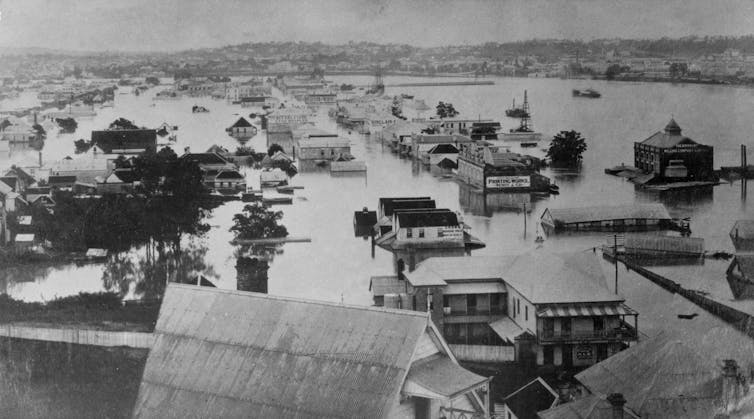
Take, for example, the Great Flood of Brisbane in February, 1893, which caused 35 known deaths. In the days preceding it, a cyclone passed to the north of Brisbane, bringing more than 900mm of rain over 24 hours to Crohamhurst.
In the 1893 event, water flowed over the D’Aguilar Range into the upper catchment of the Brisbane River (the Stanley and Upper Brisbane Rivers). This water travelled downstream and merged with extremely heavy rain that fell in Brisbane in January 1893.
As a result, Brisbane experienced severe flooding. The Brisbane River reached record heights of 8.35 metres.
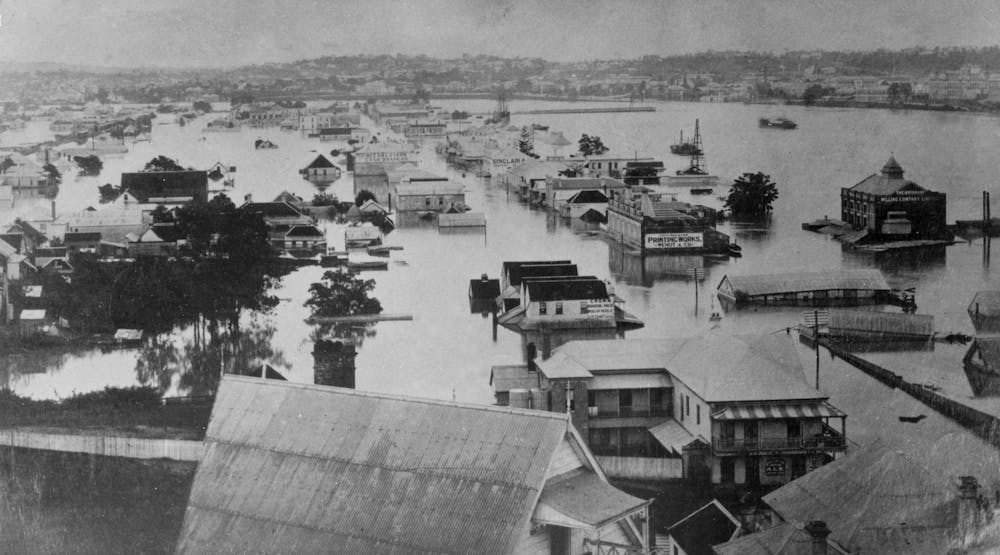
The rain depression following Cyclone Alfred looks likely to pass over the same area – just north of Brisbane – as it did in 1893. As a flood historian, I am obviously concerned about what this means for flooding in Brisbane in coming days.
Brisbane also experienced major flooding in 1974. It was caused by rain related to ex-tropical cyclone Wanda. That weather system brought more than 600mm of rain to Brisbane in three days.
And of course, the 2022 Brisbane floods are still fresh in many people’s minds. Then the Brisbane River peaked at 3.85m.
Heavy rain inundated the river’s network of 22 creeks and caused the most flooding. The situation was worst in north Brisbane, which received between 400 and 1000mm of rain over three days in late February. This was higher than the 1974 rainfall totals, and closer to the rainfall in 1893.
During the next phase of ex-tropical Cyclone Alfred, we must watch closely to see where rain falls, how much and for how long.
Preparation is key
If there are any positives to draw from Cyclone Alfred and its aftermath, it is that communities had time to prepare.
The cyclone wandered off the coast for two weeks, before heading towards land. It gave authorities time to mobilise and deliver clear, informative advice to the public.
Until recently, 97% of Australian disaster funding was spent on recovery, compared to 3% invested in mitigating risk and building resilience.
In my research and work with communities, I have advocated for proactive disaster action. This includes:
- advanced evacuation
- permanently relocating flood-prone residents
- raising homes
- rezoning to prevent development in flood-prone areas.
Bodies such as the National Emergency Management Agency, and reconstruction authorities in NSW and Queensland, are helping shift the dial towards proactive flood measures. But there is more work to do.
Armies of volunteers – and defence personnel themselves – emerge after disasters to help mop up. But I argue Australia needs an advanced party – a “flood army” if you will – that arrives before a disaster to help with preparedness such as moving possessions, cleaning gutters and drains and pruning trees.
And Brisbane’s complex picture of flood hazards means authorities must look beyond dams for flood mitigation. We must improve stormwater management, adopt new building designs and materials, and educate the public about coping with floods.
For now, affected residents should remain vigilant. Stay inside if you can so the authorities can do their work. Keep off roads and, as the slogan goes, “if it’s flooded, forget it”. Listen to the official warnings and don’t get complacent.
Bureau of Meteorology video update on Sunday March 9.Authors: Margaret Cook, Research Fellow, Australian Rivers Institute, Griffith University


















