

Hundreds of livestock breeds have gone extinct – but some Australian farmers are keeping endangered breeds alive
- Written by: Catie Gressier, Adjunct Research Fellow in Agriculture and Environment, The University of Western Australia
It took thousands of years to develop the world’s extraordinary range of domesticated farm animals – an estimated 8,800 livestock breeds across 38 farmed species.
But this diversity is dwindling fast. Advances in selective breeding and artificial insemination have fuelled the global spread of a small number of profitable livestock types. Their popularity has left ever more heritage breeds at risk of extinction.
Why does this matter? Each breed represents vital genetic diversity for the livestock species on which we rely, known as agrobiodiversity. As the number of breeds shrink, we lose their genetics forever.
There are bright spots amid the decline. Hundreds of passionate farmers are working hard to keep heritage breeds alive around Australia. As my new book shows, they do it primarily for love.
Which livestock breeds are disappearing – and why?
Cattle have experienced the highest number of extinctions, with at least 184 breeds lost globally.
Of all chicken breeds, one in ten is now extinct, and a further 30% are endangered.
Sheep are also rapidly losing diversity, with 160 breeds now extinct. The rise of synthetic materials has endangered the remaining breeds producing carpet wool in New Zealand and Australia, including the unique Tasmanian Elliottdale.
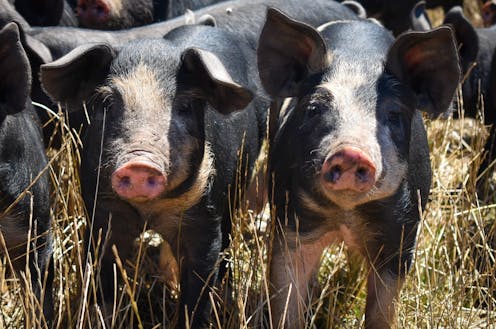
Pigs fare little better. Australia’s 2.5 million pigs are predominantly Large White, Landrace and Duroc crossbreeds, while none of the eight remaining purebred pig breeds in Australia currently has more than 100 sows registered with the Rare Breeds Trust. While not all sows are registered, we know breeds such as Tamworths are at dangerously low numbers.
How did this happen? Over the past century, the goal of animal husbandry has shifted from breeding hardy, multipurpose animals to increasing performance for economic gain. For livestock, performance means more of what humans value, such as pigs with extra ribs, prolific egg-laying hens and sheep with finer wool.
Huge sums have been spent on selective breeding and artificial insemination technologies. This, in turn, has made it possible for a small number of profitable livestock types to be farmed globally.
For instance, when you buy a roast chicken, it will likely be one of just two types of fast-growing broilers (meat chickens), the Ross or the Cobb. Their genetics are developed and trademarked by two multinational agribusinesses who dominate the global broiler market.

It’s hard to overstate how big the increases in production have been from reproductive technologies. In the dairy industry, for instance, milk yield per cow has doubled in the past 40 years. These volumes are around six times greater now than a century ago.
Holsteins, the top dairy breed, have become globally dominant. Almost 1.4 million of Australia’s 1.65 million dairy cows are Holsteins. But as Holstein numbers soar, other breeds dwindle. Many farmers have simply stopped rearing other breeds, leading to many becoming endangered or extinct.
For Holsteins themselves, this has come with a cost. Selective breeding for high milk volume has meant Holsteins suffer more medical issues such as metabolic diseases and frequent mastitis. They also have reduced fertility and longevity.
Researchers have found 99% of Holstein bulls produced by artificial insemination in the United States are descended from just two sires. This wide dissemination of limited bloodlines has led to the spread of genetic defects.

What is at stake?
Our food systems face growing threats. Genetic diversity provides a safeguard for livestock species against lethal animal diseases such as H5N1 bird flu and African swine fever.
If we rely on just a few breeds, we risk a wipe out. The Irish potato famine is a catastrophic example. In the 1800s, Irish farmers took up the “lumper” variety of potatoes to feed a growing population. But when fungal rot struck in the 1840s, it turned most of the crop to mush – and led to mass starvation.
Some breeds have very useful traits, such as resistance to particular pests and diseases.
Chickens and other birds die in swathes if infected by Newcastle disease, one of the most serious bird viruses. But breeds such as the hardy Egyptian Fayoumi survive better, while the European Leghorn – whose genetics are used in commercial egg-laying breeds – is highly susceptible.
Local breeds can also have better resistance to endemic pests. The Indian zebu humped cattle breed, for example, is less prone to tick infestation than crossbreeds.
Climate change is also making life harder for livestock, and some breeds are better adapted to heat than others.
For different cultural groups, local heritage breeds also have unique symbolic and culinary value.
While it’s well-known eating less meat would benefit ecosystems, animal welfare and human health, eating meat remains entrenched in our diets and the economy. Pursuing more sustainable and higher-welfare approaches to livestock production is crucial.
Some Aussie farmers love heritage breeds
A cohort of Australian farmers is working hard to conserve dozens of endangered livestock breeds such as Large Black pigs, Shropshire sheep and Belted Galloway cattle.
But these farmers are hampered by our reluctance as consumers to pay more to cover the cost of raising slower-growing breeds in free-range environments. Not only that, but meat processors are increasingly closing their doors to small-scale producers.
Why persevere? For four years, I’ve conducted ethnographic research with Australia’s heritage breed farmers. I found they were motivated by one of the most powerful conservation tools we have: love.
Of his endangered English Leicester sheep, one farmer told me:
I consider them to be family; they have been our family for over 150 years. I talk to them, and the rams in particular talk to me. Sorry if I sound like a silly old man, but you must talk to them. I gave myself a 60th birthday present by commissioning a large portrait of an English Leicester head, which hangs in our kitchen (I do not have a painting of my wife).
Love doesn’t often feature in agricultural research. But it is an important force. We know from wildlife conservation that humans will act to save what they love. This holds for livestock, too.
What can you do? If you eat meat or work with wool, seek out rare breeds and join organisations such as the Rare Breeds Trust of Australia and the Australian Food Sovereignty Alliance who back farmers supporting breed diversity.
Authors: Catie Gressier, Adjunct Research Fellow in Agriculture and Environment, The University of Western Australia


















