

Less than 1% of the world’s biggest radio telescope is complete – but its first image reveals a sky dotted with ancient galaxies
- Written by: Randall Wayth, SKA-Low Senior Commissioning Scientist and Adjunct Associate Professor, Curtin Institute of Radio Astronomy, Curtin University
Part of the world’s biggest mega-science facility – the SKA Observatory – is being built in outback Western Australia.
After decades of planning, countless hours of work, and more than a few setbacks, an early working version of the telescope has captured its first glimpse of the sky.
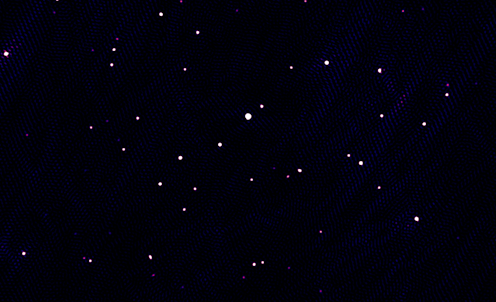
Using 1,024 of what will eventually be 131,072 radio antennas, the first SKA-Low image shows a tiny sliver of sky dotted with ancient galaxies billions of light-years from Earth.
This first snapshot shows the system works, and will improve dramatically in the coming months and years – and starts a new chapter in our exploration of the universe.
A glimpse of the universe
The SKA-Low telescope is currently under construction on Wajarri Yamaji Country in Western Australia, around 600 kilometres north of Perth. Together with the SKA-Mid telescope (under construction in South Africa), the two telescopes will make up the world’s largest and most sensitive radio observatory.
SKA-Low will consist of thousands of antennas spread across a vast area. It is designed to detect low-frequency radio signals from some of the most distant and ancient objects in the universe.
The first image, made using just 1,024 of the planned 131,000 antennas, is remarkably clear, confirming that the complex systems for transmitting and processing data from the antennas are working properly. Now we can move on to more detailed observations to analyse and verify the telescope’s scientific output.
Bright galaxies, billions of years old
The image shows a patch of the sky, approximately 25 square degrees in area, as seen in radio waves.
Twenty-five square degrees is an area of sky that would fit 100 full Moons. For comparison, it would be about the area of sky that a small apple would cover if you held it at arm’s length.

The dots in the image look like stars, but are actually some of the brightest galaxies in the universe. These galaxies are billions of light-years away, so the galaxies we are seeing now were emitting this light when the universe was half its current age.
They are so bright because each of these distant galaxies contains a supermassive black hole. Gas orbiting around black holes is very hot and moves very quickly, emitting energy in X-rays and radio waves. SKA-Low can detect these radio waves that have travelled billions of light years across the universe to reach Earth.
The world’s largest radio telescope
SKA-Low and SKA-Mid are both being built by the SKAO, a global project to build cutting-edge telescopes that will revolutionise our understanding of the universe and deliver benefits to society. (SKA stands for “square kilometre array”, describing the initial estimated collecting area of all the antennas and radio dishes put together.)
My own involvement in the project began in 2014. Since then I, along with many local and international colleagues, have deployed and verified several prototype systems on the path to SKA-Low. To now be part of the team that is making the first images with the rapidly growing telescope is extremely satisfying.
A complex system with no moving parts
SKA-Low will be made up of 512 aperture arrays (or stations), each comprised of 256 antennas.
Unlike traditional telescopes, aperture arrays have no moving parts, which makes them easier to maintain. The individual antennas receive signals from all directions at once and – to produce images – we use complex mathematics to combine the signals from each individual antenna and “steer” the telescope.

The advantages and flexibility of aperture arrays come at the cost of complex signal processing and software systems. Any errors in signal timing, calibration or processing can distort the final image or introduce noise.
For this reason, the successful production of the first image is a key validation – it can only happen if the entire system is working.
The shape of the universe and beyond
 As SKA-Low grows, it will see more detail. Simulations show the full telescope may detect up to 600,000 galaxies in the same patch of sky shown in the first test image.
SKAO
As SKA-Low grows, it will see more detail. Simulations show the full telescope may detect up to 600,000 galaxies in the same patch of sky shown in the first test image.
SKAO
Once completed, SKA-Low promises to transform our understanding of the early universe.
The antennas of the full telescope will be spread across an area approximately 70 kilometres in diameter, making it the most sensitive low-frequency radio array ever built.
This unprecedented sensitivity to low-frequency radio signals will allow scientists to detect the faint signals from the first stars and galaxies that formed after the Big Bang – the so-called “cosmic dawn”. SKA-Low will be the first radio telescope capable of imaging this very early period of our universe.
It will also help map the large-scale structure of the universe. We expect the telescope will also provide new insights into cosmic magnetism, the behaviour of interstellar gas, and the mysterious nature of dark matter and dark energy.
The sensitivity and resolution of SKA-Low gives it a huge discovery potential. Seven out of the top 10 discoveries from the Hubble Space Telescope were not part of the original science motivation. Like the HST, SKA-Low promises to be a transformative telescope. Who knows what new discoveries await?
What’s next
SKA-Low’s commissioning process will ramp up over the course of the year, as more antenna arrays are installed and brought online. With each additional station, the sensitivity and resolution of the telescope will increase. This growth will also bring greater technical challenges in handling the growing complexity and data rates.
By the end of 2025, SKA-Low is expected to have 16 working stations. The increased volume of output data at this stage will be the next major test for the telescope’s software systems.
By the end of 2026, the array is planned to expand to 68 working stations at which point it will be the the most sensitive low-frequency radio telescope on Earth.
This phase will be the next big test of the end-to-end telescope system. When we get to this stage, the same field you see in the image above will be able to comprehensively map and detect up to 600,000 galaxies. I’m personally looking forward to helping bring it together.
Authors: Randall Wayth, SKA-Low Senior Commissioning Scientist and Adjunct Associate Professor, Curtin Institute of Radio Astronomy, Curtin University


















