

Why do plastic containers always come out wet from the dishwasher? Science has the answer
- Written by: Kamil Zuber, Senior Industry Research Fellow, Future Industries Institute, University of South Australia
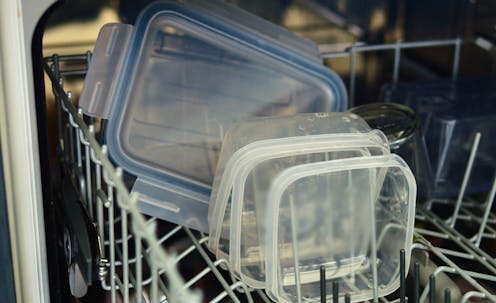
It’s annoying to open your dishwasher after the cycle is finished only to find half of the dishes still wet. Instead of being able to stack them away, you end up with a full drying rack.
And you’ve probably noticed it’s always plastic items that end up the most wet. What’s going on?
The answer is a bit convoluted and requires some materials and physics knowledge, but bear with me.
Plastics have very different properties to ceramics and metals – the stuff your plates and cutlery are most likely made out of. Two key things play a role: one is how the materials store heat, and the other is what happens on their surfaces.
How dishes store heat
If you take your dishes out of the dishwasher promptly after the cycle ends, you’ve likely noticed that plates, glasses and ceramic mugs are still hot, while plastic containers don’t feel warm at all.
This relates to their heat capacity, sometimes also referred to as the “thermal mass” of these materials. Ceramics, glass and metals can store more heat, and it takes longer for them to give it away to their surroundings than it does for plastics. In other words, ceramics and metals cool down more slowly.
Since evaporating water takes energy and cools the surface – which is also how your body cools down on a hot day as you sweat – plastics cool down faster, leaving much of the water on the surface.

How water behaves on different surfaces
The other part of the problem is in surface energy, which tells us how water wets different surfaces.
You’ve probably seen water droplets bead up on things like high-end rain jackets or non-stick frying pans. These surfaces are called hydrophobic, meaning they “fear” water. This is also the case for most plastics, although not always to such a dramatic effect.
On the other end of the spectrum, surfaces like many ceramics and metals are coated with water easily. That’s because they are more hydrophilic or “water-loving”.

But there’s another factor here – and it has to do with dishwashers, in particular. Dishwasher detergent contains a mixture of chemicals, mainly surfactants – substances that lower the surface tension of water.
Surface tension is the property of the material’s interface (for example, between solid and liquid, or liquid and gas) that tells us how much energy it takes to create a larger surface. By adding detergent to water, we reduce its surface tension. This makes it easier for the water to spread over surfaces it encounters (even over these hydrophobic plastics), in turn making it easier to wash your dishes.
More importantly, the surfactants in detergent are molecules that have both hydrophobic and hydrophilic chemical groups. This makes them a kind of link between water and fats. Since oil and water don’t like to mix, a surfactant helps to “blend” the latter and have it float in water, helping remove any oily residues from your dishes.
This happens in the main washing cycle. After rinsing, the chemicals get removed and your dishes are sprayed with clean water so you don’t have to taste the detergent in your tea.
So, at the end, water beads up on your hydrophobic plastic dishes and spreads all over your more hydrophilic ceramic plates, cups and metal pots. A large bead of water evaporates more slowly than when the same amount of water is spread more thinly over your plates and pots.
On top of that, ceramic dishes retain more heat, which makes them dry more quickly – the water that’s already spread more thinly just evaporates faster.
 Rinse aids can help water run off the surfaces of dishes more quickly.
Potashev Aleksandr/Shutterstock
Rinse aids can help water run off the surfaces of dishes more quickly.
Potashev Aleksandr/Shutterstock
Is there anything I can do to make plastics dry faster?
You’ve probably heard about rinse aids that are added to the rinse cycle. Their key ingredients are different types of low-foaming surfactants and chemicals that make water softer. Some “all in one” dishwasher tablets may already contain a small amount of rinse aid and the makers provide instructions on how to use them in a safe and efficient way.
Rinse aids also lower the surface tension of water, making it easier for water to wet and run off the surfaces, preventing it from beading up and reducing streaks.
This also works on plastic dishes, leaving much less water behind. Some dishwasher manufacturers recommend using rinse aids because in addition to drying dishes faster, they can prevent corrosion of dishwasher parts from detergent residues.
Is there anything else you can do to dry the dishes faster?
There is one thing that is really simple: just crack the door open as soon as the cycle is finished and it’s safe to do so, so that water vapour can escape. If hot air and moisture instead remain trapped in the dishwasher, the water vapour will condense on all surfaces, like dew before dawn.
At the end, you have a way to make most of your dishes drier after the cycle, although you may still end up with a first-world problem in the form of some wet plasticware. There will be less water on it if you use a rinse aid according to instructions, and open the dishwasher when safe, after the cycle is completed.
Authors: Kamil Zuber, Senior Industry Research Fellow, Future Industries Institute, University of South Australia


















