

Flooding in the Sahara, Amazon tributaries drying and warming tipping over 1.5°C – 2024 broke all the wrong records
- Written by: Andrew King, Associate Professor in Climate Science, ARC Centre of Excellence for 21st Century Weather, The University of Melbourne
Climate change is the most pressing problem humanity will face this century. Tracking how the climate is actually changing has never been more critical.
Today, the World Meteorological Organization (WMO) published its annual State of the Climate report, which found heat records kept being broken in 2024. It’s likely 2024 was the first year to be more than 1.5°C above the Earth’s pre-industrial average temperature. In 2024, levels of greenhouse gases in the atmosphere hit the highest point in the last 800,000 years.
The combination of heat and unchecked emissions, the organisation points out, had serious consequences. Attribution studies found a link between climate change and disasters such as Hurricane Helene, which left a trail of destruction in the southeastern United States, and the unprecedented flooding in Africa’s arid Sahel region.
Slowing these increasingly dangerous changes to Earth’s climate will require a rapid shift from fossil fuels to clean energy.

The record heat of 2024
From the North Pole to the South Pole, the oceans and our land masses, the report catalogues alarm bells ringing ever louder for Earth’s vital signs.
Steadily rising global average temperatures show us the influence of the extra heat we are trapping by emitting greenhouse gases. The ten warmest years on record have all happened in the past ten years.
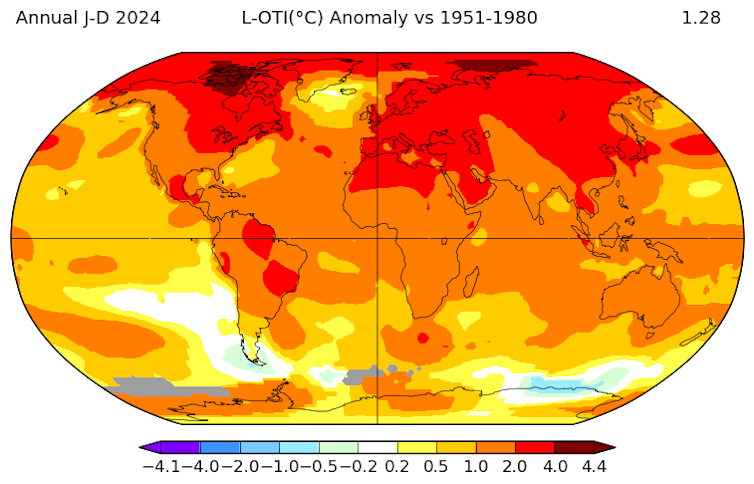
The report shows 2024 was the warmest year since comprehensive global records began 175 years ago. The planet was an estimated 1.55°C (plus or minus 0.13°C) warmer than it was between 1850 and 1900.
Together, 2023 and 2024 marked a jump in global mean temperature from previous years. There was a jump of about 0.15°C between the previous record year (2016 or 2020 depending on the dataset) and 2023. Last year was even warmer – about 0.1°C above 2023.
Last year was the first year the planet was likely more than 1.5°C above pre-industrial levels. This doesn’t mean we have broken the 2015 Paris Agreement goal of holding warming under 1.5°C – temperatures would need to be sustained over a number of years to formally lose that fight. But it’s not good news.
There are a few extra factors at play in this record-breaking global temperature, including an El Niño event boosting eastern Pacific Ocean temperatures in the first part of 2024, falling pollution from shipping leading to less cloud over the ocean, and a more active sun as well.
Researchers are hard at work unpicking why the Earth’s average temperature jumped in 2023 and 2024. But it is clear the 2024 record-breaking warmth and most other damning statistics in the report would not have occurred if it wasn’t for human-induced climate change.

Carbon dioxide up, glacial melt up, sea ice down
It’s not just global temperatures breaking records.
Carbon dioxide concentrations in the atmosphere reached 427 parts per million last year. Sea level rise has accelerated and is now about 11 centimetres above early 1990s levels, and the oceans are at their highest temperatures on record.
Seasonal sea-ice in the Arctic and around Antarctica shrank to low levels (albeit short of record lows) in 2024, while preliminary data shows glacial melt and ocean acidification continued at a rapid pace.
Almost all parts of the world were much warmer in 2024 than even recent averages (1991–2020) and much of the tropics experienced record heat.
From cyclones to heatwaves, another year of extreme events
In the English-speaking media, extreme events affecting North America, Europe and Australia are well covered, such as the devastating Hurricane Helene in the US and the lethal flash flooding in Spain.
By contrast, extreme weather and its fallout in Africa, South America and Southeast Asia get less coverage.
In September 2024, Super Typhoon Yagi killed hundreds and caused widespread damage through the Philippines, China and Vietnam. Later in the year, Cyclone Chido struck Mayotte and Mozambique causing more than 100,000 people to be displaced. Hundreds died in Afghanistan, Iran and Pakistan due to spring floods following an unusual cold wave.
 In December, a powerful cyclone made a direct hit on the French archipelago of Mayotte off the coast of East Africa, causing widespread devastation.
Adrienne Surprenant/AP
In December, a powerful cyclone made a direct hit on the French archipelago of Mayotte off the coast of East Africa, causing widespread devastation.
Adrienne Surprenant/AP
Unusual flooding hit parts of the arid Sahel and even the Sahara Desert. Meanwhile the worst drought in a century hit southern Africa, devastating small farmers and leading to rising hunger.
Much of South and Central America was hit by significant drought. Huge tributaries to the Amazon River all but dried up for the first time on record. Severe summer heat hit much of the Northern Hemisphere, while more than 1,300 pilgrims died during the Hajj pilgrimage in Mecca as heat and humidity pushed past survivable limits.
Globally, extreme weather forced more people from their homes than any other year since 2008, which had widespread floods and fires.
Did climate change play a role in these extreme events? The answer ranges from a resounding yes in some cases to a likely small role in others.
Scientists at World Weather Attribution found the fingerprints of climate change in Hurricane Helene’s large-scale rain and winds as well as the flooding rains in the eastern Sahel.
Paying the price for decades of inaction
This report is a dire score card. The numbers are sobering, scary but sadly, not surprising.
We have known the basic mechanism by which greenhouse gases warm the planet for over 100 years. The science behind climate change has been around a long time.
But our response is still not up to the task.
Currently, our activities are producing ever more greenhouse gas emissions, trapping more heat and causing more and more problems for people and the planet. Every fraction of a degree of global warming matters. The damage done will keep worsening until we end our reliance on fossil fuels and reach net zero.
Authors: Andrew King, Associate Professor in Climate Science, ARC Centre of Excellence for 21st Century Weather, The University of Melbourne


















